




Bo Yuan1, Xielin Shen1, Hua Ye1, Lei Wang2,3, and Yiming Liu2,3
1Quanzhou Power Supply Company, State Grid Fujian Electric Power Co., Ltd., Quanzhou, 362064, China
2College of Automation (College of Artificial Intelligence), Beijing Information Science & Technology University, Beijing, 100192, China
3Beijing Key Laboratory of Low-Carbon and Flexible Urban Power Supply Technology and Equipment, Beijing, 100192, China
Received: August 07, 2026
Accepted: September 07, 2026
Publication Date: October 17, 2026
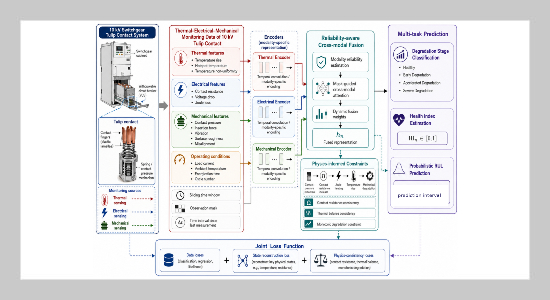
Overall architecture of the proposed PI-TEMFNet
Copyright The Author(s). This is an open access article distributed under the terms of the Creative Commons Attribution License (CC BY 4.0), which permits unrestricted use, distribution, and reproduction in any medium, provided the original author and source are cited.
Download Citation: BibTeX | http://dx.doi.org/10.6180/jase.202701_36.030
To address the coupled degradation of tulip contacts in 10 kV withdrawable switchgear under the combined effects of insertion-withdrawal wear, spring relaxation, increasing contact resistance, and localized overheating, this paper proposes a physics-informed thermal-electrical-mechanical feature fusion network (PI-TEMFNet). The method extracts multi-rate features, including temperature rise, contact resistance, contact force, and vibration, and employs reliability-aware masked cross-modal attention to fuse asynchronous and missing information. Contact-resistance relationships, the heat-balance equation, and a monotonic degradation constraint are embedded into the joint prediction of degradation stage, health index, and probabilistic remaining useful life (RUL). Accelerated degradation tests on 12 GC5 specimens and leave-one-specimen-out cross-validation show that the model achieves an Accuracy of 96.4%, a Macro-F1 of 96.1%, and an AUC of 0.988, with a health-index RMSE of 0.041. The MAE, RMSE, and MAPE for RUL prediction are 21.6×10³ cycles, 29.4×10³ cycles, and 5.8%, respectively, while the coverage probability of the 90% prediction interval is 91.3%. Under random missing rates of 20% and 40%, the MAPE remains 6.3% and 7.2%, respectively, demonstrating high accuracy and strong robustness.
Keywords: 10 kV switchgear; tulip contact; thermal-electrical-mechanical feature fusion; physics-informed neural network; degradation assessment; health index; remaining useful life; probabilistic prediction
- [1] J. A. Greenwood and J. B. P. Williamson, (1966) “Contact of nominally flat surfaces” Proceedings of the Royal Society of London. Series A: Mathematical and Physical Sciences 295(1442): 300-319. DOI: https://doi.org/10.1098/rspa.1966.0242.
- [2] M. G. Cooper, B. B. Mikic, and M. M. Yovanovich, (1969) “Thermal contact conductance” International Journal of Heat and Mass Transfer 12(3): 279-300. DOI: https://doi.org/10.1016/0017-9310(69)90011-8.
- [3] M. M. Yovanovich, (2005) “Four decades of research on thermal contact, gap, and joint resistance in microelectronics” IEEE Transactions on Components and Packaging Technologies 28(2): 182-206. DOI: https://doi.org/10.1109/TCAPT.2005.848483.
- [4] M. Bahrami, J. R. Culham, M. M. Yovanovich, and G. E. Schneider, (2006) “Review of thermal joint resistance models for nonconforming rough surfaces” Applied Mechanics Reviews 59(1): 1-12. DOI: https://doi.org/10.1115/1.2110231.
- [5] M. W. Hoffmann, S. Wildermuth, R. Gitzel, A. Boyaci, J. Gebhardt, H. Kaul, I. Amihai, B. Forg, M. Suriyah, T. Leibfried, V. Stich, J. Hicking, M. Bremer, L. Kaminski, D. Beverungen, P. zur Heiden, and T. Tornede, (2020) “Integration of novel sensors and machine learning for predictive maintenance in medium voltage switchgear to enable the energy and mobility revolutions” Sensors 20(7): 2099. DOI: https://doi.org/10.3390/s20072099.
- [6] Y. A. M. Alsumaidaee, C. T. Yaw, S. P. Koh, S. K. Tiong, C. P. Chen, and K. Ali, (2022) “Review of medium-voltage switchgear fault detection in a condition-based monitoring system by using deep learning” Energies 15(18): 6762. DOI: https://doi.org/10.3390/en15186762.
- [7] Y. A. M. Alsumaidaee, J. K. S. Paw, C. T. Yaw, S. K. Tiong, C. P. Chen, T. F. Yusaf, F. Benedict, K. Kadirgama, T. C. Hong, and A. N. Abdalla, (2023) “Fault detection for medium voltage switchgear using a deep learning hybrid 1D-CNN-LSTM model” IEEE Access 11: 97574-97589. DOI: https://doi.org/10.1109/ACCESS.2023.3294093.
- [8] K. A. A. Mahmoud, M. M. Badr, N. A. Elmalhy, R. A. Hamdy, S. Ahmed, and A. A. Mordi, (2024) “Transfer learning by fine-tuning pre-trained convolutional neural network architectures for switchgear fault detection using thermal imaging” Alexandria Engineering Journal 103: 327-342. DOI: https://doi.org/10.1016/j.aej.2024.05.102.
- [9] M. Matin, A. Dehghanian, A. H. Zeinaddini, and H. Darijani, (2025) “Interpretable machine learning modeling of temperature rise in a medium voltage switchgear using multiphysics CFD analysis” Case Studies in Thermal Engineering 65: 105585. DOI: https://doi.org/10.1016/j.csite.2024.105585.
- [10] C. Tang, J. Zhang, Y. Yang, K. Gao, B. Chen, A. Hussain, and S. Fan, (2026) “Infrared anomaly detection of switchgear equipment based on lightweight deep neural networks” Electric Power Systems Research 256: 112910. DOI: https://doi.org/10.1016/j.epsr.2026.112910.
- [11] Y. Xu and X. Lu, (2024) “Power transformer fault diagnosis based on hybrid intelligent algorithm” Journal of Applied Science and Engineering 27(1): 1859-1866. DOI: https://doi.org/10.6180/jase.202401_27(1).0002.
- [12] X. Lv, F. Liu, M. Jiang, F. Zhang, and L. Jia, (2025) “Fault diagnosis of power transformers based on dissolved gas analysis and multi-kernel graph convolution network integrated with dual-channel classifiers” Journal of Applied Science and Engineering 28(10): 2217-2226. DOI: https://doi.org/10.6180/jase.202510_28(10).0014.
- [13] J. Wen, J. Li, and Y. Zhang, (2026) “Deep multi-modal imaging temperature measurement method for detecting temperature rise in electrical equipment faults” Journal of Applied Science and Engineering 29(3): 603-610. DOI: https://doi.org/10.6180/jase.202603_29(3).0011.
- [14] F. Cordoni, G. Bacchiega, G. Bondani, R. Radu, and R. Muradore, (2022) “A multi-modal unsupervised fault detection system based on power signals and thermal imaging via deep AutoEncoder neural network” Engineering Applications of Artificial Intelligence 110: 104729. DOI: https://doi.org/10.1016/j.engappai.2022.104729.
- [15] Z. Tang and X. Jian, (2024) “Thermal fault diagnosis of complex electrical equipment based on infrared image recognition” Scientific Reports 14: 5547. DOI: https://doi.org/10.1038/s41598-024-56142-x.
- [16] Y. Lei, N. Li, L. Guo, N. Li, T. Yan, and J. Lin, (2018) “Machinery health prognostics: A systematic review from data acquisition to RUL prediction” Mechanical Systems and Signal Processing 104: 799-834. DOI: https://doi.org/10.1016/j.ymssp.2017.11.016.
- [17] R. Zhao, R. Yan, Z. Chen, K. Mao, P. Wang, and R. X. Gao, (2019) “Deep learning and its applications to machine health monitoring” Mechanical Systems and Signal Processing 115: 213-237. DOI: https://doi.org/10.1016/j.ymssp.2018.05.050.
- [18] X. Li, Q. Ding, and J.-Q. Sun, (2018) “Remaining useful life estimation in prognostics using deep convolution neural networks” Reliability Engineering & System Safety 172: 1-11. DOI: https://doi.org/10.1016/j.ress.2017.11.021.
- [19] J. Pan, B. Sun, Z. Wu, Z. Yi, Q. Feng, Y. Ren, and Z. Wang, (2024) “Probabilistic remaining useful life prediction without lifetime labels: A Bayesian deep learning and stochastic process fusion method” Reliability Engineering & System Safety 250: 110313. DOI: https://doi.org/10.1016/j.ress.2024.110313.
- [20] F. Wu, Q. Wu, Y. Tan, and X. Xu, (2024) “Remaining useful life prediction based on deep learning: A survey” Sensors 24(11): 3454. DOI: https://doi.org/10.3390/s24113454.
- [21] Y. Wang, Y. Lei, N. Li, X. Gao, X. Liu, Q. Ren, and J. Jiang, (2024) “A multimodal dynamic parameterized bilinear factorized framework for remaining useful life prediction under variational data” Reliability Engineering & System Safety 245: 110025. DOI: https://doi.org/10.1016/j.ress.2024.110025.
- [22] L. Zhou and H. Wang, (2024) “An adaptive multi-scale feature fusion and adaptive mixture-of-experts multi-task model for industrial equipment health status assessment and remaining useful life prediction” Reliability Engineering & System Safety 248: 110190. DOI: https://doi.org/10.1016/j.ress.2024.110190.
- [23] L. Zhou and H. Wang, (2024) “MST-GAT: A multi-perspective spatial-temporal graph attention network for multi-sensor equipment remaining useful life prediction” Information Fusion 110: 102462. DOI: https://doi.org/10.1016/j.inffus.2024.102462.
- [24] M. Raissi, P. Perdikaris, and G. E. Karniadakis, (2019) “Physics-informed neural networks: A deep learning framework for solving forward and inverse problems involving nonlinear partial differential equations” Journal of Computational Physics 378: 686-707. DOI: https://doi.org/10.1016/j.jcp.2018.10.045.
- [25] F. Jiang, X. Hou, and M. Xia, (2025) “Spatio-temporal attention-based hidden physics-informed neural network for remaining useful life prediction” Advanced Engineering Informatics 63: 102958. DOI: https://doi.org/10.1016/j.aei.2024.102958.
- [26] M. Kim, S. Yoo, S. Son, S. Y. Chang, and K. Y. Oh, (2025) “Physics-informed deep learning framework for explainable remaining useful life prediction” Engineering Applications of Artificial Intelligence 143: 110072. DOI: https://doi.org/10.1016/j.engappai.2025.110072.
- [27] T. Ko, D. Kim, J. Park, J. Park, and S. H. Lee, (2025) “Physics-informed neural network for long-term prognostics of proton exchange membrane fuel cells” Applied Energy 382: 125318. DOI: https://doi.org/10.1016/j.apenergy.2025.125318.
- [28] L. E, J. Wang, R. Yang, C. Wang, H. Li, and R. Xiong, (2025) “A physics-informed neural network-based method for predicting degradation trajectories and remaining useful life of supercapacitors” Green Energy and Intelligent Transportation 4(3): 100291. DOI: https://doi.org/10.1016/j.geits.2025.100291.
- [29] M. Li, J. Qin, H. Fan, and T. Ke, (2025) “SIMBA-augmented physics-informed neural networks for industrial remaining useful life prediction” Machines 13(6): 452. DOI: https://doi.org/10.3390/machines13060452.
- [30] Y. Li, M. He, Y. Ren, B. Gao, and H. Qi, (2025) “Physics-informed neural network for co-estimation of state of health, remaining useful life, and short-term degradation path in lithium-ion batteries” Applied Energy 398: 126427. DOI: https://doi.org/10.1016/j.apenergy.2025.126427.
- [31] National Standard of the People’s Republic of China. GB/T 11022-2020: Common specifications for high-voltage alternating-current switchgear and controlgear standards. Standards Press of China. Published 14 December 2020; implemented 1 July 2021. 2020.