




Hongcheng Zhou1 and Aikang Liu2
1School of Electronic Information Engineering, Jinling Institute of Technology, Nanjing 211169, China
2School of Software Engineering, Jinling Institute of Technology, Nanjing 211169, China
Received: August 04, 2026
Accepted: September 09, 2026
Publication Date: October 17, 2026
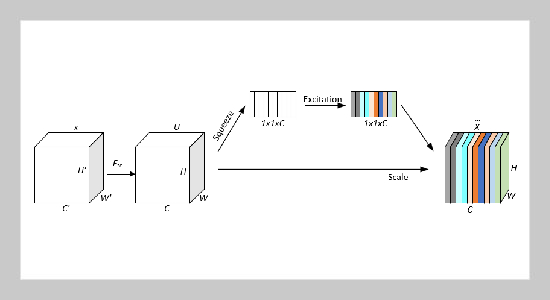
SE Channel-Attention Module
Copyright The Author(s). This is an open access article distributed under the terms of the Creative Commons Attribution License (CC BY 4.0), which permits unrestricted use, distribution, and reproduction in any medium, provided the original author and source are cited.
Download Citation: BibTeX | http://dx.doi.org/10.6180/jase.202701_36.028
Finger vein recognition is a promising biometric technology for identity authentication, but practical systems are often constrained by limited computing and storage resources. To improve the recognition performance of lightweight models under these constraints, this paper proposes PSE-MobileNetV2, a MobileNetV2-based finger vein recognition network with partially embedded Squeeze-and-Excitation (SE) channel-attention blocks. Instead of adding SE blocks to every inverted residual stage, the proposed model inserts them only into stages 4-7, where the feature maps encode higher-level vein representations. This design strengthens channel-wise feature recalibration while avoiding unnecessary early-stage computational overhead. In the reported closed-set, image-disjoint classification experiments on the FV-USM and SDUMLA public datasets, PSE-MobileNetV2 achieves accuracies of 99.49% and 97.06%, respectively, exceeding the MobileNetV2 baseline by 0.31 and 0.84 percentage points. These results suggest that selective SE placement can improve the accuracy-efficiency trade-off of MobileNetV2. However, the current study does not establish verification performance or statistical significance across repeated runs.
Keywords: Deep Learning; Convolutional Neural Network; Finger Vein Recognition; Channel Attention; MobileNetV2; Lightweight Network; Biometric Recognition
- [1] R. Singh, R. Singh, R. K. Tripathi, and P. Agarwal, (2025) “Fingerprint recognition using artificial neural networks” Proceedings of the National Academy of Sciences, India Section A: Physical Sciences 95(2): 127-135. DOI: https://doi.org/10.1007/s40010-025-00917-y.
- [2] G. Jeevan, G. C. Zacharias, M. S. Nair, and J. Rajan, (2022) “An empirical study of the impact of masks on face recognition” Pattern Recognition 122: 108308. DOI: https://doi.org/10.1016/j.patcog.2021.108308.
- [3] K. V. Shakrani, N. M. Kanyangarara, P. T. Parowa, V. Gupta, and R. Kumar, (2022) “A deep learning model for face recognition in presence of mask” Acta inform Malays 6(2): 43-6. DOI: https://doi.org/10.26480/aim.02.2022.38.41.
- [4] N. Calik, O. C. Kurban, A. R. Yilmaz, T. Yildirim, and L. D. Ata, (2019) “Large-scale offline signature recognition via deep neural networks and feature embedding” Neurocomputing 359: 1-14. DOI: https://doi.org/10.1016/j.neucom.2019.03.027.
- [5] C. Wang, J. Muhammad, Y. Wang, Z. He, and Z. Sun, (2020) “Towards complete and accurate iris segmentation using deep multi-task attention network for non-cooperative iris recognition” IEEE Transactions on Information Forensics and Security 15: 2944-2959. DOI: https://doi.org/10.1109/TIFS.2020.2980791.
- [6] B. Hou, H. Zhang, and R. Yan, (2022) “Finger-vein biometric recognition: A review” IEEE Transactions on Instrumentation and Measurement 71: 1-26. DOI: https://doi.org/10.1109/TIM.2022.3200087.
- [7] J. Yang, Y. Shi, and G. Jia, (2017) “Finger-vein image matching based on adaptive curve transformation” Pattern Recognition 66: 34-43. DOI: https://doi.org/10.1016/j.patcog.2017.01.008.
- [8] W. Yang, C. Hui, Z. Chen, J.-H. Xue, and Q. Liao, (2019) “FV-GAN: Finger vein representation using generative adversarial networks” IEEE Transactions on Information Forensics and Security 14(9): 2512-2524. DOI: https://doi.org/10.1109/TIFS.2019.2902819.
- [9] J. M. Song, W. Kim, and K. R. Park, (2019) “Finger-vein recognition based on deep DenseNet using composite image” IEEE Access 7: 66845-66863. DOI: https://doi.org/10.1109/ACCESS.2019.2918503.
- [10] K. Shaheed, A. Mao, I. Qureshi, M. Kumar, S. Hussain, I. Ullah, and X. Zhang, (2022) “DS-CNN: A pre-trained Xception model based on depth-wise separable convolutional neural network for finger vein recognition” Expert Systems with Applications 191: 116288. DOI: https://doi.org/10.1016/j.eswa.2021.116288.
- [11] X. Li, J. Feng, J. Cai, and G. Lin, (2024) “FV-MVIT: Mobile vision transformer for finger vein recognition” Sensors 24(4): 1331. DOI: https://doi.org/10.3390/s24041331.
- [12] Q. Yao, D. Song, X. Xu, and K. Zou, (2024) “Visual feature-guided diamond convolutional network for finger vein recognition” Sensors 24(18): 6097. DOI: https://doi.org/10.3390/s24186097.
- [13] M. Sandler, A. Howard, M. Zhu, A. Zhmoginov, and L.-C. Chen, (2018) “Mobilenetv2: Inverted residuals and linear bottlenecks” 2018 IEEE/CVF Conference on Computer Vision and Pattern Recognition. IEEE, 4510-4520. DOI: https://doi.org/10.1109/CVPR.2018.00474.
- [14] A. G. Howard, M. Zhu, B. Chen, D. Kalenichenko, W. Wang, T. Weyand, M. Andreetto, and H. Adam, (2017) “Mobilenets: Efficient convolutional neural networks for mobile vision applications” arXiv preprint arXiv:1704.04861. DOI: https://doi.org/10.48550/arXiv.1704.04861.
- [15] J. Hu, L. Shen, S. Albanie, G. Sun, and E. Wu, (2020) “Squeeze-and-Excitation Networks” IEEE Transactions on Pattern Analysis and Machine Intelligence 42(8): 2011-2023. DOI: https://doi.org/10.1109/TPAMI.2019.2913372.
- [16] M. S. M. Asaari, S. A. Suandi, and B. A. Rosdi, (2014) “Fusion of band limited phase only correlation and width centroid contour distance for finger based biometrics” Expert Systems with Applications 41(7): 3367-3382. DOI: https://doi.org/10.1016/j.eswa.2013.11.033.
- [17] Y. Yin, L. Liu, and X. Sun, (2011) “SDUMLA-HMT: A multimodal biometric database” Chinese Conference on Biometric Recognition. Springer, 260-268. DOI: https://doi.org/10.1007/978-3-642-25449-9_33.