




College of Fine Arts, Hubei University of Arts and Science, Xiangyang 441053, China
Received: May 15, 2026
Accepted: August 22, 2026
Publication Date: October 09, 2026
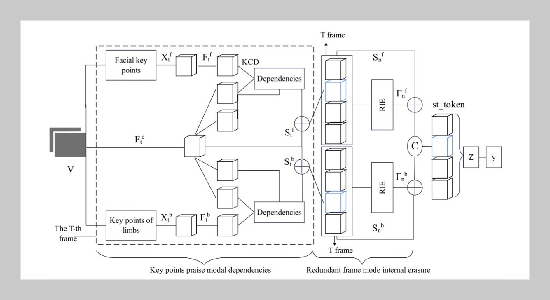
KDRE-ER network structure
Copyright The Author(s). This is an open access article distributed under the terms of the Creative Commons Attribution License (CC BY 4.0), which permits unrestricted use, distribution, and reproduction in any medium, provided the original author and source are cited.
Download Citation: BibTeX | http://dx.doi.org/10.6180/jase.202701_36.023
Constructing an intelligent human-computer interaction (HCI) perception interface from the visual communication perspective requires accurate, robust, and computationally efficient emotion perception algorithms capable of understanding multimodal visual cues. Existing visual emotion perception methods suffer from spatial representation conflicts, asynchronous temporal dynamics, and insufficient multimodal feature fusion, limiting their effectiveness in immersive interactive environments. To address these challenges, this study proposes the KDRE-ER perception algorithm for constructing an HCI perception interface by integrating facial expressions and body posture through the Key-point Cross-modal Dependency (KCD) mechanism and the Redundant-frame Intra-modal Erasure (RIE) strategy. The proposed framework enhances multimodal spatiotemporal feature representation while improving robustness under occlusion and complex interaction scenarios. Experimental results demonstrate that the proposed model achieves an accuracy of 85.2%, a recall of 83.7%, an AUC of 0.87, and a false alarm rate of 14.8%. Reduced inference latency and computational overhead enable efficient multimodal emotion recognition for real-time emotional interaction and immersive communication environments. Compared with CNN- and LSTM-TSA-based approaches, the framework improves prediction accuracy by 3.2% and recall by 11.6%, demonstrating superior recognition performance and practical applicability in emotional interaction and immersive communication environments. Furthermore, practical deployment reduced mental health crisis incidence to 2.1%, shortened intervention response time to 1.2 days, and increased psychological counseling utilization to 68.5%, demonstrating a scalable and computationally efficient perception framework for intelligent HCI.
Keywords: visual communication; human-computer interaction; perception interface; perception algorithm
- [1] Z. Nie, Y. Yu, and Y. Bao, (2023) “Application of Human-Computer Interaction System Based on Machine Learning Algorithm in Artistic Visual Communication” Soft Computing 27(14): 10199-10211. DOI: https://doi.org/10.1007/s00500-023-08267-w.
- [2] L. Huang and P. Zheng, (2023) “Human-Computer Collaborative Visual Design Creation Assisted by Artificial Intelligence” ACM Transactions on Asian and Low-Resource Language Information Processing 22(9): 1-21. DOI: https://doi.org/10.1145/3554735.
- [3] H. Chen, N. Zendehdel, M. C. Leu, and Z. Yin, (2023) “Real-Time Human-Computer Interaction Using Eye Gazes” Manufacturing Letters 35(1): 883-894. DOI: https://doi.org/10.1016/j.mfglet.2023.07.024.
- [4] K. Vitsaxaki, S. Ntoa, G. Margetis, and N. Spyratos, (2023) “Interactive Visual Exploration of Big Relational Datasets” International Journal of Human-Computer Interaction 39(10): 2033-2047. DOI: https://doi.org/10.1080/10447318.2022.2073007.
- [5] N. R. Aturi, (2023) “Psychophysiology of Human-Computer Interaction (HCI) and the Role of Haptic Feedback in Emotional Regulation” International Journal of Scientific Research 12(8): 2566-2570. DOI: https://doi.org/10.21275/SR230811144545.
- [6] W. Alsabhan, (2023) “Human-Computer Interaction with a Real-Time Speech Emotion Recognition with Ensembling Techniques 1D Convolution Neural Network and Attention” Sensors 23(3): 1386-1397. DOI: https://doi.org/10.3390/s23031386.
- [7] A. Zolyomi and J. Snyder, (2023) “Designing for Common Ground: Visually Representing Conversation Dynamics of Neurodiverse Dyads” Proceedings of the ACM on Human-Computer Interaction 7(CSCW2): 1-33. DOI: https://doi.org/10.1145/3610057.
- [8] F. Choi, T. Bajpai, S. Pratipati, and E. Chandrasekharan, (2023) “ConvEx: A Visual Conversation Exploration System for Discord Moderators” Proceedings of the ACM on Human-Computer Interaction 7(CSCW2): 1-30. DOI: https://doi.org/10.1145/3610053.
- [9] R. J. Moore, S. An, and G. J. Ren, (2023) “The IBM Natural Conversation Framework: A New Paradigm for Conversational UX Design” Human-Computer Interaction 38(3-4): 168-193. DOI: https://doi.org/10.1080/07370024.2022.2081571.
- [10] Y. Sun, Q. Guo, S. Zhao, K. Chandran, and G. Fathima, (2024) “Context-Aware Augmented Reality Using Human-Computer Interaction Models” Journal of Control and Decision 11(1): 1-14. DOI: https://doi.org/10.1080/23307706.2022.2026260.
- [11] T. M. Alzubi, J. A. Alzubi, A. Singh, O. A. Alzubi, and M. Subramanian, (2025) “A Multimodal Human-Computer Interaction for Smart Learning System” International Journal of Human-Computer Interaction 41(3): 1718-1728. DOI: https://doi.org/10.1080/10447318.2023.2206758.
- [12] D. Lu, T. Liu, X. Meng, B. Luo, J. Yuan, Y. Liu, and S. Nie, (2023) “Wearable Triboelectric Visual Sensors for Tactile Perception” Advanced Materials 35(7): 2209117-2209129. DOI: https://doi.org/10.1002/adma.202209117.
- [13] D. Ryumin, D. Ivanko, and E. Ryumina, (2023) “Audio-Visual Speech and Gesture Recognition by Sensors of Mobile Devices” Sensors 23(4): 2284-2295. DOI: https://doi.org/10.3390/s23042284.
- [14] L. Zhang, W. He, Z. Cao, S. Wang, H. Bai, and M. Billinghurst, (2023) “Haptic Proxy: Providing Positional Vibrotactile Feedback on a Physical Proxy for Virtual-Real Interaction in Augmented Reality” International Journal of Human-Computer Interaction 39(3): 449-463. DOI: https://doi.org/10.1080/10447318.2022.2041895.
- [15] K. Morrison, M. Jain, J. Hammer, and A. Perer, (2023) “Eye into AI: Evaluating the Interpretability of Explainable AI Techniques through a Game with a Purpose” Proceedings of the ACM on Human-Computer Interaction 7(CSCW2): 1-22. DOI: https://doi.org/10.1145/3610064.