




Received: August 6, 2025
Accepted: July 15, 2026
Publication Date: October 09, 2026
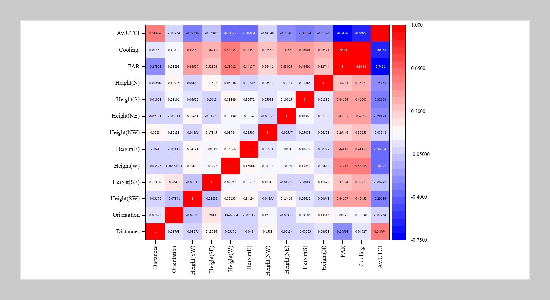
The correlation matrix of features for type A
Copyright The Author(s). This is an open access article distributed under the terms of the Creative Commons Attribution License (CC BY 4.0), which permits unrestricted use, distribution, and reproduction in any medium, provided the original author and source are cited.
Download Citation: BibTeX | http://dx.doi.org/10.6180/jase.202701_36.022
Estimation of energy consumption in urban areas, particularly in relation to the Universal Thermal Climate Index, and related environmental factors associated with architectural design, has remained an essential challenge in the related field of urban planning. This study, holding interest in the first three advanced algorithms, namely HGBR, CatBoost, and LightGBM, was proposed to explore related possibilities in using machine learning algorithms for estimation. The used algorithms were analyzed using three different architectural setups (types A, B, and C) that were optimized using the HGS optimization algorithm. The obtained results clearly highlight that the HGBR-HGS system was significantly accurate for type A buildings for cooling load calculations and estimates related to the Universal Thermal Climate Index. The CatBoost-HGS system performed better than the HGBR-HGS system for type B buildings, again forming the top-performing system for cooling loads. Type C buildings also followed similar lines, where again the CatBoost-HGS system performed better for calculations related to Universal Thermal Climate Index, while the HGBR-HGS system again formed the top-performing system for cooling loads. The results demonstrate that the HGBR-HGS model achieved superior performance, with R² values reaching up to 0.9994 for cooling load prediction and 0.9880 for UTCI estimation, along with the lowest RMSE values across most scenarios. Additionally, the CatBoost-HGS model exhibited strong performance in predicting UTCI, achieving R² values up to 0.9875 for specific building types.
Keywords: Cooling loads, Universal Thermal Climate Index, LightGBM, CatBoost, HGBR, HGS
- [1] C. Li, J. Yao, Y. Li, Y. Wei, M. Li, Y. Shen, G. Shao, H. Feng, and H. Zheng, (2025) “The application and development of Pennes’ biological heat transfer model in human comfort and thermal therapy” International Communications in Heat and Mass Transfer 169: 109724. DOI: https://doi.org/10.1016/j.icheatmasstransfer.2025.109724.
- [2] M. Motamedi, S. Iranfar, F. W. K. Khudhur, and A. Hassanpouryouzband, (2026) “When heat meets water: Environmental trade-offs of underground thermal energy storage” Journal of Energy Storage 149: 120265. DOI: https://doi.org/10.1016/j.est.2025.120265.
- [3] Z. Xie, Y. Wang, G. Tan, J. Wang, J. Zhao, Y. Zhu, and B. Cao, (2026) “Physical characteristics, human perceptions, and energy-saving performance of dynamic airflow in built environments-A comprehensive review” Renewable and Sustainable Energy Reviews 235: 116936. DOI: https://doi.org/10.1016/j.rser.2026.116936.
- [4] K. Błażejczyk and A. Kunert, (2011) “Bioklimatyczne uwarunkowania rekreacji i turystyki w Polsce Bioclimatic principles of recreation and tourism in Poland” Monografie-Polska Akademia Nauk. Instytut Geografii i Przestrzennego Zagospodarowania im. Stanisława Leszczyckiego.
- [5] Y. Ibrahim, T. Kershaw, P. Shepherd, and H. Elkady, (2022) “Multi-objective optimisation of urban courtyard blocks in hot arid zones” Solar Energy 240: 104-120. DOI: https://doi.org/10.1016/j.solener.2022.05.024.
- [6] T. Edition, (2001) “Glossary of terms for thermal physiology” The Japanese Journal of Physiology 51: 245.
- [7] G. Havenith, (2001) “Individualized model of human thermoregulation for the simulation of heat stress response” Journal of applied physiology 90: 1943-1954. DOI: https://doi.org/10.1152/jappl.2001.90.5.1943.
- [8] K. Parsons. Human Thermal Environments: The Effects of Hot, Moderate, and Cold Environments on Human Health, Comfort, and Performance. 3rd. Boca Raton: CRC Press, 2014. DOI: https://doi.org/10.1201/b16750.
- [9] G. Jendritzky, G. Havenith, P. Weihs, E. Batchvarova, and R. DeDear, (2007) “The universal thermal climate index UTCI goal and state of COST action 730” Environmental ergonomics XII. Biomed, Ljubljana: 509-512.
- [10] Z. Liu, Q. Xu, and H. Jin, (2025) “The influence of urban residential block morphology on seasonal outdoor thermal comfort in severely cold regions: A case study of Harbin, China” Frontiers of Architectural Research. DOI: https://doi.org/10.1016/j.foar.2025.09.009.
- [11] J. K. Vanos, J. S. Warland, T. J. Gillespie, and N. A. Kenny, (2010) “Review of the physiology of human thermal comfort while exercising in urban landscapes and implications for bioclimatic design” International journal of biometeorology 54: 319-334. DOI: https://doi.org/10.1007/s00484-010-0301-9.
- [12] N. A. Kenny, J. S. Warland, R. D. Brown, and T. G. Gillespie, (2009) “Part B: Revisions to the COMFA outdoor thermal comfort model for application to subjects performing physical activity” International journal of biometeorology 53: 429-441. DOI: https://doi.org/10.1007/s00484-009-0227-2.
- [13] P. Höppe, (1999) “The physiological equivalent temperature-a universal index for the biometeorological assessment of the thermal environment” International journal of Biometeorology 43: 71-75. DOI: https://doi.org/10.1007/s004840050118.
- [14] P. Höppe, (2002) “Different aspects of assessing indoor and outdoor thermal comfort” Energy and buildings 34: 661-665. DOI: https://doi.org/10.1016/S0378-7788(02)00017-8.
- [15] D. Fiala, G. Havenith, P. Bröde, B. Kampmann, and G. Jendritzky, (2012) “UTCI-Fiala multi-node model of human heat transfer and temperature regulation” International journal of biometeorology 56: 429-441. DOI: https://doi.org/10.1007/s00484-011-0424-7.
- [16] A. Psikuta, D. Fiala, G. Laschewski, G. Jendritzky, M. Richards, K. Błażejczyk, I. Mekjavič, H. Rintamäki, R. de Dear, and G. Havenith, (2012) “Validation of the Fiala multi-node thermophysiological model for UTCI application” International journal of biometeorology 56: 443-460. DOI: https://doi.org/10.1007/s00484-011-0450-5.
- [17] G. Havenith, D. Fiala, K. Błazejczyk, M. Richards, P. Bröde, I. Holmér, H. Rintamaki, Y. Benshabat, and G. Jendritzky, (2012) “The UTCI-clothing model” International journal of biometeorology 56: 461-470. DOI: https://doi.org/10.1007/s00484-011-0451-4.
- [18] C. Koppe and G. Jendritzky, (2005) “Inclusion of short-term adaptation to thermal stresses in a heat load warning procedure” Meteorologische Zeitschrift 14: 271-278. DOI: https://doi.org/10.1127/0941-2948/2005/0030.
- [19] H. Staiger, K. Bucher, and G. Jendritzky, (1997) “Gefühlte temperatur. Die physiologisch gerechte bewertung von wärmebelastung und kältestress beim aufenthalt im freien in der maßzahl grad celsius” Annalen der Meteorologie 33: 100-107.
- [20] E. L. Krüger, T. J. V. Silva, S. Q. da Silveira Hirashima, E. G. da Cunha, and L. A. Rosa, (2021) “Calibrating UTCI’S comfort assessment scale for three Brazilian cities with different climatic conditions” International journal of biometeorology 65: 1463-1472. DOI: https://doi.org/10.1007/s00484-020-01897-x.
- [21] A. Xu, R. Zhang, J. Yu, and Y. Dong, (2023) “Energy saving optimization of commercial complex atrium roof with resilient ventilation using machine learning” Smart Cities 6: 2367-2396. DOI: https://doi.org/10.3390/smartcities6050108.
- [22] G. Zhong, (2022) “Convolutional neural network model to predict outdoor comfort UTCI microclimate map” Atmosphere 13: 1860. DOI: https://doi.org/10.3390/atmos13111860.
- [23] X. Zhang, L. Yang, R. Luo, H.-Y. Wu, J. Xu, C. Huang, Y. Ruan, X. Zheng, and J. Yao, (2022) “Estimating the outdoor environment of workers’ villages in East China using machine learning” Building and Environment 226: 109738. DOI: https://doi.org/10.1016/j.buildenv.2022.109738.
- [24] Z. Fang, X. Feng, J. Liu, Z. Lin, C. M. Mak, J. Niu, K.-T. Tse, and X. Xu, (2019) “Investigation into the differences among several outdoor thermal comfort indices against field survey in subtropics” Sustainable cities and society 44: 676-690. DOI: https://doi.org/10.1016/j.scs.2018.10.022.
- [25] S. Zare, N. Hasheminejad, H. E. Shirvan, R. Hemmatjo, K. Sarebanzadeh, and S. Ahmadi, (2018) “Comparing Universal Thermal Climate Index (UTCI) with selected thermal indices/environmental parameters during 12 months of the year” Weather and climate extremes 19: 49-57. DOI: https://doi.org/10.1016/j.wace.2018.01.004.
- [26] M. Borowski and K. Zwolińska, (2020) “Prediction of cooling energy consumption in hotel building using machine learning techniques” Energies 13: 6226. DOI: https://doi.org/10.3390/en13236226.
- [27] C. Fan, F. Xiao, and Y. Zhao, (2017) “A short-term building cooling load prediction method using deep learning algorithms” Applied energy 195: 222-233. DOI: https://doi.org/10.1016/j.apenergy.2017.03.064.
- [28] W. Li, G. Gong, H. Fan, P. Peng, and L. Chun, (2020) “Meta-learning strategy based on user preferences and a machine recommendation system for real-time cooling load and COP forecasting” Applied Energy 270: 115144. DOI: https://doi.org/10.1016/j.apenergy.2020.115144.
- [29] Y. Feng, Q. Duan, X. Chen, S. S. Yakkali, and J. Wang, (2021) “Space cooling energy usage prediction based on utility data for residential buildings using machine learning methods” Applied energy 291: 116814. DOI: https://doi.org/10.1016/j.apenergy.2021.116814.
- [30] G. Ke, Q. Meng, T. Finley, T. Wang, W. Chen, W. Ma, Q. Ye, and T.-Y. Liu, (2017) “Lightgbm: A highly efficient gradient boosting decision tree” Advances in neural information processing systems 30.
- [31] A. V. Dorogush, V. Ershov, and A. Gulin, (2018) “CatBoost: gradient boosting with categorical features support” arXiv preprint arXiv:1810.11363. DOI: https://doi.org/10.48550/arXiv.1810.11363.
- [32] M. Entezami and S. Goodarzi, (2025) “Cooling Load Prediction in Residential Buildings: Machine Learning Approaches and Comparative Analysis” Advances in Engineering and Intelligence Systems 4: 86-100. DOI: https://doi.org/10.22034/aeis.2025.537166.1344.
- [33] L. Prokhorenkova, G. Gusev, A. Vorobev, A. V. Dorogush, and A. Gulin, (2018) “CatBoost: unbiased boosting with categorical features” Advances in neural information processing systems 31.
- [34] R. S. Benemaran, E. Khajavi, and A. R. T. Khanghah, (2026) “Construction of multi-parameter intelligent comprehensive estimation algorithms for soil compression modulus” Scientific Reports. DOI: https://doi.org/10.1038/s41598-026-43812-1.
- [35] B. Naeim, A. J. Khiavi, E. Khajavi, A. R. T. Khanghah, A. Asgari, R. Taghipour, and M. Bagheri, (2025) “Machine learning approaches for fatigue life prediction of steel and feature importance analyses” Infrastructures 10: 295. DOI: https://doi.org/10.3390/infrastructures10110295.
- [36] H. Hang, T. Huang, Y. Cai, H. Yang, and Z. Lin, (2021) “Gradient boosted binary histogram ensemble for large-scale regression” arXiv preprint arXiv:2106.01986. DOI: https://doi.org/10.48550/arXiv.2106.01986.
- [37] Y. Yang, H. Chen, A. A. Heidari, and A. H. Gandomi, (2021) “Hunger games search: Visions, conception, implementation, deep analysis, perspectives, and towards performance shifts” Expert Systems with Applications 177: 114864. DOI: https://doi.org/10.1016/j.eswa.2021.114864.
- [38] E. Khajavi, A. R. T. Khanghah, and A. J. Khiavi. “An efficient prediction of punching shear strength in reinforced concrete slabs through boosting methods and metaheuristic algorithms”. In: Structures. 74. Elsevier, 2025, 108519. DOI: https://doi.org/10.1016/j.istruc.2025.108519.