




Department of Physical Education, Changzhou Institute of Technology, Changzhou, Jiangsu, 213032, China
Received: August 11, 2026
Accepted: September 15, 2026
Publication Date: October 09, 2026
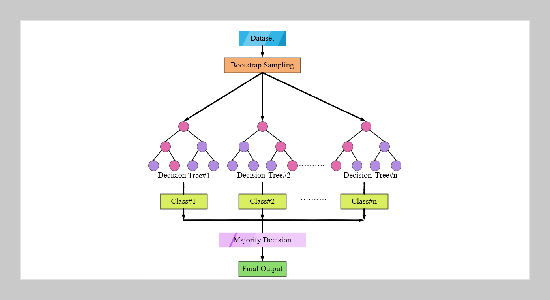
Random Forest Model Architecture
Copyright The Author(s). This is an open access article distributed under the terms of the Creative Commons Attribution License (CC BY 4.0), which permits unrestricted use, distribution, and reproduction in any medium, provided the original author and source are cited.
Download Citation: BibTeX | http://dx.doi.org/10.6180/jase.202701_36.019
Accurate and objective assessment of movement quality is essential for enhancing physical education outcomes; however, traditional evaluation methods depend largely on manual observation, leading to subjectivity, inconsistency, and increased assessment time. This study presents a Computer Vision-Driven Intelligent Assessment System for Physical Education that automates movement recognition, standardization evaluation, performance scoring, and feedback generation. The proposed framework integrates Media Pipe Blaze Pose-based pose estimation with a hybrid Random Forest (RF) and Extreme Gradient Boosting (XGBoost) classifier to analyse student activities effectively. The system utilizes the KTH Action Recognition Dataset, containing six human activities: boxing, handclapping, handwaving, jogging, running, and walking. Video frames are processed through preprocessing, landmark extraction, normalization, and noise reduction, followed by feature extraction from 33 detected body landmarks. Movement quality is evaluated using joint angle deviation, pose similarity, body symmetry, and motion consistency. The hybrid classifier achieved superior performance with an accuracy of 0.9759, precision of 0.9764, recall of 0.9759, and F1-score of 0.9761. The proposed system offers an efficient, scalable, and intelligent approach for automated movement assessment and personalized performance improvement in physical education environments.
Keywords: Computer Vision, Physical Education, Media Pipe Blaze Pose, Human Activity Recognition, Movement Standardization, Performance Scoring
- [1] V. M. Valle-Muñoz, M. Mendoza-Muñoz, and E. Villa-González, (2025) “Physical Literacy as a Pedagogical Model in Physical Education” Children 12(8): 1008. DOI: https://doi.org/10.3390/children12081008.
- [2] H. Liu, H. Min, Y. Wu, Y. Guo, T. Hu, and Y. Shi, (2025) “Construction of an evaluation index system for core literacy in physical education and health for Chinese college students” Scientific Reports 15(1): 41829. DOI: https://doi.org/10.1038/s41598-025-25852-1.
- [3] L. Zhao, G. Wu, W. Shao, and X. Ma, (2024) “Conceptual understanding and cognitive patterns construction for physical education teaching based on deep learning algorithms” Scientific Reports 14(1): 31409. DOI: https://doi.org/10.1038/s41598-024-83028-9.
- [4] X. Suo, W. Tang, L. Mao, and Z. Li, (2025) “Digital human and embodied intelligence for sports science: advancements, opportunities and prospects” The Visual Computer 41(4): 2477-2493. DOI: https://doi.org/10.1007/s00371-024-03547-4.
- [5] S. Edriss et al., (2024) “The Role of Emergent Technologies in the Dynamic and Kinematic Assessment of Human Movement in Sport and Clinical Applications” Applied Sciences 14(3): 1012. DOI: https://doi.org/10.3390/app14031012.
- [6] L.-H. Hsia, G.-J. Hwang, and J.-P. Hwang, (2024) “AI-facilitated reflective practice in physical education: an auto-assessment and feedback approach” Interactive Learning Environments 32(9): 5267-5286. DOI: https://doi.org/10.1080/10494820.2023.2212712.
- [7] C. Ferraris, G. Amprimo, S. Cerfoglio, L. Vismara, and V. Cimolin, (2025) “A Deep Dive Into MediaPipe Pose for Postural Assessment: A Comparative Investigation” IEEE Access 13: 211055-211074. DOI: https://doi.org/10.1109/ACCESS.2025.3643126.
- [8] D. Koźlenia and K. Kochan-Jacheć, (2024) “The Impact of Interaction between Body Posture and Movement Pattern Quality on Injuries in Amateur Athletes” Journal of Clinical Medicine 13(5): 1456. DOI: https://doi.org/10.3390/jcm13051456.
- [9] I. Ćirić, N. Ivačko, M. Milić, P. Ristić, and D. Krstić, (2025) “Computer Vision-Driven Framework for IoT-Enabled Basketball Score Tracking” Computers 14(11): 469. DOI: https://doi.org/10.3390/computers14110469.
- [10] S. Khater, M. Hadhoud, and M. B. Fayek, (2022) “A novel human activity recognition architecture: using residual inception ConvLSTM layer” Journal of Engineering and Applied Sciences 69(1): 45. DOI: https://doi.org/10.1186/s44147-022-00098-0.
- [11] Y. Fan et al., (2025) “Computer Vision-Driven Digitalization of the Nine Hole Peg Test Assessment Method: A Pilot Study” Journal of Medical and Biological Engineering 45(5): 720-737. DOI: https://doi.org/10.1007/s40846-025-00980-1.
- [12] D. Rode, A. Dunkel, R. Willi, P. Wolf, M. Xiloyannis, and R. Riener, (2025) “Assessment of monocular human pose estimation models for clinical movement analysis” Scientific Reports 15(1): 38767. DOI: https://doi.org/10.1038/s41598-025-22626-7.
- [13] J.-W. Kim, J.-Y. Choi, E.-J. Ha, and J.-H. Choi, (2023) “Human Pose Estimation Using MediaPipe Pose and Optimization Method Based on a Humanoid Model” Applied Sciences 13(4): 2700. DOI: https://doi.org/10.3390/app13042700.
- [14] G. L. Goh, G. D. Goh, J. W. Pan, P. S. P. Teng, and P. W. Kong, (2023) “Automated Service Height Fault Detection Using Computer Vision and Machine Learning for Badminton Matches” Sensors 23(24): 9759. DOI: https://doi.org/10.3390/s23249759.
- [15] A. Kryeem et al., (2025) “Action assessment in rehabilitation: Leveraging machine learning and vision-based analysis” Computer Vision and Image Understanding 251: 104228. DOI: https://doi.org/10.1016/j.cviu.2024.104228.
- [16] A. Vafaei. KTH Action Recognition Dataset. 2026. URL: https://www.kaggle.com/datasets/vafaeii/kth-action-recognition-dataset (visited on 07/11/2026).