




Yunhui Zhang, Qi Yang, Minghao Li, Hui Han, and Yupu Zhang
School of Mechanical Engineering, Shenyang Ligong University, Shenyang 110159, China
Received: August 18, 2026
Accepted: September 20, 2026
Publication Date: October 09, 2026
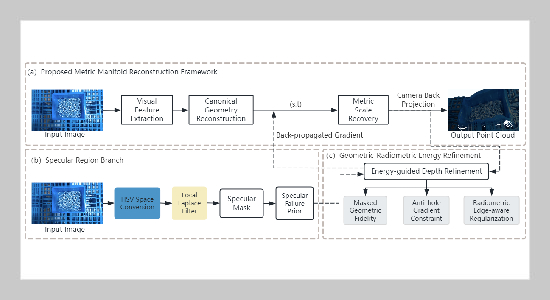
The proposed Geometric-Radiometric Collaborative Framework
Copyright The Author(s). This is an open access article distributed under the terms of the Creative Commons Attribution License (CC BY 4.0), which permits unrestricted use, distribution, and reproduction in any medium, provided the original author and source are cited.
Download Citation: BibTeX | http://dx.doi.org/10.6180/jase.202701_36.017
Accurate monocular metric depth perception is crucial for complex robotic tasks such as bin-picking. However, in real industrial scenes, specular reflections from metal surfaces and mutual occlusions cause severe feature distortions and scale inconsistencies. To address this issue, we propose a Geometric-Radiometric Collaborative Framework guided by specular failure priors for robust absolute metric reconstruction under strong specular reflections. We decouple canonical depth reconstruction from global metric calibration and use affine parameters s and t to map scale-independent canonical depth to metric depth. In addition, a specular-aware energy constraint combining mask guidance and image gradients suppresses reflection-induced depth collapse and local distortions. Experiments on the XYZ-IBD dataset demonstrate that our method consistently outperforms the evaluated baseline models[cite: 99]. In highly reflective metal regions, the framework lowers the root mean square error (RMSE) to 97.0 mm, increases the δ₁ accuracy to 91.39%, and reduces the Local Surface Smoothness (LSS) metric to 3.04. These results provide a reliable basis for 3D reconstruction in vision-based robotic bin-picking.
Keywords: Monocular depth estimation, Absolute scale recovery, Energy functional optimization, Specular reflection, Robotic bin-picking
- [1] A. Cordeiro, L. F. Rocha, J. Boaventura-Cunha, D. Figueiredo, and J. P. Souza, (2026) “A Review of Visual Perception for Robotic Bin-Picking” Robotics and Autonomous Systems 196: 105236. DOI: https://doi.org/10.1016/j.robot.2025.105236.
- [2] R. L. Haugaard and A. G. Buch. “SurfEmb: Dense and Continuous Correspondence Distributions for Object Pose Estimation with Learnt Surface Embeddings”. In: 2022 IEEE/CVF Conference on Computer Vision and Pattern Recognition (CVPR). 2022, 6739-6748. DOI: https://doi.org/10.1109/CVPR52688.2022.00663.
- [3] J. Huang, J. Hu, P. K. Yu, S. Ilic, M. Sundermeyer, and B. Busam. “XYZ-IBD: Benchmarking Robust 6D Object Pose Estimation under Real-World Industrial Complexity”. In: European Conference on Computer Vision (ECCV). 2026.
- [4] R. Ranftl, K. Lasinger, D. Hafner, K. Schindler, and V. Koltun, (2022) “Towards Robust Monocular Depth Estimation: Mixing Datasets for Zero-Shot Cross-Dataset Transfer” IEEE Transactions on Pattern Analysis and Machine Intelligence 44(3): 1623-1637. DOI: https://doi.org/10.1109/TPAMI.2020.3019967.
- [5] A. Eftekhar, A. Sax, J. Malik, and A. Zamir. “Omnidata: A Scalable Pipeline for Making Multi-Task Mid-Level Vision Datasets From 3D Scans”. In: 2021 IEEE/CVF International Conference on Computer Vision (ICCV). 2021, 10766-10776. DOI: https://doi.org/10.1109/ICCV48922.2021.01061.
- [6] W. Yin, J. Zhang, O. Wang, S. Niklaus, L. Mai, S. Chen, and C. Shen. “Learning to Recover 3D Scene Shape from a Single Image”. In: 2021 IEEE/CVF Conference on Computer Vision and Pattern Recognition (CVPR). IEEE, 2021, 204-213. DOI: https://doi.org/10.1109/CVPR46437.2021.00027.
- [7] L. Piccinelli, C. Sakaridis, Y.-H. Yang, M. Segu, S. Li, W. Abbeloos, and L. Van Gool, (2026) “UniDepth V2: Universal Monocular Metric Depth Estimation Made Simpler” IEEE Transactions on Pattern Analysis and Machine Intelligence 48(3): 2354-2367. DOI: https://doi.org/10.1109/TPAMI.2025.3628473.
- [8] J. Yang, J. Yao, and S. L. Waslander. “Active Pose Refinement for Textureless Shiny Objects using the Structured Light Camera”. In: 2024 IEEE/RSJ International Conference on Intelligent Robots and Systems (IROS). IEEE, 2024, 7550-7557. DOI: https://doi.org/10.1109/IROS58592.2024.10801300.
- [9] S. F. Bhat, I. Alhashim, and P. Wonka. “AdaBins: Depth Estimation Using Adaptive Bins”. In: Proceedings of the IEEE/CVF Conference on Computer Vision and Pattern Recognition (CVPR). IEEE, 2021, 4009-4018. DOI: https://doi.org/10.1109/CVPR46437.2021.00400.
- [10] A. Costanzino, P. Z. Ramirez, M. Poggi, F. Tosi, S. Mattoccia, and L. Di Stefano. “Learning Depth Estimation for Transparent and Mirror Surfaces”. In: 2023 IEEE/CVF International Conference on Computer Vision (ICCV). 2023, 9210-9221. DOI: https://doi.org/10.1109/ICCV51070.2023.00848.
- [11] W. Choi, K. Hwang, M. Choi, K. Han, W. Choi, M. Shin, and S. Im, (2025) “Intrinsic Image Decomposition for Robust Self-supervised Monocular Depth Estimation on Reflective Surfaces” Proceedings of the AAAI Conference on Artificial Intelligence 39(3): 2555-2563. DOI: https://doi.org/10.1609/aaai.v39i3.32258.
- [12] K. He, J. Sun, and X. Tang, (2013) “Guided Image Filtering” IEEE Transactions on Pattern Analysis and Machine Intelligence 35(6): 1397-1409. DOI: https://doi.org/10.1109/TPAMI.2012.213.
- [13] F. Liu, C. Shen, and G. Lin. “Deep Convolutional Neural Fields for Depth Estimation from a Single Image”. In: 2015 IEEE Conference on Computer Vision and Pattern Recognition (CVPR). 2015, 5162-5170. DOI: https://doi.org/10.1109/CVPR.2015.7299152.
- [14] S. A. Shafer, (1985) “Using Color to Separate Reflection Components” Color Research & Application 10(4): 210-218. DOI: https://doi.org/10.1002/col.5080100409.
- [15] J. M. Facil, B. Ummenhofer, H. Zhou, L. Montesano, T. Brox, and J. Civera. “CAM-Convs: Camera-Aware Multi-Scale Convolutions for Single-View Depth”. In: 2019 IEEE/CVF Conference on Computer Vision and Pattern Recognition (CVPR). 2019, 11818-11827. DOI: https://doi.org/10.1109/CVPR.2019.01210.
- [16] X. Cheng, P. Wang, and R. Yang. “Depth Estimation via Affinity Learned with Convolutional Spatial Propagation Network”. In: European Conference on Computer Vision (ECCV). Springer International Publishing, 2018, 108-125. DOI: https://doi.org/10.1007/978-3-030-01270-0_7.
- [17] M. Jia, L. Tang, B.-C. Chen, C. Cardie, S. Belongie, B. Hariharan, and S.-N. Lim. “Visual Prompt Tuning”. In: European Conference on Computer Vision (ECCV). Springer Nature Switzerland, 2022, 709-727. DOI: https://doi.org/10.1007/978-3-031-19827-4_41.
- [18] L. Yang, B. Kang, Z. Huang, Z. Zhao, X. Xu, J. Feng, and H. Zhao. “Depth Anything V2”. In: Advances in Neural Information Processing Systems. 37. Curran Associates, Inc., 2024, 21875-21877. DOI: https://doi.org/10.52202/079017-0688.
- [19] S. F. Bhat, R. Birkl, D. Wofk, P. Wonka, and M. Müller, (2023) “ZoeDepth: Zero-shot Transfer by Combining Relative and Metric Depth” arXiv preprint arXiv:2302.12288: DOI: https://doi.org/10.48550/ARXIV.2302.12288.
- [20] J. Mahler, J. Liang, S. Niyaz, M. Laskey, R. Doan, X. Liu, J. A. Ojea, and K. Goldberg. “Dex-Net 2.0: Deep Learning to Plan Robust Grasps with Synthetic Point Clouds and Analytic Grasp Metrics”. In: Robotics: Science and Systems (RSS). 2017. DOI: https://doi.org/10.15607/rss.2017.xiii.058.