



Mingjie Zhang1,2, Jinbo Zhang1,2, Zhihong Tan1,2, and Zhe Li1,2
1State Key Laboratory Cultivation Base for Gas Geology and Gas Control, Henan Province, Henan Polytechnic University, Jiaozuo 454003, China
2School of Safety Science and Engineering, Henan Polytechnic University, Jiaozuo 454003, China
Received: July 15, 2026
Accepted: September 08, 2026
Publication Date: October 09, 2026
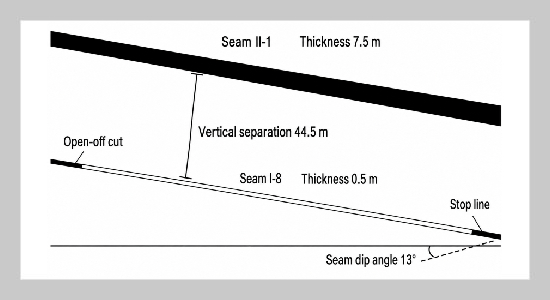
Spatial relationship between the protective and protected seams.
Copyright The Author(s). This is an open access article distributed under the terms of the Creative Commons Attribution License (CC BY 4.0), which permits unrestricted use, distribution, and reproduction in any medium, provided the original author and source are cited.
Download Citation: BibTeX | http://dx.doi.org/10.6180/jase.202701_36.016
Mining an ultra-thin lower protective seam alone may provide insufficient pressure relief because of the limited mining height, whereas excessive co-mining of adjacent rock increases the engineering burden associated with rock excavation, transportation, hoisting, waste-rock handling, and coal-quality control. To address this problem, this study investigates a reasonable coal-soft-rock co-mining height for the long-distance ultra-thin lower protective Seam I-8 at Zhongtai Mine. The heights of the overburden failure zones were first estimated theoretically under different mining heights. RFPA2D simulations were subsequently conducted for three representative mining heights of 0.5, 1.0, and 1.5 m to compare the evolution of overburden failure, the gas permeability response, and the expansion strain of Seam II-1. Among the three simulated cases, increasing the mining height from 0.5 to 1.0 m markedly enhanced the pressure-relief response of the protected seam, whereas the additional improvement from 1.0 to 1.5 m was comparatively limited. At a mining height of 1.0 m, the maximum gas permeability coefficient of Seam II-1 reached approximately 160 m²·MPa⁻²·d⁻¹, and the maximum expansion strain reached 6.13‰. Considering the pressure-relief performance and the additional rock excavation associated with a larger mining height, a mining height of 1.0 m was selected for field implementation. The field scheme consisted of mining the 0.5 m-thick Seam I-8 together with approximately 0.5 m of soft roof rock and applying pressure-relief gas drainage. The maximum pure methane drainage rate reached 14 m³/min, and the maximum gas content measured after drainage was 1.83 m³/t. These results indicate that the 1.0 m coal-soft rock co-mining scheme can provide effective pressure relief and regional gas outburst control under the geological and mining conditions investigated in this study.
Keywords: ultra-thin lower protective seam; coal-soft-rock co-mining; mining height; gas outburst control
- [1] H. Liu and Y. Cheng, (2015) “The elimination of coal and gas outburst disasters by long distance lower protective seam mining combined with stress-relief gas extraction in the Huaibei coal mine area” Journal of Natural Gas Science and Engineering 27: 346-353. DOI: https://doi.org/10.1016/j.jngse.2015.08.068.
- [2] K. Jin, Y. Cheng, W. Wang, H. Liu, Z. Liu, and H. Zhang, (2016) “Evaluation of the remote lower protective seam mining for coal mine gas control: A typical case study from the Zhuxianzhuang Coal Mine, Huaibei Coalfield, China” Journal of Natural Gas Science and Engineering 33: 44-55. DOI: https://doi.org/10.1016/j.jngse.2016.05.004.
- [3] B. Yao, Q. Ma, J. Wei, J. Ma, and D. Cai, (2016) “Effect of protective coal seam mining and gas extraction on gas transport in a coal seam” International Journal of Mining Science and Technology 26(4): 637-643. DOI: https://doi.org/10.1016/j.ijmst.2016.05.016.
- [4] H. Liu, X. Xiao, and Z. Shu, (2021) “Elimination of Coal and Gas Outburst Dynamic Disasters in Dengfeng Coalfield through Gas Extraction Based on Extremely Thin Protective Coal Seam Mining” Advances in Civil Engineering 2021: DOI: https://doi.org/10.1155/2021/8675060.
- [5] H. Liu, H. Liu, and Y. Cheng, (2014) “The elimination of coal and gas outburst disasters by ultrathin protective seam drilling combined with stress-relief gas drainage in Xinggong coalfield” Journal of Natural Gas Science and Engineering 21: 837-844. DOI: https://doi.org/10.1016/j.jngse.2014.10.022.
- [6] Q. Sun, J. X. Zhang, Q. Zhang, W. Yin, and D. Germain, (2016) “A protective seam with nearly whole rock mining technology for controlling coal and gas outburst hazards: a case study” Natural Hazards 84(3): 1793-1806. DOI: https://doi.org/10.1007/s11069-016-2512-9.
- [7] X. Cheng, G. Zhao, Y. Li, X. Meng, and Q. Tu, (2020) “Key technologies and engineering practices for soft-rock protective seam mining” International Journal of Mining Science and Technology 30(6): 889-899. DOI: https://doi.org/10.1016/j.ijmst.2020.07.006.
- [8] Z. Cao, X. He, E. Wang, and B. Kong, (2018) “Protection scope and gas extraction of the low-protective layer in a thin coal seam: lessons from the DaHe coalfield, China” Geosciences Journal 22(3): 487-499. DOI: https://doi.org/10.1007/s12303-017-0061-1.
- [9] C. Zhang, L. Yu, R. Feng, Y. Zhang, and G. Zhang, (2018) “A Numerical Study of Stress Distribution and Fracture Development above a Protective Coal Seam in Longwall Mining” Processes 6(9): 146-146. DOI: https://doi.org/10.3390/pr6090146.
- [10] H. Xie, X. Li, J. Cai, S. Wang, and C. Feng, (2023) “Evolution of fissures and pressure discharge of gas caused by mining of the upper protective layer of a coal seam.” Scientific reports 13(1): 2561-2561. DOI: https://doi.org/10.1038/s41598-023-29020-1.
- [11] H. Chen, Y. Cheng, T. Ren, H. Zhou, and Q. Liu, (2014) “Permeability distribution characteristics of protected coal seams during unloading of the coal body” International Journal of Rock Mechanics and Mining Sciences 71: 105-116. DOI: https://doi.org/10.1016/j.ijrmms.2014.03.018.
- [12] Z. Shi, D. Ye, B. Qin, J. Hao, W. Sun, and S. Fang, (2022) “Mining Height Effect and Application of Upper Protected Layer Mining Pressure Relief” Sustainability 14(16): 10119. DOI: https://doi.org/10.3390/su141610119.
- [13] L. Wang, Y.-p. Cheng, C. Xu, F.-h. An, K. Jin, and X.-l. Zhang, (2013) “The controlling effect of thick-hard igneous rock on pressure relief gas drainage and dynamic disasters in outburst coal seams” Natural Hazards 66(2): 1221-1241. DOI: https://doi.org/10.1007/s11069-012-0547-0.
- [14] S. Fang, H. Zhu, Y. Huo, Y. Zhang, H. Wang, F. Li, and X. Wang, (2021) “The pressure relief protection effect of different strip widths, dip angles and pillar widths of an underside protective seam.” PLOS ONE 16(1): e0246199. DOI: https://doi.org/10.1371/journal.pone.0246199.
- [15] D. Feng, F. Xuan, Z. Li, Z. Cao, W. Wang, F. Lu, and Y. Jiang, (2024) “Research on overburden structural characteristics and support adaptability in cooperative mining of sectional coal pillar and bottom coal seam” Scientific Reports 14(1): 12693. DOI: https://doi.org/10.1038/s41598-024-62375-7.
- [16] E. Xu, C. Xu, X. Li, W. Zhou, X. You, Y. Peng, Z. Dong, C. Zou, and S. Chen, (2025) “Study on the development pattern of continuous aquitard water-conducting fracture zones and rock layer detection borehole camera technology” Scientific Reports 15(1): 40418. DOI: https://doi.org/10.1038/s41598-025-13349-w.
- [17] T. Hu, K. Han, C. Song, J. Che, B. Li, T. Huo, and T. Hu, (2024) “Development Law of Water-Conducting Fracture Zones in Overburden above Fully Mechanized Top-Coal Caving Face: A Comprehensive Study” Processes 12(10): 2076. DOI: https://doi.org/10.3390/pr12102076.
- [18] K. Zhan, B. Zhang, and M. Wang, (2026) “Theoretical study on the pressure relief range of the upper protected coal seam in protective layer mining.” Scientific reports 16(1): 15688. DOI: https://doi.org/10.1038/s41598-026-47249-4.
- [19] C. A. Tang, L. G. Tham, P. K. K. Lee, T. H. Yang, and L. C. Li, (2002) “Coupled analysis of flow, stress and damage (FSD) in rock failure” International Journal of Rock Mechanics and Mining Sciences 39(4): 477-489. DOI: https://doi.org/10.1016/S1365-1609(02)00023-0.
- [20] W. C. Zhu and C. A. Tang, (2004) “Micromechanical Model for Simulating the Fracture Process of Rock” Rock Mechanics and Rock Engineering 37(1): 25-56. DOI: https://doi.org/10.1007/s00603-003-0014-z.