




Received: July 28, 2026
Accepted: August 31, 2026
Publication Date: October 09, 2026
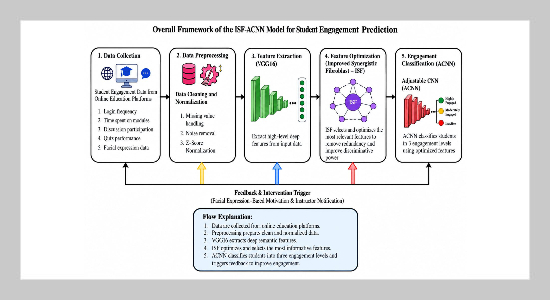
Schematic diagram of proposed flow
Copyright The Author(s). This is an open access article distributed under the terms of the Creative Commons Attribution License (CC BY 4.0), which permits unrestricted use, distribution, and reproduction in any medium, provided the original author and source are cited.
Download Citation: BibTeX | http://dx.doi.org/10.6180/jase.202701_36.015
The rapid growth of online learning platforms has transformed education by enabling students to access learning resources anytime and anywhere. Despite these advantages, maintaining student engagement remains a significant challenge, as engagement directly influences motivation, knowledge retention, and academic performance. This study presents a deep learning-based predictive framework for forecasting student engagement and delivering facial expression-based feedback to improve learners’ motivation and commitment[cite: 110]. The proposed model, termed the Improved Synergistic Fibroblast-tuned Adjustable Convolutional Neural Network (ISF-ACNN), classifies students into three engagement categories: inactive, moderately engaged, and highly engaged. Initially, the collected educational data are preprocessed through data cleaning and noise removal to improve quality. Subsequently, the Visual Geometry Group 16 (VGG16) model extracts meaningful features, while the Improved Synergistic Fibroblast (ISF) algorithm selects the most relevant features for prediction. The optimized feature set is then integrated with the ACNN model to achieve accurate and adaptive engagement classification. Experimental evaluation demonstrates that the proposed ISF-ACNN model outperforms existing approaches, achieving 98.49% accuracy, 98.05% precision, 98.00% recall, and an F1-score of 98.00%. These findings confirm the effectiveness of the proposed framework in predicting student engagement. In addition, the intelligent system identifies fluctuations in engagement level of students and provides personalized guidance based on the facial expression to promote student participation, enhance learning motivation, and sustain active learning in all terms of online education, and informs the instructor at the same time to allow the timely and appropriate intervention of the instructor.
Keywords: Student Engagement, Online Education, Facial Expression, Improved Synergistic Fibroblast Tuned Adjustable Convolution Neural Network (ISF-ACNN)
- [1] V. Abou-Khalil, S. Helou, E. Khalifé, M. A. Chen, R. Majumdar, and H. Ogata, (2021) “Emergency online learning in low-resource settings: Effective student engagement strategies” Education Sciences 11(1): 24. DOI: https://doi.org/10.3390/educsci11010024.
- [2] C. Poondej and T. Lerdpornkulrat, (2020) “Gamification in e-learning: A Moodle implementation and its effect on student engagement and performance” Interactive Technology and Smart Education 17(1): 56-66. DOI: https://doi.org/10.1108/ITSE-06-2019-0030.
- [3] A. Singh, D. Singh, and S. Chhikara. “Online Learning: Challenges and Suggestions to Enhance Student Engagement in Higher Education Institutions”. In: Reshaping Entrepreneurial Education With an Industry 4.0 Context. 2024, 59-80. DOI: https://doi.org/10.4018/979-8-3693-0409-9.ch004.
- [4] O. A. Lasekan, V. Pachava, M. T. Godoy Pena, S. K. Golla, and M. S. Raje, (2024) “Investigating factors influencing students’ engagement in sustainable online education” Sustainability 16(2): 689. DOI: https://doi.org/10.3390/su16020689.
- [5] S. Yi, Y. Zhang, Y. Lu, and R. Shadiev, (2024) “Sense of belonging, academic self-efficacy and hardiness: Their impacts on student engagement in distance learning courses” British Journal of Educational Technology 55(4): 1703-1727. DOI: https://doi.org/10.1111/bjet.13421.
- [6] E. J. Vermeulen and M. L. Volman, (2024) “Promoting student engagement in online education: Online learning experiences of Dutch university students” Technology, Knowledge and Learning 29(2): 941-961. DOI: https://doi.org/10.1007/s10758-023-09645-7.
- [7] A. Adiyono, E. W. Hayat, E. D. Oktavia, and N. T. Prasetiyo, (2024) “Learning interaction in the digital era: Technological innovations and education management strategies to enhance student engagement” Journal of Research in Instructional 4(1): 205-221. DOI: https://doi.org/10.30862/jri.v4i1.333.
- [8] B. Lyu and C. Lai, (2024) “Analysing learner engagement with native speaker feedback on an educational social networking site: An ecological perspective” Computer Assisted Language Learning 37(1-2): 114-148. DOI: https://doi.org/10.1080/09588221.2022.2030364.
- [9] C. Beloufa. “Leading the Shift to Online English Education: Insights into Managing Virtual Learning Environments”. In: 2021st Learning and Technology Conference (L&T). 2024, 337-342. DOI: https://doi.org/10.1109/LT60077.2024.10469252.
- [10] L. Han, S. Z. M. Osman, and J. Che, (2024) “Impact of Online Learning Interactive Experience on Language Learners’ Emotional Engagement” Eurasian Journal of Applied Linguistics 10(1): 115-126.
- [11] R. Rukminingsih, H. Novianti, M. Anees, and N. S. Rukmi, (2024) “Portrait of Indonesian and Pakistan EFL Students’ Engagement in Online Classroom Based on Neuroscience Approach” Journal of Languages and Language Teaching 12(1): 21-38. DOI: https://doi.org/10.33394/jollt.v12i1.10119.
- [12] E. R. Kahu, H. G. Thomas, and E. Heinrich, (2024) “A sense of community and camaraderie: Increasing student engagement by supplementing an LMS with a Learning Commons Communication Tool” Active Learning in Higher Education 25(2): 303-316. DOI: https://doi.org/10.1177/14697874221127691.
- [13] P. Bhardwaj, P. K. Gupta, H. Panwar, M. K. Siddiqui, R. Morales-Menendez, and A. Bhaik, (2021) “Application of deep learning on student engagement in e-learning environments” Computers & Electrical Engineering 93: 107277. DOI: https://doi.org/10.1016/j.compeleceng.2021.107277.
- [14] K. T. Chong, N. Ibrahim, S. H. Huspi, W. M. N. W. Kadir, and M. A. Isa, (2025) “A systematic review of machine learning techniques for predicting student engagement in higher education online learning” Journal of Information Technology Education: Research 24: 005. DOI: https://doi.org/10.28945/5456.
- [15] Y. Bellarhmouch, H. Majjate, A. Jeghal, H. Tairi, and N. Benjelloun, (2025) “Detecting student engagement in an online learning environment using a machine learning algorithm” Informatics 12(2): 44. DOI: https://doi.org/10.3390/informatics12020044.
- [16] S. Ahmed, M. Shehata, and M. Hassanien, (2020) “Emerging faculty needs for enhancing student engagement on a virtual platform” MedEdPublish 9: 75. DOI: https://doi.org/10.15694/mep.2020.000075.1.
- [17] R. Ahshan, (2021) “A framework of implementing strategies for active student engagement in remote/online teaching and learning during the COVID-19 pandemic” Education Sciences 11(9): 483. DOI: https://doi.org/10.3390/educsci11090483.
- [18] S. Rizwan, C. K. Nee, and S. Garfan, (2025) “Identifying the factors affecting student academic performance and engagement prediction in MOOC using deep learning: A systematic literature review” IEEE Access 13: 18952-18982. DOI: https://doi.org/10.1109/ACCESS.2025.3533915.
- [19] I. Ali, A. K. Narayan, and U. Sharma, (2021) “Adapting to COVID-19 disruptions: student engagement in online learning of accounting” Accounting Research Journal 34(3): 261-269. DOI: https://doi.org/10.1108/ARJ-09-2020-0293.
- [20] R. A. Khan, K. Atta, M. Sajjad, and M. Jawaid, (2022) “Twelve tips to enhance student engagement in synchronous online teaching and learning” Medical Teacher 44(6): 601-606. DOI: https://doi.org/10.1080/0142159X.2021.1912310.
- [21] A. Brown, J. Lawrence, M. Basson, and P. Redmond, (2022) “A conceptual framework to enhance student online learning and engagement in higher education” Higher Education Research & Development 41(2): 284-299. DOI: https://doi.org/10.1080/07294360.2020.1860912.
- [22] M. Muzammil, A. Sutawijaya, and M. Harsasi, (2020) “Investigating student satisfaction in online learning: The role of student interaction and engagement in distance learning university” Turkish Online Journal of Distance Education 21(Special Issue-IODL): 88-96. DOI: https://doi.org/10.17718/tojde.770928.
- [23] D. Kim, Y. Lee, W. L. Leite, and A. C. Huggins-Manley, (2020) “Exploring student and teacher usage patterns associated with student attrition in an open educational resource-supported online learning platform” Computers & Education 156: 103961. DOI: https://doi.org/10.1016/j.compedu.2020.103961.
- [24] I. Bouchrika, N. Harrati, V. Wanick, and G. Wills, (2021) “Exploring the impact of gamification on student engagement and involvement with e-learning systems” Interactive Learning Environments 29(8): 1244-1257. DOI: https://doi.org/10.1080/10494820.2019.1623267.
- [25] B. Xu, N. S. Chen, and G. Chen, (2020) “Effects of teacher role on student engagement in WeChat-Based online discussion learning” Computers & Education 157: 103956. DOI: https://doi.org/10.1016/j.compedu.2020.103956.
- [26] B. W. Gao, J. Jiang, and Y. Tang, (2020) “The effect of blended learning platform and engagement on students’ satisfaction: The case from the tourism management teaching” Journal of Hospitality, Leisure, Sport & Tourism Education 27: 100272. DOI: https://doi.org/10.1016/j.jhlste.2020.100272.
- [27] S. Ayouni, F. Hajjej, M. Maddeh, and S. Al-Otaibi, (2021) “A new ML-based approach to enhance student engagement in online environment” PLOS ONE 16(11): e0258788. DOI: https://doi.org/10.1371/journal.pone.0258788.
- [28] G. B. Brahim, (2022) “Predicting student performance from online engagement activities using novel statistical features” Arabian Journal for Science and Engineering 47(8): 10225-10243. DOI: https://doi.org/10.1007/s13369-021-06548-w.