



Received: July 21, 2026
Accepted: August 14, 2026
Publication Date: October 09, 2026
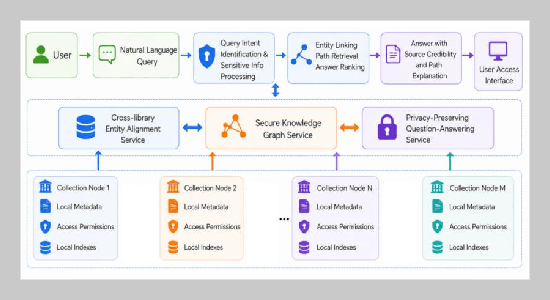
Overall system architecture of the proposed industrial knowledge service-oriented distributed digital library framework
Copyright The Author(s). This is an open access article distributed under the terms of the Creative Commons Attribution License (CC BY 4.0), which permits unrestricted use, distribution, and reproduction in any medium, provided the original author and source are cited.
Download Citation: BibTeX | http://dx.doi.org/10.6180/jase.202701_36.013
Industrial knowledge service-oriented distributed digital libraries integrate patents, standards, drawings, reports, and bibliographic records across nodes, facing collection fusion, entity redundancy, privacy leakage, and limited QA scalability. This study proposes a secure knowledge graph construction and privacy-preserving QA method combining metadata standardization, entity extraction, relation recognition, cross-library alignment, credibility-driven triple verification, graph partitioning, hotspot caching, parallel retrieval, and differential privacy ranking[cite: 108]. Evaluated at five scales, it reaches 94.2%/92.6%/94.5%/93.1% entity F1/relation F1/alignment accuracy/triple validity, and QA accuracy/F1/MRR/Hit@5 of 93.6%/92.1%/91.3%/95.2%. At 64 nodes, latency is 360 ms (vs. 950/1650 ms for Federated/Centralized KG-QA), with 1650 queries/s at 10,000 concurrent queries.
Keywords: Industrial knowledge service, distributed digital library, secure knowledge graph, privacy-preserving question answering, entity alignment, differential privacy
- [1] C. Chen, F. Zheng, J. Cui, Y. Cao, G. Liu, J. Wu, and J. Zhou, (2024) “Survey and Open Problems in Privacy-Preserving Knowledge Graph: Merging, Query, Representation, Completion, and Applications” International Journal of Machine Learning and Cybernetics 15(8): 3513-3532. DOI: https://doi.org/10.1007/s13042-024-02106-6.
- [2] N. Fanourakis, V. Efthymiou, D. Kotzinos, and V. Christophides, (2023) “Knowledge Graph Embedding Methods for Entity Alignment: An Experimental Review” Data Mining and Knowledge Discovery 37(5): 2070-2137. DOI: https://doi.org/10.1007/s10618-023-00941-9.
- [3] B. D. Trisedya, F. D. Salim, J. Chan, D. Spina, F. Scholer, and M. Sanderson, (2023) “i-Align: An Interpretable Knowledge Graph Alignment Model” Data Mining and Knowledge Discovery 37(6): 2494-2516. DOI: https://doi.org/10.1007/s10618-023-00963-3.
- [4] N. Ibrahim, S. Aboulela, A. Ibrahim, and R. Kashef, (2024) “A Survey on Augmenting Knowledge Graphs (KGs) with Large Language Models (LLMs): Models, Evaluation Metrics, Benchmarks, and Challenges” Discover Artificial Intelligence 4: DOI: https://doi.org/10.1007/s44163-024-00175-8.
- [5] X. Zhu, Z. Li, X. Wang, X. Jiang, P. Sun, X. Wang, Y. Xiao, and N. J. Yuan, (2024) “Multi-Modal Knowledge Graph Construction and Application: A Survey” IEEE Transactions on Knowledge and Data Engineering 36(2): 715-735. DOI: https://doi.org/10.1109/TKDE.2022.3224228.
- [6] Y. Lan, G. He, J. Jiang, J. Jiang, W. X. Zhao, and J.-R. Wen, (2023) “Complex Knowledge Base Question Answering: A Survey” IEEE Transactions on Knowledge and Data Engineering 35(11): 11196-11215. DOI: https://doi.org/10.1109/TKDE.2022.3223858.
- [7] S. Aghaei, E. Raad, and A. Fensel, (2022) “Question Answering over Knowledge Graphs: A Case Study in Tourism” IEEE Access 10: 69788-69801. DOI: https://doi.org/10.1109/ACCESS.2022.3187178.
- [8] Y. Song, W. Li, G. Dai, and X. Shang, (2023) “Advancements in Complex Knowledge Graph Question Answering: A Survey” Electronics 12(21): DOI: https://doi.org/10.3390/electronics12214395.
- [9] X. Chen, S. Jia, and Y. Xiang, (2020) “A Review: Knowledge Reasoning over Knowledge Graph” Expert Systems with Applications 141: DOI: https://doi.org/10.1016/j.eswa.2019.112948.
- [10] Q. Liu, Q. Zhang, F. Zhao, and G. Wang, (2024) “Uncertain Knowledge Graph Embedding: An Effective Method Combining Multi-Relation and Multi-Path” Frontiers of Computer Science 18: DOI: https://doi.org/10.1007/s11704-023-2427-z.
- [11] K. Shi, X. Cai, L. Yang, and J. Zhao, (2023) “Enriched Entity Representation of Knowledge Graph for Text Generation” Complex & Intelligent Systems 9: 2019-2030. DOI: https://doi.org/10.1007/s40747-022-00898-0.
- [12] T. Guo, Q. Yang, C. Wang, Y. Liu, P. Li, J. Tang, D. Li, and Y. Wen, (2024) “KnowledgeNavigator: Leveraging Large Language Models for Enhanced Reasoning over Knowledge Graph” Complex & Intelligent Systems 10(5): 7063-7076. DOI: https://doi.org/10.1007/s40747-024-01527-8.
- [13] A. Majeed and S. O. Hwang, (2024) “A Multifaceted Survey on Federated Learning: Fundamentals, Paradigm Shifts, Practical Issues, Recent Developments, Partnerships, Trade-Offs, Trustworthiness, and Ways Forward” IEEE Access 12: 84643-84679. DOI: https://doi.org/10.1109/ACCESS.2024.3413069.
- [14] X. Yin, Y. Zhu, and J. Hu, (2021) “A Comprehensive Survey of Privacy-Preserving Federated Learning: A Taxonomy, Review, and Future Directions” ACM Computing Surveys 54(6): DOI: https://doi.org/10.1145/3460427.
- [15] G. Beigi and H. Liu, (2020) “A Survey on Privacy in Social Media: Identification, Mitigation, and Applications” ACM Transactions on Data Science 1(1): DOI: https://doi.org/10.1145/3343038.