



Sella Yuniar Marlianti and Tavio
Department of Civil Engineering, Institut Teknologi Sepuluh Nopember, Surabaya 60111, Indonesia
Received: June 13, 2026
Accepted: September 03, 2026
Publication Date: October 09, 2026
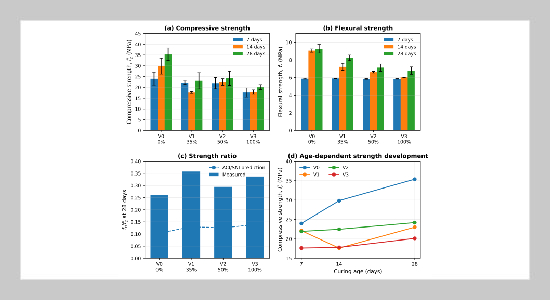
Multi-mechanical performance of reduced-density concrete with non-expanded clay-based ALWA.
Copyright The Author(s). This is an open access article distributed under the terms of the Creative Commons Attribution License (CC BY 4.0), which permits unrestricted use, distribution, and reproduction in any medium, provided the original author and source are cited.
Download Citation: BibTeX | http://dx.doi.org/10.6180/jase.202701_36.009
This study evaluates reduced-density concrete incorporating non-expanded sintered clay artificial lightweight aggregate (ALWA) produced with coconut fiber ash and rice husk ash. Four coarse-aggregate substitution levels of 0%, 35%, 50%, and 100% by volume were tested for unit weight, compressive strength, and flexural strength at 7, 14, and 28 days. The ALWA exhibited a specific gravity of 1.62 g/cm³ and water absorption of 27.49%, indicating a porous but mechanically viable aggregate. The 50% ALWA mixture achieved the best balance between density and mechanical performance, reaching 24.19 MPa compressive strength and 7.12 MPa flexural strength at 28 days, with a density of 2,210 kg/m³. All ALWA mixtures exceeded the 17.24 MPa compressive-strength criterion used in SNI 03-3449-2002, although their densities remained above the structural lightweight-concrete limit commonly adopted in ACI 213R-14. The measured modulus-of-rupture-to-compressive-strength ratios exceeded ACI 318-19 and SNI 2847:2019 predictions under the ASTM C293 center-point loading configuration used in this study. The results support 50% ALWA replacement as a resource-efficient reduced-density concrete option for applications requiring moderate self-weight reduction, subject to further durability and serviceability verification.
Keywords: Coconut fiber ash, Compressive strength, Flexural strength, Resource efficiency, Rice husk ash, Structural classification
- [1] P. K. Mehta and P. J. M. Monteiro, (2014) “Concrete: Microstructure, Properties, and Materials” 4th ed. McGraw-Hill Education, New York.
- [2] A. M. Neville, (2011) “Properties of Concrete” 5th ed. Pearson Education, Harlow.
- [3] ACI Committee 213, (2014) “Guide for Structural Lightweight-Aggregate Concrete (ACI 213R-14)” Tech. rep. American Concrete Institute, Farmington Hills, MI, USA.
- [4] S. K. Adhikary, D. K. Ashish, H. Sharma, J. Patel, Z. Rudžionis, M. Al-Ajamee, B. S. Thomas, and J. M. Khatib, (2022) “Lightweight self-compacting concrete: a review” Resources, Conservation and Recycling Advances 15: 200107. DOI: https://doi.org/10.1016/j.rcradv.2022.200107.
- [5] A. M. Rashad, (2018) “Lightweight expanded clay aggregate as a building material: an overview” Construction and Building Materials 170: 757-775. DOI: https://doi.org/10.1016/j.conbuildmat.2018.03.009.
- [6] D. L. C. Hao, R. A. Razak, M. Kheimi, Z. Yahya, M. M. A. B. Abdullah, D. D. B. Nergis, H. Fansuri, R. Ediati, R. Mohamed, and A. Abdullah, (2022) “Artificial lightweight aggregates made from pozzolanic material: a review on the method, physical and mechanical properties, thermal and microstructure” Materials 15(11): 3929. DOI: https://doi.org/10.3390/ma15113929.
- [7] J. X. Lu, (2023) “Recent advances in high-strength lightweight concrete: from development strategies to practical applications” Construction and Building Materials 400: 132905. DOI: https://doi.org/10.1016/j.conbuildmat.2023.132905.
- [8] R. Vijayalakshmi and S. Ramanagopal, (2018) “Structural concrete using expanded clay aggregate: a review” Indian Journal of Science and Technology 11(16): 1-12. DOI: https://doi.org/10.17485/ijst/2018/v11i16/121888.
- [9] M. Bernhardt, H. Tellesbø, H. Justnes, and K. Wiik, (2013) “Mechanical properties of lightweight aggregates” Journal of the European Ceramic Society 33(13-14): 2731-2743. DOI: https://doi.org/10.1016/j.jeurceramsoc.2013.05.013.
- [10] G. B. Bekkeri, K. K. Shetty, and G. S. Nayak, (2023) “Synthesis of artificial aggregates and their impact on performance of concrete: a review” Journal of Material Cycles and Waste Management 25: 1988-2011. DOI: https://doi.org/10.1007/s10163-023-01713-9.
- [11] M. Bernhardt, H. Justnes, H. Tellesbø, and K. Wiik, (2014) “The effect of additives on the properties of lightweight aggregates produced from clay” Cement and Concrete Composites 53: 233-238. DOI: https://doi.org/10.1016/j.cemconcomp.2014.07.005.
- [12] H. H. Ahmad and Tavio, (2018) “Experimental study of cold-bonded artificial lightweight aggregate concrete” AIP Conference Proceedings 1977: 030011. DOI: https://doi.org/10.1063/1.5042931.
- [13] F. D. Aryani, Tavio, I. G. P. Raka, and Puryanto, (2018) “The influence of OPC and PPC on compressive strength of ALWA concrete” MATEC Web of Conferences 195: 01021. DOI: https://doi.org/10.1051/matecconf/201819501021.
- [14] D. H. Darayani, Tavio, I. G. P. Raka, and Puryanto, (2018) “The effect of styrofoam artificial lightweight aggregate (ALWA) on compressive strength of self-compacting concrete (SCC)” Civil Engineering Journal 4(9): 2111-2123. DOI: https://doi.org/10.28991/cej-03091143.
- [15] M. Wulandari, Tavio, I. G. P. Raka, and Puryanto, (2018) “Compressive strength of steel-fiber concrete with artificial lightweight aggregate (ALWA)” Civil Engineering Journal 4(9): 2011-2022. DOI: https://doi.org/10.28991/cej-03091134.
- [16] M. Wulandari, M. F. Sofianto, and Tavio, (2020) “Split tensile and flexural strength of concrete with artificial lightweight aggregate (ALWA) and steel-fiber” Journal of Physics: Conference Series 1569(4): 042025. DOI: https://doi.org/10.1088/1742-6596/1569/4/042025.
- [17] F. Hussain, F. Rehman, R. A. Khushnood, S. A. Khan, and A. Hamza, (2023) “Study of physical and mechanical behavior of artificial lightweight aggregate made of Pakistani clays” Construction and Building Materials 378: 131103. DOI: https://doi.org/10.1016/j.conbuildmat.2023.131103.
- [18] J. Latośińska, M. Žygadło, and P. Czapik, (2021) “The influence of sewage sludge content and sintering temperature on selected properties of lightweight expanded clay aggregate” Materials 14(12): 3363. DOI: https://doi.org/10.3390/ma14123363.
- [19] ACI Committee 318, (2019) “Building Code Requirements for Structural Concrete (ACI 318-19) and Commentary” Tech. rep. American Concrete Institute, Farmington Hills, MI, USA. DOI: https://doi.org/10.14359/51716937.
- [20] Badan Standardisasi Nasional, (2019) “SNI 2847:2019: Structural Concrete Requirements for Buildings” Tech. rep. BSN, Jakarta, Indonesia.
- [21] Badan Standardisasi Nasional, (2002) “SNI 03-3449-2002: Procedure for Mix Design of Lightweight Concrete” Tech. rep. BSN, Jakarta, Indonesia.
- [22] N. U. Kockal and T. Ozturan, (2011) “Strength and elastic properties of structural lightweight concretes” Materials and Design 32(4): 2396-2403. DOI: https://doi.org/10.1016/j.matdes.2010.12.053.
- [23] B. González-Corrochano, J. Alonso-Azcárate, and M. Rodas, (2009) “Characterization of lightweight aggregates manufactured from washing aggregate sludge and fly ash” Resources, Conservation and Recycling 53(10): 571-581. DOI: https://doi.org/10.1016/j.resconrec.2009.04.008.
- [24] S. Islam, G. Ara, U. S. Akhtar, M. G. Mostafa, I. Haque, Z. M. Shuva, and A. Samad, (2024) “Development of lightweight structural concrete with artificial aggregate manufactured from local clay and solid waste materials” Heliyon 10(15): e34887. DOI: https://doi.org/10.1016/j.heliyon.2024.e34887.
- [25] Y. C. Lim, C. F. Chen, C. W. Chen, and C. D. Dong, (2023) “Development of alternative disposals for waste rice husk and dredged harbor sediment by sintering as lightweight aggregates” Environmental Technology 44(19): 2864-2875. DOI: https://doi.org/10.1080/09593330.2022.2046647.
- [26] J. A. Bogas, A. Gomes, and M. F. C. Pereira, (2012) “Self-compacting lightweight concrete produced with expanded clay aggregate” Construction and Building Materials 35: 1013-1022. DOI: https://doi.org/10.1016/j.conbuildmat.2012.04.111.
- [27] C. R. Cheeseman and G. S. Virdi, (2005) “Properties and microstructure of lightweight aggregate produced from sintered sewage sludge ash” Resources, Conservation and Recycling 45(1): 18-30. DOI: https://doi.org/10.1016/j.resconrec.2004.12.006.
- [28] Badan Standardisasi Nasional, (2020) “SNI 2049-1:2020: Portland Cement – Part 1: Specifications” Tech. rep. BSN, Jakarta, Indonesia.
- [29] Badan Standardisasi Nasional, (2022) “SNI 1972:2022: Test Method for Slump of Hydraulic-Cement Concrete” Tech. rep. BSN, Jakarta, Indonesia.
- [30] Badan Standardisasi Nasional, (2011) “SNI 1974:2011: Test Method for Compressive Strength of Concrete Using Cylindrical Specimens” Tech. rep. BSN, Jakarta, Indonesia.
- [31] ASTM International, (2016) “ASTM C293/C293M-16: Standard Test Method for Flexural Strength of Concrete (Using Simple Beam with Center-Point Loading)” Tech. rep. ASTM International, West Conshohocken, PA, USA. DOI: https://doi.org/10.1520/C0293_C0293M-16.
- [32] ASTM International, (2021) “ASTM E178-21: Standard Practice for Dealing with Outlying Observations” Tech. rep. ASTM International, West Conshohocken, PA, USA. DOI: https://doi.org/10.1520/E0178-21.
- [33] Y. O. Özkılıç, A. N. Beskopylny, S. A. Stel’makh, E. M. Shcherban’, L. R. Mailyan, B. Meskhi, A. Chernil’nik, O. Ananova, C. Aksoylu, and E. Madenci, (2023) “Lightweight expanded-clay fiber concrete with improved characteristics reinforced with short natural fibers” Case Studies in Construction Materials 19: e02367. DOI: https://doi.org/10.1016/j.cscm.2023.e02367.
- [34] J. Wang, K. Zheng, N. Cui, X. Cheng, K. Ren, P. Hou, L. Feng, Z. Zhou, and N. Xie, (2020) “Green and durable lightweight aggregate concrete: the role of waste and recycled materials” Materials 13(13): 3041. DOI: https://doi.org/10.3390/ma13133041.
- [35] T. Y. Lo and H. Z. Cui, (2004) “Effect of porous lightweight aggregate on strength of concrete” Materials Letters 58(6): 916-919. DOI: https://doi.org/10.1016/j.matlet.2003.07.036.
- [36] H. Z. Cui, T. Y. Lo, S. A. Memon, and W. Xu, (2012) “Effect of lightweight aggregates on the mechanical properties and brittleness of lightweight aggregate concrete” Construction and Building Materials 35: 149-158. DOI: https://doi.org/10.1016/j.conbuildmat.2012.02.053.
- [37] M. C. Stratoura, G.-E. D. Lazari, E. G. Badogiannis, and V. G. Papadakis, (2023) “Perlite and rice husk ash reuse as fine aggregates in lightweight aggregate structural concrete: durability assessment” Sustainability 15(5): 4217. DOI: https://doi.org/10.3390/su15054217.
- [38] T. M. Grabois, G. C. Cordeiro, and R. D. Toledo Filho, (2016) “Fresh and hardened-state properties of self-compacting lightweight concrete reinforced with steel fibers” Construction and Building Materials 104: 284-292. DOI: https://doi.org/10.1016/j.conbuildmat.2015.12.060.