





V Rajini1, V. S. Nagarajan2, Bharatiraja .C3, Krtin Narayanan1, and N Christina Lydia Grace1
1Department of Electrical and Electronics Engineering, Sri Sivasubramaniya Nadar College of Engineering, Chennai, Kalavakkam, Tamil Nadu, 603110, India
2Department of Electrical and Electronics Engineering, SSN School of Engineering, Shiv Nadar University Chennai, Kalavakkam, Tamil Nadu, 603110, India
3Centre for Electric Mobility, SRM Institute of Science and Technology, SRM Nagar, Kattankulathur, 603203, Chengalpattu, Chennai, TN, India
Received: May 30, 2026
Accepted: August 24, 2026
Publication Date: October 09, 2026
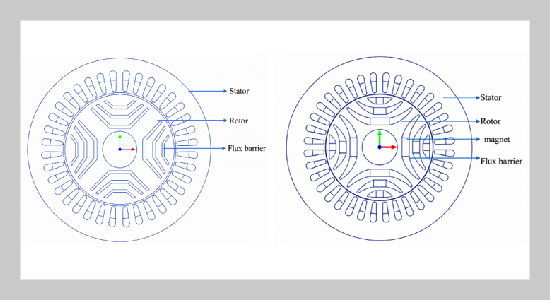
Schematic of Syn RM and PmaSynRM
Copyright The Author(s). This is an open access article distributed under the terms of the Creative Commons Attribution License (CC BY 4.0), which permits unrestricted use, distribution, and reproduction in any medium, provided the original author and source are cited.
Download Citation: BibTeX | http://dx.doi.org/10.6180/jase.202701_36.008
Synchronous Reluctance Motor (SynRM), Permanent-Magnet-assisted Synchronous Reluctance Motor (PMa-SynRM), and Ferrite-Assisted Synchronous Reluctance (FASR) motor topologies have emerged as promising alternatives for high efficiency electric drive applications due to their reduced rotor losses, robust construction, and potential for reduced dependence on rare earth materials. However, torque ripple remains a major performance limitation in these machines, leading to vibration, acoustic noise, speed pulsation and reduced drive quality. This paper presents a comprehensive review of torque ripple mitigation techniques reported in the literature for three major reluctance based synchronous machine variants: pure SynRM, PMa-SynRM, and FASR machines. The reviewed techniques include rotor flux barrier number and geometry optimization, barrier shape refinement, rib and bridge design, permanent magnet placement and shaping, ferrite magnet arrangement, rotor skewing and step skewing, stator slot/pole and winding configuration optimization and control based harmonic current injection. The review highlights the relative effectiveness, practical constraints and performance trade offs of these methods with respect to average torque, efficiency, power factor, demagnetization risk, manufacturability and mechanical integrity. By consolidating the available literature, this paper aims to provide a structured understanding of torque ripple reduction strategies and to identify suitable design and control approaches for achieving smoother torque production in SynRM, PMa-SynRM, and FASR motor drives.
Keywords: Ferrite Assisted Synchronous Reluctance (FASR), Finite Element Analysis (FEA), Permanent Magnet assisted Synchronous Reluctance (PMa-SynRM), Rotor step skew, Slot/pole selection, Synchronous Reluctance Motor (SynRM), Torque ripple
- [1] N. Bianchi, S. Bolognani, E. Carraro, M. Castiello, and E. Fornasiero, (2016) “Electric Vehicle Traction Based on Synchronous Reluctance Motors” IEEE Transactions on Industry Applications 52(6): 4762-4769. DOI: https://doi.org/10.1109/TIA.2016.2599850.
- [2] V. S. Nagarajan, (2018) “Design Optimization and Analysis of Ferrite Assisted Synchronous Reluctance Motor” (PhD dissertation). Anna University.
- [3] N. Bianchi, S. Bolognani, D. Bon, and M. Dai Pré, (2009) “Rotor Flux-Barrier Design for Torque Ripple Reduction in Synchronous Reluctance and PM-Assisted Synchronous Reluctance Motors” IEEE Transactions on Industry Applications 45(3): 921-928. DOI: https://doi.org/10.1109/TIA.2009.2018960.
- [4] N. Bianchi, M. Degano, and E. Fornasiero, (2015) “Sensitivity Analysis of Torque Ripple Reduction of Synchronous Reluctance and Interior PM Motors” IEEE Transactions on Industry Applications 51(1): 187-195. DOI: https://doi.org/10.1109/TIA.2014.2327143.
- [5] H. Cai, B. Guan, and L. Xu, (2014) “Low-Cost Ferrite PM-Assisted Synchronous Reluctance Machine for Electric Vehicles” IEEE Transactions on Industrial Electronics 61(10): 5741-5748. DOI: https://doi.org/10.1109/TIE.2014.2304702.
- [6] S. M. Taghavi Araghi, A. Kiyoumarsi, and B. Mirzaeian Dehkordi, (2023) “Synchronous Reluctance Machines with New Type of Fractional-Slot Concentrated-Windings Based on the Concept of Stator Slot Shifting” IET Electric Power Applications 17(1): 92-108. DOI: https://doi.org/10.1049/elp2.12248.
- [7] L. Yan, Y. Liao, H. Lin, and J. Sun, (2019) “Torque Ripple Suppression of Permanent Magnet Synchronous Machines by Minimal Harmonic Current Injection” IET Power Electronics 12(6): 1368-1375. DOI: https://doi.org/10.1049/iet-pel.2018.5647.
- [8] C. Jedryczka, M. Mysinski, and W. Szelag, (2024) “Development and Analysis of Six-Phase Synchronous Reluctance Motor for Increased Fault Tolerance Capabilities” Energies 17(10): 2351. DOI: https://doi.org/10.3390/en17102351.
- [9] S. Yammine, C. Hénaux, M. Fadel, and F. Messine, (2018) “Torque Ripple Reduction in a SynRM at a Constant Average Torque by Means of Current Harmonics Injection” Progress In Electromagnetics Research C 80: 167-180. DOI: https://doi.org/10.2528/PIERC17101801.
- [10] J.-C. Park, J.-H. Kim, S.-H. Park, K.-O. Kim, M.-H. Sung, and M.-S. Lim, (2023) “Design Optimization Using Asymmetric Rotor in IPMSM for Torque Ripple Reduction Considering Forward and Reverse Directions” IEEE Transactions on Magnetics 59(11): 8205805. DOI: https://doi.org/10.1109/TMAG.2023.3292295.
- [11] C. Gallardo, C. Madariaga, J. A. Tapia, and M. Degano, (2023) “A Method to Determine the Torque Ripple Harmonic Reduction in Skewed Synchronous Reluctance Machines” Applied Sciences 13(5): 2949. DOI: https://doi.org/10.3390/app13052949.