





Lianfei Zhao1, Fulong Ji2, and Yongmao Zhao3
1State Grid Jilin Electric Power Co., Ltd., Changchun 130022, Jilin, China
2State Grid Location Based Service Co., Ltd., Beijing 102211, Beijing, China
3Beijing Sinan Beidou Technology Development Co., Ltd., Beijing 100029, Beijing, China
Received: July 22, 2026
Accepted: August 19, 2026
Publication Date: September 27, 2026
Anti-Interference And Secure Communication For Distributed Power Line Inspection Networks Based On The BeiDou Short Message Service
Copyright The Author(s). This is an open access article distributed under the terms of the Creative Commons Attribution License (CC BY 4.0), which permits unrestricted use, distribution, and reproduction in any medium, provided the original author and source are cited.
Download Citation: BibTeX | http://dx.doi.org/10.6180/jase.202701_36.001
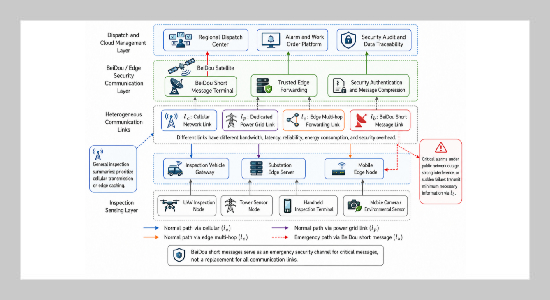
Distributed power line inspection networks in mountainous areas and post-disaster sites often suffer from link outages, high-power interference, queue congestion, and false alarms due to weak public-network coverage, making critical alarm delivery unreliable. We propose BD-SASC, jointly modeling cellular, dedicated power, edge multi-hop, and BeiDou short-message links, evaluating latency, interference, reliability, security risk, and trustworthiness for adaptive link selection, with priority-based scheduling, field compression, lightweight authentication, and trusted edge forwarding ensuring prioritized P1 alarm delivery. With 500 nodes and 10% malicious nodes, BD-SASC maintains 91.6% secure delivery under strong interference (vs. 61.8% Cellular-only, 78.4% Fixed-BDS, 71.4% Encryption-only), reduces average P1 latency to 4.31s under burst alarms (vs. 12.46s/8.92s baselines), and maintains 92.4% delivery at 1000 nodes.
Keywords: BeiDou short-message service, distributed power line inspection, anti-interference communication, security authentication, power IoT, scalable information system
- [1] G. Li, S. Guo, J. Lv, K. Zhao, and Z. He, (2021) “Introduction to Global Short-Message Communication Service of BeiDou-3 Navigation Satellite System” Advances in Space Research 67(5): 1701-1708. DOI: [https://doi.org/10.1016/j.asr.2020.12.011](https://doi.org/10.1016/j.asr.2020.12.011).
- [2] C. Xu, S. Sun, Y. Zhou, and Z. Ding, (2024) “Research on a Vehicle-Mounted Emergency Communication System Using BeiDou Regional Short Message Communication (RSMC) for Firefighting Operations in Forest Areas Without a Public Network” Forests 15(7): 1185. DOI: [https://doi.org/10.3390/f15071185](https://doi.org/10.3390/f15071185).
- [3] C. Li, P. Liu, S. Fu, Y. Jiao, and W. Zhang, (2023) “Requirement-Oriented TT&C Method for Satellite Based on BDS-3 Short-Message Communication System” Space: Science & Technology 3: 0038. DOI: [https://doi.org/10.34133/space.0038](https://doi.org/10.34133/space.0038).
- [4] M. Centenaro, C. E. Costa, F. Granelli, C. Sacchi, and L. Vangelista, (2021) “A Survey on Technologies, Standards and Open Challenges in Satellite IoT” IEEE Communications Surveys & Tutorials 23(3): 1693-1720. DOI: [https://doi.org/10.1109/COMST.2021.3078433](https://doi.org/10.1109/COMST.2021.3078433).
- [5] X. Chen, Z. Xu, and L. Shang, (2023) “Satellite Internet of Things: Challenges, Solutions, and Development Trends” Frontiers of Information Technology & Electronic Engineering 24(7): 935-944. DOI: [https://doi.org/10.1631/FITEE.2200648](https://doi.org/10.1631/FITEE.2200648).
- [6] X. Zhu and C. Jiang, (2022) “Integrated Satellite-Terrestrial Networks Toward 6G: Architectures, Applications, and Challenges” IEEE Internet of Things Journal 9(1): 437-461. DOI: [https://doi.org/10.1109/JIOT.2021.3126825](https://doi.org/10.1109/JIOT.2021.3126825).
- [7] H. Guo, J. Li, J. Liu, N. Tian, and N. Kato, (2022) “A Survey on Space-Air-Ground-Sea Integrated Network Security in 6G” IEEE Communications Surveys & Tutorials 24(1): 53-87. DOI: [https://doi.org/10.1109/COMST.2021.3131332](https://doi.org/10.1109/COMST.2021.3131332).
- [8] Y. Wang, Z. Su, J. Ni, N. Zhang, and X. Shen, (2022) “Blockchain-Empowered Space-Air-Ground Integrated Networks: Opportunities, Challenges, and Solutions” IEEE Communications Surveys & Tutorials 24(1): 160-209. DOI: [https://doi.org/10.1109/COMST.2021.3131711](https://doi.org/10.1109/COMST.2021.3131711).
- [9] P. Tedeschi, S. Sciancalepore, and R. Di Pietro, (2022) “Satellite-Based Communications Security: A Survey of Threats, Solutions, and Research Challenges” Computer Networks 216: 109246. DOI: [https://doi.org/10.1016/j.comnet.2022.109246](https://doi.org/10.1016/j.comnet.2022.109246).
- [10] A. Pourranjbar, G. Kaddoum, F. Ferdowsi, and W. Saad, (2021) “Reinforcement Learning for Deceiving Reactive Jammers in Wireless Networks” IEEE Transactions on Communications 69(6): 3682-3697. DOI: [https://doi.org/10.1109/TCOMM.2021.3062854](https://doi.org/10.1109/TCOMM.2021.3062854).
- [11] M. Letafati, A. Kuhestani, K.-K. Wong, and M. J. Piran, (2021) “A Lightweight Secure and Resilient Transmission Scheme for the Internet of Things in the Presence of a Hostile Jammer” IEEE Internet of Things Journal 8(6): 4373-4388. DOI: [https://doi.org/10.1109/JIOT.2020.3026475](https://doi.org/10.1109/JIOT.2020.3026475).
- [12] J. Zhang, Y. Ye, C. Hu, and B. Li, (2021) “Architecture Design and Demand Analysis on Application Layer of Standard System for Ubiquitous Power Internet of Things” Global Energy Interconnection 4(3): 304-314. DOI: [https://doi.org/10.1016/j.gloei.2021.07.001](https://doi.org/10.1016/j.gloei.2021.07.001).
- [13] Z. Alavikia and M. Shabro, (2022) “A Comprehensive Layered Approach for Implementing Internet of Things-Enabled Smart Grid: A Survey” Digital Communications and Networks 8(3): 388-410. DOI: [https://doi.org/10.1016/j.dcan.2022.01.002](https://doi.org/10.1016/j.dcan.2022.01.002).