




Received: January 28, 2026
Accepted: June 19, 2026
Publication Date: September 25, 2026
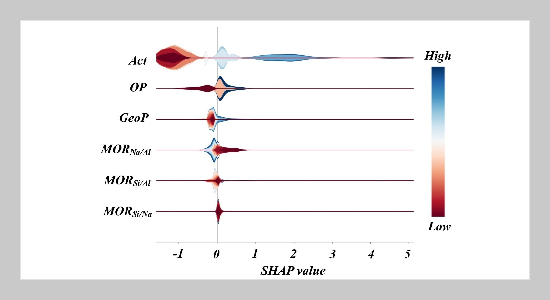
The impact of each attribute on the target using SHAP analysis
Copyright The Author(s). This is an open access article distributed under the terms of the Creative Commons Attribution License (CC BY 4.0), which permits unrestricted use, distribution, and reproduction in any medium, provided the original author and source are cited.
Download Citation: BibTeX | http://dx.doi.org/10.6180/jase.202612_35.069
This study investigates the capability of machine learning (ML) techniques to predict the unconfined compressive strength (UCS) of sandy soil composite grains stabilized with natural pozzolanic geopolymer. Geopolymer stabilization is employed to boost the performance of soils with fundamentally feeble mechanical qualities for engineering applications. An Extremely Randomized Trees (ERT) model is developed using a comprehensive dataset compiled from existing literature. To improve model performance, key hyperparameters are optimized using metaheuristic algorithms, namely Artificial Protozoa (AP) and Coati (Co) optimization techniques. The models are trained and evaluated based on multiple input variables influencing UCS. The results indicate that both optimized ERT models provide reliable and accurate predictions, with the AP-based approach demonstrating comparatively superior performance. Overall, the findings highlight the effectiveness of integrating ML models with metaheuristic optimization for predicting the strength characteristics of geopolymer-stabilized soils.
Keywords: Composite materials; Pozzolanic geopolymer; Unconfined compressive strength; ML; ERT
- [1] S. A. Hoor and M. Esmaeili-Falak, (2025) “Innovative approaches for mitigating soil liquefaction: a state-of-the-art review of techniques and bibliometric analysis” Indian Geotechnical Journal 55: 3460-3487. DOI: 10.1007/s40098-024-01120-3.
- [2] X. Jiang, D. Lu, B. Yin, and Z. Leng, (2024) “Advancing carbon nanomaterials-engineered self-sensing cement composites for structural health monitoring: A state-of-the-art review” Journal of Building Engineering 87: 109129. DOI: 10.1016/j.jobe.2024.109129.
- [3] M. Zhang, H. Guo, T. El-Korchi, G. Zhang, and M. Tao, (2013) “Experimental feasibility study of geopolymer as the next-generation soil stabilizer” Construction and building materials 47: 1468-1478. DOI: 10.1016/j.conbuildmat.2013.06.017.
- [4] X. Jiang, H. Zhu, Z. Yan, F. Zhang, F. Ye, P. Li, X. Zhang, Z. Dai, Y. Bai, and B. Huang, (2023) “A state-of-art review on development and progress of backfill grouting materials for shield tunneling” Developments in the Built Environment 16: 100250. DOI: 10.1016/j.dibe.2023.100250.
- [5] Q. Zhao, C. Ma, B. Huang, and X. Lu, (2023) “Development of alkali activated cementitious material from sewage sludge ash: Two-part and one-part geopolymer” Journal of Cleaner Production 384: 135547. DOI: 10.1016/j.jclepro.2022.135547.
- [6] Y. Min, M. Gao, C. Yao, J. Wu, and X. Wei, (2023) “On the use of one-part geopolymer activated by solid sodium silicate in soft clay stabilization” Construction and Building Materials 402: 132957. DOI: 10.1016/j.conbuildmat.2023.132957.
- [7] X. Zheng and J. Wu, (2021) “Early strength development of soft clay stabilized by one-part ground granulated blast furnace slag and fly ash-based geopolymer” Frontiers in Materials 8: 616430. DOI: 10.3389/fmats.2021.616430.
- [8] H. Kou, J. Quan, S. Guo, and E. Hassankhani, (2024) “Light and normal weight concretes shear strength estimation using tree-based tunned frameworks” Construction and Building Materials 452: 138955. DOI: 10.1016/j.conbuildmat.2024.138955.
- [9] R. Liang and B. Bayrami, (2023) “Estimation of frost durability of recycled aggregate concrete by hybridized Random Forests algorithms” Steel & Composite structures: an international journal 49: 91-107. DOI: 10.12989/scs.2023.49.1.091.
- [10] K. Zhang, Y. Zhang, and B. Razzaghzadeh, (2024) “Application of the optimal fuzzy-based system on bearing capacity of concrete pile” Steel & Composite structures: an international journal 51: 25-41. DOI: 10.12989/scs.2024.51.1.025.
- [11] M. Esmaeili-Falak and A. Letafat, (2025) “Prediction of unconfined compressive strength in pozzolanic geopolymer-stabilized granular materials using tree-based models” Transportation Infrastructure Geotechnology 12: 247. DOI: 10.1007/s40515-025-00701-w.
- [12] T. Oey, S. Jones, J. W. Bullard, and G. Sant, (2020) “Machine learning can predict setting behavior and strength evolution of hydrating cement systems” Journal of the American Ceramic Society 103: 480-490. DOI: 10.1111/jace.16706.
- [13] W. B. Chaabene, M. Flah, and M. L. Nehdi, (2020) “Machine learning prediction of mechanical properties of concrete: Critical review” Construction and Building Materials 260: 119889. DOI: 10.1016/j.conbuildmat.2020.119889.
- [14] X. Sun, X. Dong, W. Teng, L. Wang, and E. Hassankhani, (2024) “Creation of regression analysis for estimation of carbon fiber reinforced polymer-steel bond strength” Steel & Composite structures: an international journal 51: 509-527. DOI: 10.12989/scs.2024.51.5.509.
- [15] M. S. Borchelooei and M. Esmaeili-Falak, (2026) “Predicting water absorption in hardened concrete using machine learning: a comparative analysis of XGBoost optimization methods” International Journal of Pavement Research and Technology: 1-20. DOI: 10.1007/s42947-026-00707-8.
- [16] M. Monjezi, H. A. Khoshalan, and A. Y. Varjani, (2012) “Prediction of flyrock and backbreak in open pit blasting operation: a neuro-genetic approach” Arabian Journal of Geosciences 5: 441-448. DOI: 10.1007/s12517-010-0185-3.
- [17] M. Esmaeili-Falak, H. Katebi, M. Vadiati, and J. Adamowski, (2019) “Predicting triaxial compressive strength and Young’s modulus of frozen sand using artificial intelligence methods” Journal of Cold Regions Engineering 33: 04019007. DOI: 10.1061/(ASCE)CR.1943-5495.0000188.
- [18] K. Li, Y. Long, H. Wang, and Y.-F. Wang, (2021) “Modeling and sensitivity analysis of concrete creep with machine learning methods” Journal of Materials in Civil Engineering 33: 04021206. DOI: 10.1061/(ASCE)MT.1943-5533.0003843.
- [19] J. Feng, H. Zhang, K. Gao, Y. Liao, J. Yang, and G. Wu, (2022) “A machine learning and game theory-based approach for predicting creep behavior of recycled aggregate concrete” Case Studies in Construction Materials 17: e01653. DOI: 10.1016/j.cscm.2022.e01653.
- [20] J. Huang, T. Duan, Y. Zhang, J. Liu, J. Zhang, and Y. Lei, (2020) “Predicting the permeability of pervious concrete based on the beetle antennae search algorithm and random forest model” Advances in Civil Engineering 2020: 8863181. DOI: 10.1155/2020/8863181.
- [21] X. Jiang, H. Zhu, Z. Yan, F. Zhang, X. Huang, Z. Leng, C. Yan, N. Hua, D. Lu, and X. Zhang, (2025) “Fire-Retarding Asphalt Pavement for Urban Road Tunnels: A State-of-the-Art Review and Beyond” Fire Technology 61: 2737-2777. DOI: 10.1007/s10694-024-01556-2.
- [22] Y. Dawei, Z. Bing, G. Bingbing, G. Xibo, and B. Razzaghzadeh, (2023) “Predicting the CPT-based pile set-up parameters using HHO-RF and PSO-RF hybrid models” Structural engineering and mechanics: An international journal 86: 673-686. DOI: 10.12989/sem.2023.86.5.673.
- [23] M. Esmaeili-Falak and B. Sojoudi, (2026) “Enhancing dimensional stability in cement pastes: a machine learning approach with metaheuristic-optimized categorical boosting” Multiscale and Multidisciplinary Modeling, Experiments and Design 9: 94. DOI: 10.1007/s41939-026-01183-0.
- [24] B. Razzaghzadeh, (2025) “Data-driven forecasting of plastic viscosity in stressed fresh concrete using metaheuristic boosted XGBoost models” Novel Approaches in Civil and Geotechnical Engineering 1: 69-84.
- [25] A. Ahmad, W. Ahmad, K. Chaiyasarn, K. A. Ostrowski, F. Aslam, P. Zajdel, and P. Joyklad, (2021) “Prediction of geopolymer concrete compressive strength using novel machine learning algorithms” Polymers 13: 3389. DOI: 10.3390/polym13193389.
- [26] Q. Wang, W. Ahmad, A. Ahmad, F. Aslam, A. Mohamed, and N. I. Vatin, (2022) “Application of soft computing techniques to predict the strength of geopolymer composites” Polymers 14: 1074. DOI: 10.3390/polym14061074.
- [27] F. da Silveira Maranhão, F. G. de Souza Junior, P. Soares, H. G. Alcan, O. Çelebi, B. Bayrak, G. Kaplan, and A. C. Aydın, (2023) “Physico-mechanical and microstructural properties of waste geopolymer powder and lime-added semi-lightweight geopolymer concrete: Efficient machine learning models” Journal of Building Engineering 72: 106629. DOI: 10.1016/j.jobe.2023.106629.
- [28] M. N. Uddin, J. Ye, M. A. Haque, K. Yu, and L. Li, (2024) “A novel compressive strength estimation approach for 3D printed fiber-reinforced concrete: integrating machine learning and gene expression programming” Multiscale and Multidisciplinary Modeling, Experiments and Design 7: 4889-4910.
- [29] Z. Kurt, Y. Yilmaz, T. Cakmak, and L. Ustabaş, (2023) “A novel framework for strength prediction of geopolymer mortar: Renovative precursor effect” Journal of Building Engineering 76: 107041. DOI: 10.1016/j.jobe.2023.107041.
- [30] G. Ma, A. Cui, Y. Huang, and W. Dong, (2022) “A data-driven influential factor analysis method for fly ash-based geopolymer using optimized machine-learning algorithms” Journal of Materials in Civil Engineering 34: 04022132. DOI: 10.1061/(ASCE)MT.1943-5533.0004266.
- [31] W. Ahmad, S. H. Farooq, M. Usman, M. Khan, A. Ahmad, F. Aslam, R. A. Yousef, H. A. Abduljabbar, and M. Sufian, (2020) “Effect of coconut fiber length and content on properties of high strength concrete” Materials 13: 1075. DOI: 10.3390/ma13051075.
- [32] C. Rudin, (2019) “Stop explaining black box machine learning models for high stakes decisions and use interpretable models instead” Nature machine intelligence 1: 206-215. DOI: 10.1038/s42256-019-0048-x.
- [33] X. Ke and Y. Duan, (2021) “Coupling machine learning with thermodynamic modelling to develop a composition-property model for alkali-activated materials” Composites Part B: Engineering 216: 108801. DOI: 10.1016/j.compositesb.2021.108801.
- [34] S. Soleimani, S. Rajaei, P. Jiao, A. Sabz, and S. Soheilinia, (2018) “New prediction models for unconfined compressive strength of geopolymer stabilized soil using multi-gen genetic programming” Measurement 113: 99-107. DOI: 10.1016/j.measurement.2017.08.043.
- [35] R. Islam and M. A. Hossain, (2024) “Unconfined compressive strength prediction of rocks using a novel hybrid machine learning algorithm” Advances in Engineering and Intelligence Systems 3: 82-94.
- [36] L. Davies and D. Jánošík, (2024) “Enhanced prediction of California bearing ratio (CBR) values in geotechnical engineering using decision tree algorithm and meta-heuristic optimizations” Journal of Artificial Intelligence and System Modelling 2: 29-44. DOI: 10.22034/jaism.2024.444025.1025.
- [37] A. Graham and E. Scott, (2024) “A comparative study of hybrid adaptive neuro-fuzzy inference systems to predict the unconfined compressive strength of rocks” Advances in Engineering and Intelligence Systems 3: 1-17. DOI: 10.1186/s44147-024-00574-9.
- [38] N. A.-H. K. Hussein, S. Khalaf, and K. D. Shah, (2024) “Advanced composite materials for sustainable construction: innovations in civil engineering applications” Khwarizmia 2024: 8-16. DOI: 10.70470/KHWARIZMIA/2024/003.
- [39] M. Bojdi, M. M. Toufigh, and V. Toufigh, (2024) “Estimation of unconfined compressive strength of stabilized sandy soil with Natural pozzolanic geopolymer using artificial neural networks algorithm”: DOI: 10.21203/rs.3.rs-4406446/v1.
- [40] X. Wang, V. Snášel, S. Mirjalili, J.-S. Pan, L. Kong, and H. A. Shehadeh, (2024) “Artificial Protozoa Optimizer (APO): A novel bio-inspired metaheuristic algorithm for engineering optimization” Knowledge-based systems 295: 111737. DOI: 10.1016/j.knosys.2024.111737.
- [41] M. Dehghani, Z. Montazeri, E. Trojovská, and P. Trojovský, (2023) “Coati Optimization Algorithm: A new bio-inspired metaheuristic algorithm for solving optimization problems” Knowledge-based systems 259: 110011. DOI: 10.1016/j.knosys.2022.110011.