



Received: July 26, 2026
Accepted: September 5, 2026
Publication Date: September 25, 2026
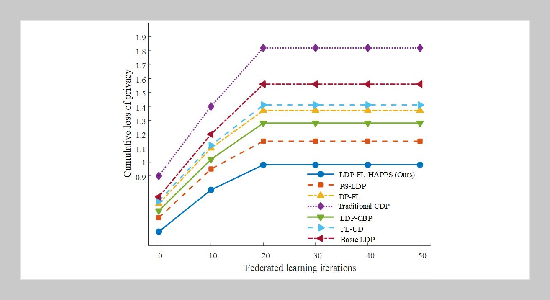
Privacy loss curves for each strategy
Copyright The Author(s). This is an open access article distributed under the terms of the Creative Commons Attribution License (CC BY 4.0), which permits unrestricted use, distribution, and reproduction in any medium, provided the original author and source are cited.
Download Citation: BibTeX | http://dx.doi.org/10.6180/jase.202612_35.060
To address the core challenge of synergistically optimizing privacy protection, data utility, system real-time performance, and privacy budget utilization efficiency in multi-sensor interaction scenarios of smart museums, this paper proposes a hierarchical adaptive privacy protection strategy that integrates local differential privacy and federated learning (abbreviated as: LDP-FL-HAPPS). This method employs a multi-sensor data hierarchical model to classify collected data into core privacy-level and general privacy-level categories, achieving differentiated privacy protection. A dynamic LDP perturbation mechanism is used to adjust noise intensity in real time based on data sensitivity, minimizing data distortion while ensuring privacy. A privacy-aware federated fusion algorithm is designed to optimize the accuracy and transmission efficiency of multi-sensor data fusion, which can enhance data visualization effectiveness. A hierarchical adaptive budget allocation strategy is introduced, combining data privacy levels with feature correlation to achieve efficient utilization and rational allocation of the privacy budget. Experimental results demonstrate that the hierarchical privacy budget allocation strategy proposed in this paper is highly effective in protecting multi-sensor data privacy. Under various privacy budget configurations, the system’s overall privacy leakage probability can be as low as 4.5%. In an extreme scenario involving 1,000 membership inference attacks, the leakage probability for core privacy-sensitive data was only 8.9%, it validates the method’s effectiveness in defending against adaptive attacks. With a mean squared error (MSE) of 0.334, a total data processing latency of approximately 68 ms, and a privacy budget utilization rate reaching 95.7%, this approach offers an efficient and reliable technical solution for multi-sensor privacy protection in smart museums.
Keywords: smart museum, interactive display system, multi-sensor data, privacy protection
- [1] X. Xin, X. Xia, L. Zhao, Z. Zhu, and X. Cui, (2026) “A Verifiable Federated Learning Mechanism for Digital Museum Collection Based on Homomorphic Proxy Re-Authentication Technology” IEEE Transactions on Computational Social Systems: DOI: https://doi.org/10.1109/TCSS.2025.3642006.
- [2] W. Hewage, R. Sinha, and M. A. Naeem, (2025) “An accuracy-privacy optimization framework considering user’s privacy requirements for data stream mining” Journal of Big Data 12(1): 143. DOI: https://doi.org/10.1186/s40537-025-01147-0.
- [3] Y. Qin, S. Lai, J. Liu, C. Wang, and X. Yuan. “SPG: Ensuring Structural Privacy in Secure Graph Learning”. In: Proceedings of the 2025 Workshop on Large AI Systems and Models with Privacy and Security Analysis. 2025, 39-47. DOI: https://doi.org/10.1145/3733800.3763263.
- [4] V. A. L. Sosa-León, S. Mukhametov, S. T. Oliver, J. H. Guijarro, and J. Torres-Sospedra. “Privacy-Preserving Skeleton-Based Analysis of Visitor Behavior in Museums”. In: 2026 IEEE International Conference on Pervasive Computing and Communications Workshops and other Affiliated Events (PerCom Workshops). IEEE. 2026, 1-6. DOI: https://doi.org/10.1109/PerComWorkshops68308.2026.11585236.
- [5] Y. Kang and Y.-S. Su, (2022) “A literature analysis of consumer privacy protection in augmented reality applications in creative and cultural industries: a text mining study” Frontiers in Psychology 13: 869865. DOI: https://doi.org/10.3389/fpsyg.2022.869865.
- [6] L. Zhao, L. Zhong, and J. Zhang, (2023) “Traceable one-time address solution to the interactive blockchain for digital museum assets” Information Sciences 625: 157-174. DOI: https://doi.org/10.1016/j.ins.2022.12.084.
- [7] L. Chen and Y. Zhou. “Federated Reinforcement Learning for Privacy-Preserving and Context-Aware Museum Recommendation Systems”. In: Proceedings of the 2026 2nd International Conference on Generative Artificial Intelligence and Digital Media. 2026, 1-5. DOI: https://doi.org/10.1145/3803730.3803731.
- [8] S. Boiano, A. Borda, G. Gaia, and G. Di Fraia. “Ethical AI and Museums: Challenges and new directions”. In: Proceedings of EVA London 2024. BCS Learning & Development. 2024, 18-25. DOI: https://doi.org/10.14236/ewic/EVA2024.4.
- [9] J. Feng and H. Wei. “A method of distributed multi-sensor data fusion under privacy protection”. In: 2023 3rd International Conference on Electronic Information Engineering and Computer Science (EIECS). IEEE. 2023, 188-191. DOI: https://doi.org/10.1109/EIECS59936.2023.10435490.
- [10] X. Liu, Y. Zheng, Z. Li, and Y. Hu. “Multi-sensor data privacy protection with adaptive privacy budget for IoT systems”. In: 2024 IEEE Conference on Communications and Network Security (CNS). IEEE. 2024, 1-9. DOI: https://doi.org/10.1109/CNS62487.2024.10735696.
- [11] H. Belgacem, W. Aggoune-Mtalaa, D. H. Stolfi, M. Adzaga, and C. Kavka, (2026) “Multi-Sensor Data Fusion: An overview of concepts, methods and classifications” IEEE Access: DOI: https://doi.org/10.1109/ACCESS.2026.3673744.
- [12] J. C. Kush, (2025) “Integrating sensor technologies with conversational AI: enhancing context-sensitive interaction through real-time data fusion” Sensors 25(1): 249. DOI: https://doi.org/10.3390/s25010249.
- [13] A. El Ouadrhiri and A. Abdelhadi, (2022) “Differential privacy for deep and federated learning: A survey” IEEE access 10: 22359-22380. DOI: https://doi.org/10.1109/ACCESS.2022.3151670.
- [14] J. Wang, J. Zhang, and X. Chen, (2025) “A Privacy-Enhanced Multi-Stage Dimensionality Reduction Vertical Federated Clustering Framework” Electronics 14(16): 3182. DOI: https://doi.org/10.3390/electronics14163182.
- [15] Z. Faska, L. Khrissi, K. Haddouch, and N. El Akkad, (2023) “A robust and consistent stack generalized ensemble-learning framework for image segmentation” Journal of Engineering and Applied Science 70(1): 74. DOI: https://doi.org/10.1186/s44147-023-00226-4.
- [16] R. Saha, (2024) “Data privacy and cyber security in digital library perspective: Safe guarding user information” International journal of scientific research in engineering and management 8(4): 1-5. DOI: https://doi.org/10.55041/IJSREM30761.
- [17] S. Li, (2025) “Personalized recommendation of intelligent library resources based on artificial intelligence algorithm” Procedia Computer Science 261: 1012-1018. DOI: https://doi.org/10.1016/j.procs.2025.0.
- [18] J. Liu. “A review of the application and development of artificial intelligence technology in museums”. In: Proceedings of the 4th Asia-Pacific Artificial Intelligence and Big Data Forum. 2024, 187-193. DOI: https://doi.org/10.1145/3718491.3718523.