




Qi Yang, Cong Zhang, Lili Li, Chonglei Shao, and Yanhong Zhao
School of Mechanical Engineering, Shenyang Ligong University, Shenyang, Liaoning, China
Received: August 18, 2026
Accepted: September 11, 2026
Publication Date: September 25, 2026
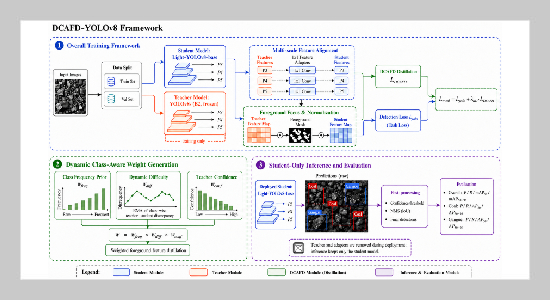
Overall Framework of DCAFD-YOLOv8, Dynamic Class-Aware Distillation, and Student-Only Deployment Pipeline
Copyright The Author(s). This is an open access article distributed under the terms of the Creative Commons Attribution License (CC BY 4.0), which permits unrestricted use, distribution, and reproduction in any medium, provided the original author and source are cited.
Download Citation: BibTeX | http://dx.doi.org/10.6180/jase.202612_35.057
In industrial visual detection, class imbalance often causes model optimization to favor high-frequency classes, leaving low-frequency targets insufficiently represented and more susceptible to missed detections. At the same time, lightweight model design further constrains feature representation capacity. To mitigate the representation loss introduced by model compression, a frozen teacher network is used to transfer multi-scale knowledge from the P3, P4, and P5 feature levels to the Light-YOLOv8-base student model. To reduce background interference during conventional feature distillation, a foreground-focused mechanism is introduced to concentrate knowledge transfer on informative target regions. A class-frequency prior is further incorporated to compensate for insufficient supervision of low-frequency classes. Since fixed weighting cannot adequately reflect the evolving learning states of different classes, class-wise teacher-student feature discrepancies are used to dynamically estimate learning difficulty and adjust the distillation strength accordingly. In addition, teacher confidence is introduced to suppress unreliable supervisory signals. These components together form DCAFD-YOLOv8 and are activated only during training, leaving the student network unchanged at inference. Experimental results show that the proposed model requires only 0.9 M parameters and 2.4 GFLOPs, while achieving an overall Recall of 90.6% and an mAP50 of 94.5%. The Recall of the low-frequency coal class improves from 90.6% to 91.2%, indicating that DCAFD-YOLOv8 can improve low-frequency target detection while preserving the advantages of lightweight deployment.
Keywords: Lightweight Object Detection; Class Imbalance; Focal Feature Distillation; Dynamic Class Weighting; Teacher Confidence
- [1] P. Mittal, (2024) “A Comprehensive Survey of Deep Learning-Based Lightweight Object Detection Models for Edge Devices” Artificial Intelligence Review 57(9): 242. DOI: https://doi.org/10.1007/s10462-024-10877-1.
- [2] R. Sunkara and T. Luo, (2023) “YOGA: Deep Object Detection in the Wild with Lightweight Feature Learning and Multiscale Attention” Pattern Recognition 139: 109451. DOI: https://doi.org/10.1016/j.patcog.2023.109451.
- [3] M. Shao and Z. Peng, (2024) “Distance Metric-Based Learning for Long-Tail Object Detection” Image and Vision Computing 142: 104888. DOI: https://doi.org/10.1016/j.imavis.2023.104888.
- [4] K. Zhang, T. Wang, X. Yang, L. Xu, J. Thé, Z. Tan, and H. Yu, (2024) “STATNet: One-Stage Coal-Gangue Detector Based on Deep Learning Algorithm for Real Industrial Application” Energy and AI 17: 100388. DOI: https://doi.org/10.1016/j.egyai.2024.100388.
- [5] Y. Song, P. Zhang, W. Huang, Y. Zha, T. You, and Y. Zhang, (2024) “Closed-Loop Unified Knowledge Distillation for Dense Object Detection” Pattern Recognition 149: 110235. DOI: https://doi.org/10.1016/j.patcog.2023.110235.
- [6] Q. Lan and Q. Tian, (2023) “Instance, Scale, and Teacher Adaptive Knowledge Distillation for Visual Detection in Autonomous Driving” IEEE Transactions on Intelligent Vehicles 8(3): 2358-2370. DOI: https://doi.org/10.1109/TIV.2022.3217261.
- [7] J. Li, Z. Meng, D. Shi, R. Song, X. Diao, J. Wang, and H. Xu. “FCC: Feature Clusters Compression for Long-Tailed Visual Recognition”. In: Proceedings of the IEEE/CVF Conference on Computer Vision and Pattern Recognition. 2023, 24080-24089. DOI: https://doi.org/10.1109/CVPR52729.2023.02306.
- [8] E. S. Aimar, A. Jonnarth, M. Felsberg, and M. Kuhlmann. “Balanced Product of Calibrated Experts for Long-Tailed Recognition”. In: Proceedings of the IEEE/CVF Conference on Computer Vision and Pattern Recognition. 2023, 19967-19977. DOI: https://doi.org/10.1109/CVPR52729.2023.01912.
- [9] L. Zhang and K. Ma, (2023) “Structured Knowledge Distillation for Accurate and Efficient Object Detection” IEEE Transactions on Pattern Analysis and Machine Intelligence 45(12): 15706-15724. DOI: https://doi.org/10.1109/TPAMI.2023.3300470.
- [10] Y. Zhang, W. Zhang, J. Li, X. Qi, X. Lu, L. Wang, and Y. Hou, (2024) “Empowering lightweight detectors: Orientation Distillation via anti-ambiguous spatial transformation for remote sensing images” ISPRS Journal of Photogrammetry and Remote Sensing 214: 244-260. DOI: https://doi.org/10.1016/j.isprsjprs.2024.05.023.
- [11] Q. Zhao, C. Jiang, W. Hu, F. Zhang, and J. Liu. “MDCS: More Diverse Experts With Consistency Self-Distillation for Long-Tailed Recognition”. In: Proceedings of the IEEE/CVF International Conference on Computer Vision. 2023, 11563-11574. DOI: https://doi.org/10.1109/ICCV51070.2023.01065.
- [12] H. Zhang, L. Zhu, X. Wang, and Y. Yang, (2024) “Divide and Retain: A Dual-Phase Modeling for Long-Tailed Visual Recognition” IEEE Transactions on Neural Networks and Learning Systems 35(10): 13538-13549. DOI: https://doi.org/10.1109/TNNLS.2023.3269907.
- [13] J. Wang, Y. Chen, Z. Zheng, X. Li, M.-M. Cheng, and Q. Hou. “CrossKD: Cross-Head Knowledge Distillation for Object Detection”. In: Proceedings of the IEEE/CVF Conference on Computer Vision and Pattern Recognition. 2024, 16520-16530. DOI: https://doi.org/10.1109/CVPR52733.2024.01563.
- [14] Y. Wang, X. Li, S. Weng, G. Zhang, H. Yue, H. Feng, J. Han, and E. Ding. “KD-DETR: Knowledge Distillation for Detection Transformer With Consistent Distillation Points Sampling”. In: Proceedings of the IEEE/CVF Conference on Computer Vision and Pattern Recognition. 2024, 16016-16025. DOI: https://doi.org/10.1109/CVPR52733.2024.01516.
- [15] Y. Zhu, Q. Zhou, N. Liu, Z. Xu, Z. Ou, X. Mou, and J. Tang. “ScaleKD: Distilling Scale-Aware Knowledge in Small Object Detector”. In: Proceedings of the IEEE/CVF Conference on Computer Vision and Pattern Recognition. 2023, 19723-19733. DOI: https://doi.org/10.1109/CVPR52729.2023.01889.
- [16] J. Zeng, L. Chen, H. Deng, L. Lu, J. Yan, Y. Qiao, and H. Li. “Distilling Focal Knowledge From Imperfect Expert for 3D Object Detection”. In: Proceedings of the IEEE/CVF Conference on Computer Vision and Pattern Recognition. 2023, 992-1001. DOI: https://doi.org/10.1109/CVPR52729.2023.00102.
- [17] T. Huang, Y. Zhang, M. Zheng, S. You, F. Wang, C. Qian, and C. Xu. “Knowledge Diffusion for Distillation”. In: Advances in Neural Information Processing Systems. 36. 2023, 65299-65316. DOI: https://doi.org/10.52202/075280-2849.
- [18] M. Li, D. Pi, and S. Qin, (2023) “An Efficient Single Shot Detector With Weight-Based Feature Fusion for Small Object Detection” Scientific Reports 13(1): 9883. DOI: https://doi.org/10.1038/s41598-023-36972-x.
- [19] X. Jia, Y. Tong, H. Qiao, M. Li, J. Tong, and B. Liang, (2023) “Fast and Accurate Object Detector for Autonomous Driving Based on Improved YOLOv5” Scientific Reports 13(1): 9711. DOI: https://doi.org/10.1038/s41598-023-36868-w.
- [20] Y. Zhao, W. Lv, S. Xu, J. Wei, G. Wang, Q. Dang, Y. Liu, and J. Chen. “DETRs Beat YOLOs on Real-Time Object Detection”. In: Proceedings of the IEEE/CVF Conference on Computer Vision and Pattern Recognition. 2024, 16965-16974. DOI: https://doi.org/10.1109/CVPR52733.2024.01605.