


Received: May 22, 2026
Accepted: July 24, 2026
Publication Date: September 18, 2026
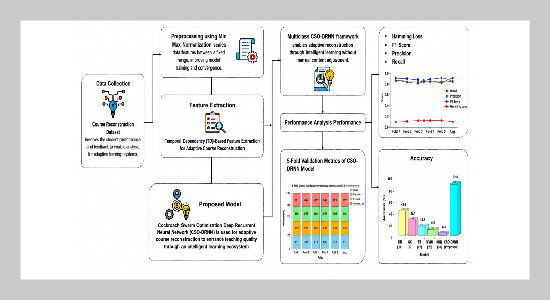
An overview of the Methodological workflow of the proposed CSO-DRNN model
Copyright The Author(s). This is an open access article distributed under the terms of the Creative Commons Attribution License (CC BY 4.0), which permits unrestricted use, distribution, and reproduction in any medium, provided the original author and source are cited.
Download Citation: BibTeX | http://dx.doi.org/10.6180/jase.202612_35.054
The system incorporates a Cockroach Swarm Optimized Deep Recurrent Neural Network (CSO-DRNN), which combines the sequential learning capability of recurrent neural networks with the global optimization strength of the cockroach swarm algorithm. This hybrid design enables iterative analysis, reconstruction, and refinement of course content, creating a responsive teaching environment that adapts to learner needs and expert feedback. A course performance dataset, gathered from Kaggle, is developed for experimentation. Data preprocessing is performed using min-max normalization to ensure uniform scaling, while sequential features are extracted through deep recurrent layers to capture temporal and structural dependencies in evaluation metrics. To validate robustness, a 5-fold cross-validation strategy is applied, ensuring reliable generalization across different data partitions. Comparative evaluation confirms that CSO-DRNN achieves superior accuracy (97%), recall (0.9141), F1-score (0.9352), precision (0.9224), and hamming loss (0.0943) compared with conventional approaches, and 5-fold cross-validation achieved an average accuracy of 95.6%, demonstrating robustness. The system is implemented in Python using TensorFlow and Keras, ensuring scalability and applicability in diverse educational platforms. The proposed AI-driven adaptive course reconstruction information teaching system enhances curriculum design, improves teaching quality assessment, and supports education reform toward a human-centered, technology-driven paradigm.
Keywords: Intelligent Learning Ecosystem, AI-Driven Adaptive Course Reconstruction, Information Teaching System, Cockroach Swarm Optimization (CSO), Deep Recurrent Neural Network (DRNN)
- [1] A. Szymkowiak, B. Melović, M. Dabić, K. Jeganathan, and G. S. Kundi, (2021) “Information technology and Gen Z: The role of teachers, the internet, and technology in the education of young people” Technology in Society 65: 101565. DOI: https://doi.org/10.1016/j.techsoc.2021.101565.
- [2] L. T. Liu, S. Wang, T. Britton, and R. Abebe, (2023) “Reimagining the machine learning life cycle to improve educational outcomes of students” Proceedings of the National Academy of Sciences 120(9): e2204781120. DOI: https://doi.org/10.1073/pnas.2204781120.
- [3] Y. Zhang, M. Zhang, L. Wu, and J. Li, (2025) “Digital transition framework for higher education in AI-assisted engineering teaching: Challenge, strategy, and initiatives in China” Science and Education 34(2): 933-954. DOI: https://doi.org/10.1007/s11191-024-00575-3.
- [4] H. Mu and Y. Shi, (2022) “Online education classroom intelligent management system based on tensor CS reconstruction model” Computational Intelligence and Neuroscience 2022: 9907786. DOI: https://doi.org/10.1155/2022/9907786.
- [5] J. Liang, R. Hare, T. Chang, F. Xu, Y. Tang, F. Y. Wang, S. Peng, and M. Lei, (2022) “Student modeling and analysis in adaptive instructional systems” IEEE Access 10: 59359-59372. DOI: https://doi.org/10.1109/ACCESS.2022.3178744.
- [6] Z. Dong, (2022) “Educational behaviour analysis using convolutional neural network and particle swarm optimization algorithm” Advances in Multimedia 2022: 9449328. DOI: https://doi.org/10.1155/2022/9449328.
- [7] U. Odilov, S. Antonibiya, S. Malarvizhi, S. Usmonova, and A. Qosimov, (2026) “Enhancing adaptive learning systems using swarm intelligence algorithms for personalized education” International Journal of Artificial Intelligence and Machine Learning 6(1s): 137-151. DOI: https://doi.org/10.51483/IJAIML.6.1s.2026.137-151.
- [8] H. M. Qadir, M. T. Suleman, R. A. Khan, M. Sohaib, M. J. Hasan, and S. A. Hussain, (2025) “Optimizing learning outcomes: A deep dive into hybrid AI models for adaptive educational feedback” Journal of Big Data 12(1): 144. DOI: https://doi.org/10.1186/s40537-025-01187-6.
- [9] F. Yan, (2025) “Machine Learning-assisted Intelligent Teaching System (ML-ITS) for college online English learning” International Journal of High-Speed Electronics and Systems: 2540224. DOI: https://doi.org/10.1142/S0129156425402244.
- [10] Y. Shi, F. Sun, H. Zuo, and F. Peng, (2023) “Analysis of learning behavior characteristics and prediction of learning effect for improving college students’ information literacy based on machine learning” IEEE Access 11: 50447-50461. DOI: https://doi.org/10.1109/ACCESS.2023.3278370.
- [11] B. Shannaq and A. Al-Zeidi, (2024) “Intelligent information system: Leveraging AI and machine learning for university course registration and academic performance enhancement in educational systems” Achieving Sustainable Business Through AI, Technology Education and Computer Science: Volume 2: Teaching Technology and Business Sustainability, Springer Nature Switzerland, 51-65. DOI: https://doi.org/10.1007/978-3-031-71213-5_5.
- [12] A. Alam, (2022) “A digital game-based learning approach for effective curriculum transaction for teaching-learning of artificial intelligence and machine learning” Proceedings of the International Conference on Sustainable Computing Data and Communication Systems (ICSCDS), IEEE, 69-74. DOI: https://doi.org/10.1109/ICSCDS53736.2022.9760932.
- [13] E. Garzón Artacho, T. S. Martínez, J. L. Ortega Martin, J. A. Marin Marin, and G. Gómez García, (2020) “Teacher training in lifelong learning-The importance of digital competence in the encouragement of teaching innovation” Sustainability 12(7): 2852. DOI: https://doi.org/10.3390/su12072852.
- [14] N. Yanes, A. M. Mostafa, M. Ezz, and S. N. Al-muayqil, (2020) “A machine learning-based recommender system for improving students learning experiences” IEEE Access 8: 201218-201235. DOI: https://doi.org/10.1109/ACCESS.2020.3036336.
- [15] M. Zhang, (2024) “Integrating deep learning into educational big data analytics for enhanced intelligent learning platforms” Information Technology and Control 53(4): 1060-1073. DOI: https://doi.org/10.5755/j01.itc.53.4.36968.