



Rong Wang1 , Yingcun Wang2 , Jinfeng Wang2, and Jiajia Ma2
1School of International Business, Weifang Vocational College, Weifang 262737, China
2School of Information Engineering, Weifang Vocational College, Weifang, 261031, China
Received: June 05, 2026
Accepted: July 13, 2026
Publication Date: September 16, 2026
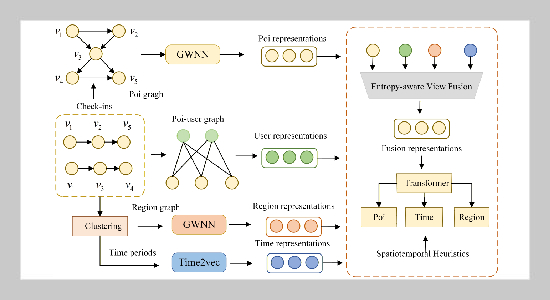
The illustration of the proposed method
Copyright The Author(s). This is an open access article distributed under the terms of the Creative Commons Attribution License (CC BY 4.0), which permits unrestricted use, distribution, and reproduction in any medium, provided the original author and source are cited.
Download Citation: BibTeX | http://dx.doi.org/10.6180/jase.202612_35.039
Next point-of-interest (POI) recommendation is a critical task in location-based social networks, offering significant value for personalized services and smart city governance. However, existing methods still struggle with the extreme scale of candidate search spaces and the inherent sparsity of check-in data. In this paper, we propose EMRF-WGD, an Entropy-oriented Multi-view Representation Fusion framework with Wavelet Graph Diffusion. To capture heterogeneous mobility dependencies, we first design a multi-view feature extraction module that jointly encodes POI transitions, user preferences, geographical regions, and temporal periods. Then, to effectively aggregate information, we introduce an entropy-aware view fusion strategy grounded in information theory, which maximizes mutual information while suppressing view-specific noise through variational approximation. Furthermore, a hybrid decoding framework is implemented to jointly predict the next POI, time, and region, supplemented by a spatiotemporal heuristic refinement stage that leverages historical relational tensors to narrow the search space. Extensive experiments on the NYC dataset demonstrate that EMRF-WGD consistently outperforms state-of-the-art baselines across all evaluation metrics, including Acc@k and MRR.
Keywords: Spatio-temporal partition, wavelet graph neural network, entropy fusion
- [1] P. Zhao, A. Luo, Y. Liu, J. Xu, Z. Li, F. Zhuang, V. S. Sheng, and X. Zhou, (2022) “Where to Go Next: A Spatio-Temporal Gated Network for Next POI Recommendation” IEEE Transactions on Knowledge and Data Engineering 34(5): 2512-2524. DOI: 10.1109/TKDE.2020.3007194.
- [2] H. Li and C. Zhao, (2024) “Fusion Cycle GAN: a multiple feature fusion based cycle-consistent generative adversarial network for person re-identification” IFS/ACM Transactions on Machine Learning 1(1): 7-12. DOI: 10.70891/JSE.2024.100006.
- [3] J. Gao, M. Liu, P. Li, A. A. Laghari, A. R. Javed, N. Victor, and T. R. Gadekallu, (2024) “Deep Incomplete Multiview Clustering via Information Bottleneck for Pattern Mining of Data in Extreme-Environment IoT” IEEE Internet of Things Journal 11(16): 26700-26712. DOI: 10.1109/JIOT.2023.3325272.
- [4] J. Gao, M. Liu, P. Li, J. Zhang, and Z. Chen, (2024) “Deep Multiview Adaptive Clustering With Semantic Invariance” IEEE Transactions on Neural Networks and Learning Systems 35(9): 12965-12978. DOI: 10.1109/TNNLS.2023.3265699.
- [5] S. Yin, L. Wang, T. Chen, H. Huang, J. Gao, J. Zhang, M. Liu, P. Li, and C. Xu, (2026) “LKAFormer: A lightweight kolmogorov-arnold transformer model for image semantic segmentation” ACM Transactions on Intelligent Systems and Technology 17(3): 1-24. DOI: 10.1145/3759254.
- [6] Z. Zhan, X. Mao, H. Liu, and S. Yu, (2025) “STGL: Self-Supervised Spatio-Temporal Graph Learning for Traffic Forecasting” Journal of Artificial Intelligence Research 2(1): 1-8. DOI: 10.70891/JAIR.2025.040001.
- [7] W. Liu, (2024) “Channel Reorganization for Few-Shot Segmentation” Journal of Artificial Intelligence Research 1(1): 36-40. DOI: 10.70891/JAIR.2024.100025.
- [8] W. Zhang and J. Wang, (2024) “English text sentiment analysis network based on CNN and U-Net” IFS/ACM Transactions on Machine Learning 1(1): 13-18. DOI: 10.70891/JSE.2024.100009.
- [9] F. Yin, Y. Liu, Z. Shen, L. Chen, S. Shang, and P. Han, (2023) “Next POI recommendation with dynamic graph and explicit dependency” Proceedings of the AAAI conference on artificial intelligence 37(4): 4827-4834. DOI: 10.1609/aaai.v37i4.25608.
- [10] Z. Wang, Y. Zhu, Q. Zhang, H. Liu, C. Wang, and T. Liu, (2022) “Graph-enhanced spatial-temporal network for next POI recommendation” ACM Transactions on Knowledge Discovery from Data (TKDD) 16(6): 1-21. DOI: 10.1145/3513092.
- [11] W. Chen, H. Wan, S. Guo, H. Huang, S. Zheng, J. Li, S. Lin, and Y. Lin, (2022) “Building and exploiting spatial-temporal knowledge graph for next POI recommendation” Knowledge-Based Systems 258: 109951. DOI: 10.1016/j.knosys.2022.109951.
- [12] X. Sun, Z. Gao, D. Yu, and B. Huang, (2025) “Joint Modeling of Multimodal Information Based on Dynamic and Static Knowledge Graphs for Next POI Recommendation” IEEE Transactions on Computational Social Systems 12(6): 3985-3999. DOI: 10.1109/TCSS.2025.3567512.
- [13] Y. Xie, L. Wang, W. Nie, C. Shi, X. Dong, S. Chen, H. Sun, W. Rao, and A.-A. Liu, (2026) “Next Chain Prediction: A Generative Recommendation Model With Sequence-Chain Attention” IEEE Transactions on Multimedia 28: 321-332. DOI: 10.1109/TMM.2025.3623521.
- [14] Y. Huang, X. Liu, Y. Miao, J. Zhang, and D. Cheng, (2025) “LDPTRec: A Differential Privacy Based Transformer Framework for Next POI Recommendation” IEEE Transactions on Dependable and Secure Computing 22(6): 7043-7059. DOI: 10.1109/TDSC.2025.3594398.
- [15] Y. Koren, R. Bell, and C. Volinsky, (2009) “Matrix Factorization Techniques for Recommender Systems” Computer 42(8): 30-37. DOI: 10.1109/MC.2009.263.
- [16] S. Rendle, C. Freudenthaler, and L. Schmidt-Thieme, (2010) “Factorizing personalized markov chains for next-basket recommendation” Proceedings of the 19th international conference on World wide web: 811-820. DOI: 10.1145/1772690.1772773.
- [17] S. Yang, J. Liu, and K. Zhao, (2022) “GETNext: Trajectory Flow Map Enhanced Transformer for Next POI Recommendation” Proceedings of the 45th International ACM SIGIR Conference on Research and Development in Information Retrieval: 1144-1153. DOI: 10.1145/3477495.3531983.
- [18] Z. Wang, Y. Zhu, C. Wang, W. Ma, B. Li, and J. Yu, (2023) “Adaptive Graph Representation Learning for Next POI Recommendation” Proceedings of the 46th International ACM SIGIR Conference on Research and Development in Information Retrieval: 393-402. DOI: 10.1145/3539618.3591634.
- [19] C. Zuo, X. Zhang, L. Yan, and Z. Zhang, (2024) “GUGEN: Global User Graph Enhanced Network for Next POI Recommendation” IEEE Transactions on Mobile Computing 23(12): 14975-14986. DOI: 10.1109/TMC.2024.3455107.