
School of Civil and Environmental Engineering, Zhengzhou University of Aeronautics, ZhengZhou 450046, China
Received: April 04, 2026
Accepted: May 27, 2026
Publication Date: September 13, 2026
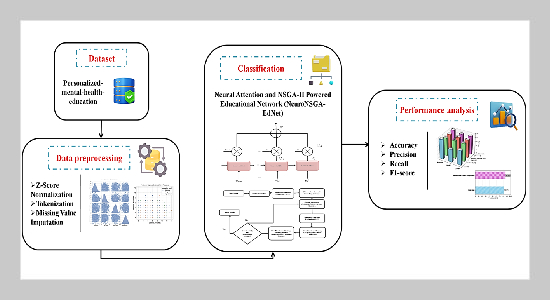
Overall Flow of MH Education.
Copyright The Author(s). This is an open access article distributed under the terms of the Creative Commons Attribution License (CC BY 4.0), which permits unrestricted use, distribution, and reproduction in any medium, provided the original author and source are cited.
Download Citation: BibTeX | http://dx.doi.org/10.6180/jase.202612_35.035
Mental Health (MH) disorders are becoming increasingly prevalent across diverse populations, yet conventional MH education often lacks personalisation, reducing its effectiveness. However, current frameworks do not effectively integrate heterogeneous data sources nor adaptively respond to individual user needs and progress. This research aims to develop a personalised MH education framework termed Neural Attention and NSGA-II Powered Educational Network (NeuroNSGA-EdNet) that integrates neural network modelling and big data analysis to deliver adaptive, user-specific content. The primary objective is to improve MH literacy, promote early awareness, and enhance user engagement through data-driven personalisation. The NeuroNSGA-EdNet framework incorporates heterogeneous data sources, including social media activity, wearable sensor data, academic records, and self-reported psychological assessments. Data pre-processing techniques such as Z-score normalisation, tokenisation, and missing value imputation ensure consistency and quality. An attention-based Convolutional Long Short-Term Memory (ConvLSTM) network models temporal and contextual patterns in the data. Personalised content recommendations are generated using a Non-dominated Sorting Genetic Algorithm (NSGA-II), optimising multiple objectives based on individual psychological profiles. A feedback and adaptive learning loop continuously update recommendations based on user interactions and learning outcomes. The experimental validation conducted using a systematic train-validation-test split approach on a heterogeneous dataset revealed an accuracy of 98.4%, 86.1% precision, 89.4% recall, and 91.6% F1. Users reported higher satisfaction with personalised learning paths compared to static modules. NeuroNSGA-EdNet integrates AI and big data for personalised MH education, combining deep learning, genetic optimisation, and adaptive feedback to enhance MH literacy and support early intervention.
Keywords: Personalised Framework, Mental Health, Education, Big Data, Neural Attention, and NSGA-II Powered Educational Network (NeuroNSGA-EdNet), Psychological Assessments.
- [1] G. Delanerolle, X. Yang, S. Shetty, V. Raymont, A. Shetty, P. Phiri, et al., (2021) “Artificial Intelligence: A Rapid Case for Advancement in the Personalization of Gynaecology/Obstetric and Mental Health Care” Womens Health 17: 17455065211018111. DOI: https://doi.org/10.1177/17455065211018111.
- [2] S. A. Najim, Z. A. M. Al-Omari, and S. M. Said, (2008) “On the Application of Artificial Neural Network in Analyzing and Studying Daily Loads of Jordan Power System Plant” Computer Science and Information Systems 5(1): 127-136. DOI: https://doi.org/10.2298/CSIS0801127N.
- [3] A. BaniMustafa and Z. Al-Omari, (2022) “Trends of Electricity Consumption in Jordan” 2022 International Engineering Conference on Electrical, Energy, and Artificial Intelligence (EICEEAI): IEEE, DOI: https://doi.org/10.1109/EICEEA156378.2022.10050498.
- [4] M. Alnsour, Z. Al-Omari, and T. Rawashdeh, (2024) “Shaping Tomorrow’s Community Requires Right Decisions to Be Made Today through Investment in Sustainable Infrastructure: An International Review” Evergreen 11(3): 1508-1529.
- [5] X. Ji, (2024) “Research on Mental Health Assessment and Intervention Methods for College Students Based on Big Data Analysis” Scalable Computing: Practice and Experience 25(6): 4702-4711. DOI: https://doi.org/10.12694/scpe.v25i6.3285.
- [6] H. Sundaram, S. H. Subramaniam, S. H. Ab Hamid, and A. M. Nor, (2024) “An Adaptive Data-Driven Architecture for Mental Health Care Applications” PeerJ 12: e17133. DOI: https://doi.org/10.7717/peerj.17133.
- [7] Y. Jia, (2024) “Impact of Music Teaching on Student Mental Health Using IoT, Recurrent Neural Networks, and Big Data Analytics” Mobile Networks and Applications: 1-20. DOI: https://doi.org/10.1007/s11036-024-02366-0.
- [8] Z. Tian and D. Yi, (2024) “Application of Artificial Intelligence Based on Sensor Networks in Student Mental Health Support System and Crisis Prediction” Measurement: Sensors 32: 101056. DOI: https://doi.org/10.1016/j.measen.2024.101056.
- [9] F. Norouzi and B. L. M. S. Machado, (2024) “Predicting Mental Health Outcomes: A Machine Learning Approach to Depression, Anxiety, and Stress” International Journal of Applied Data Science in Engineering and Health 1(2): 98-104.
- [10] V. R. Vallu, V. K. Samudrala, and W. Pulakhandam, (2025) “AI-Driven Digital Twin Framework for Accurate Mental Health Stress Detection and Personalized Management” Accelerating Product Development Cycles With Digital Twins and IoT Integration: IGI Global Scientific Publishing, 377-408. DOI: https://doi.org/10.4018/979-8-3373-2028-1.ch018.
- [11] B. Gan and X. Jin, (2025) “Integration of Knowledge Graph and CNN-GRU in College Students’ Mental Health Education and Psychological Crisis Intervention” Concurrency and Computation: Practice and Experience 37(15-17): e70138. DOI: https://doi.org/10.1002/cpe.70138.
- [12] R. Xing, (2025) “Methods and Implementation Paths for Evaluating the Impact of Deep Learning Based on Big Data on Ideological and Political Education and Mental Health of College Students” International Journal of High Speed Electronics and Systems: 2540387. DOI: https://doi.org/10.1142/S0129156425403870.
- [13] Y. Zhao and Q. Tang, (2021) “Analysis of Influencing Factors of Social Mental Health Based on Big Data” Mobile Information Systems 2021: 9969399. DOI: https://doi.org/10.1155/2021/9969399.
- [14] Y. Wang, (2026) “Analysis of the Relationship between College Students’ Mental Health Fluctuations and the Effect of the Civics Program Based on the ARFIMA Model” International Journal of Computer Information Systems and Industrial Management Applications: DOI: https://doi.org/10.70917/ijcisim-2026-0121.
- [15] Y. Han, (2022) “Application of Computer Digital Technology and Group Psychological Counseling in Higher Vocational Education Mental Health Education Curriculum under Complex Network Environment” Mathematical Problems in Engineering 2022: 5673248. DOI: https://doi.org/10.1155/2022/5673248.