




Hongtao Diao, Yu Li, Zengrui wang, Youyi Liang, Yi Yang
Pipe China Oil & Gas Control Center, Beijing, 100013 China
Received: July 13, 2026
Accepted: August 22, 2026
Publication Date: September 11, 2026
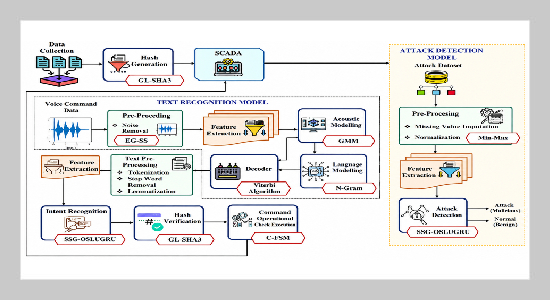
Block diagram of the proposed framework.
Copyright The Author(s). This is an open access article distributed under the terms of the Creative Commons Attribution License (CC BY 4.0), which permits unrestricted use, distribution, and reproduction in any medium, provided the original author and source are cited.
Download Citation: BibTeX | http://dx.doi.org/10.6180/jase.202612_35.033
Natural gas dispatching (NgD) systems increasingly employ voice control instructions to improve operational efficiency and human-machine interaction. However, existing voice-command frameworks lack end-to-end command traceability, limiting failure localization and compromising operational reliability and cybersecurity. This study proposes a natural gas dispatching system architecture that integrates unique identifiers with voice control instructions to enhance command traceability, authentication, and secure execution. The proposed framework assigns a unique ID to each voice command and integrates Exponential Growth Spectral Subtraction (EG-SS) for industrial noise suppression, Gaussian Mixture Model (GMM)-based speech recognition, Grunwald-Letnikov Secure Hash Algorithm-3 (GL-SHA-3) for command integrity verification, Consensus Finite State Machine (C-FSM) for operational limit validation, and SSG-aSiLUGRU for intent recognition and attack detection within the SCADA environment. Experimental results using voice command data and the SCADA Cybersecurity Research dataset collected from a simulated SCADA environment demonstrate that the proposed framework achieves 98.945% intent recognition and attack detection accuracy, a 20.5 dB Noise Reduction Ratio, 32 dB Signal-to-Noise Ratio, 687 ms hash creation time, 654 ms hash verification time, and 98.46% state transition accuracy, outperforming conventional approaches. These findings confirm that the proposed architecture effectively enhances command integrity, enables precise failure localization, strengthens cybersecurity against malicious voice-command attacks, and improves the reliability, safety, and traceability of natural gas dispatching operations.
Keywords: Natural gas Dispatching (NgD) System, Voice Control Instructions (VCI), Traceability, Intent Recognition, Supervisory Control and Data Acquisition (SCADA).
- [1] M. Norda, C. Engel, J. Rennies, J. E. Appell, S. C. Lange, and A. Hahn, (2023) “Evaluating the Efficiency of Voice Control as Human Machine Interface in Production” IEEE Transactions on Automation Science and Engineering 21(3): 4817-4828. DOI: https://doi.org/10.1109/TASE.2023.3302951.
- [2] H. Kwon, D. Park, and O. Jo, (2024) “Silent-Hidden-Voice Attack on Speech Recognition System” IEEE Access 12: 173010-173019. DOI: https://doi.org/10.1109/ACCESS.2022.3181194.
- [3] X. Ji, G. Zhang, X. Li, G. Qu, X. Cheng, and W. Xu, (2024) “Detecting Inaudible Voice Commands via Acoustic Attenuation by Multi-Channel Microphones” IEEE Transactions on Dependable and Secure Computing: DOI: https://doi.org/10.1109/TDSC.2024.3355117.
- [4] P. Cheng and U. Roedig, (2022) “Personal Voice Assistant Security and Privacy-A Survey” Proceedings of the IEEE 110(4): 476-507. DOI: https://doi.org/10.1109/JPROC.2022.3153167.
- [5] J. Guan, L. Pan, C. Wang, S. Yu, L. Gao, and X. Zheng, (2023) “Trustworthy Sensor Fusion Against Inaudible Command Attacks in Advanced Driver-Assistance Systems” IEEE Internet of Things Journal 10(19): 17254-17264. DOI: https://doi.org/10.1109/JIOT.2023.3275931.
- [6] Z. Sun, J. Zhao, F. Guo, Y. Chen, and L. Ju, (2024) “CommanderUAP: A Practical and Transferable Universal Adversarial Attacks on Speech Recognition Models” Cybersecurity 7(1): 38. DOI: https://doi.org/10.1186/s42400-024-00218-8.
- [7] H. Cao, H. Jiang, D. Liu, R. Wang, G. Min, J. Liu, and J. C. Lui, (2022) “LiveProbe: Exploring Continuous Voice Liveness Detection via Phonemic Energy Response Patterns” IEEE Internet of Things Journal 10(8): 7215-7228. DOI: https://doi.org/10.1109/JIOT.2022.3228819.
- [8] S. Wang, Z. Zhang, G. Zhu, X. Zhang, Y. Zhou, and J. Huang, (2022) “Query-Efficient Adversarial Attack with Low Perturbation Against End-to-End Speech Recognition Systems” IEEE Transactions on Information Forensics and Security 18: 351-364. DOI: https://doi.org/10.1109/TIFS.2022.3222963.
- [9] A. R. Abbasi, (2025) “Statistical Techniques in Power Systems Fault Diagnostic: Classifications, Challenges, and Strategic Recommendations” Electric Power Systems Research 239: 111279. DOI: https://doi.org/10.1016/j.epsr.2024.111279.
- [10] A. R. Abbasi and C. Parkash, (2025) “Innovative Diagnosis of Transformer Winding Defects Using Fuzzy and Neutrosophic Cross Entropy Measures” Advanced Engineering Informatics 65: 103196. DOI: https://doi.org/10.1016/j.aei.2025.103196.
- [11] M. Zadehbagheri and A. R. Abbasi, (2023) “Energy Cost Optimization in Distribution Network Considering Hybrid Electric Vehicle and Photovoltaic Using Modified Whale Optimization Algorithm” The Journal of Supercomputing 79(13): 14427-14456. DOI: https://doi.org/10.1007/s11227-023-05214-2.
- [12] J. Ansari, M. Homayounzade, and A. R. Abbasi, (2025) “Innovative Load Frequency Control: Integrating Adaptive Backstepping and Disturbance Observers” IEEE Access 13: 53673-53693. DOI: https://doi.org/10.1109/ACCESS.2025.3554141.
- [13] H. K. Risan, F. M. Serhan, and A. A. Al-Azzawi, (2024) “Management of a Typical Experiment in Engineering and Science” AIP Conference Proceedings 2864(1): 050001. DOI: https://doi.org/10.1063/5.0186079.
- [14] A. Kassis and U. Hengartner, (2021) “Practical Attacks on Voice Spoofing Countermeasures” arXiv: DOI: https://doi.org/10.48550/arXiv.2107.14642. eprint: 2107.14642.
- [15] Y. Wang, H. Guo, and Q. Yan, (2022) “GhostTalk: Interactive Attack on Smartphone Voice System Through Power Line” arXiv: DOI: https://doi.org/10.14722/ndss.2022.24254. eprint: 2202.02585.