




Anjiang Liu, Youzhuo Zheng, Di Weng, Hengrong Zhang, Xinhao Li
Electric Power Research Institute, Guizhou Power Grid Co., Ltd, Guiyang, 550002, China
Received: March 31, 2026
Accepted: July 10, 2026
Publication Date: August 26, 2026
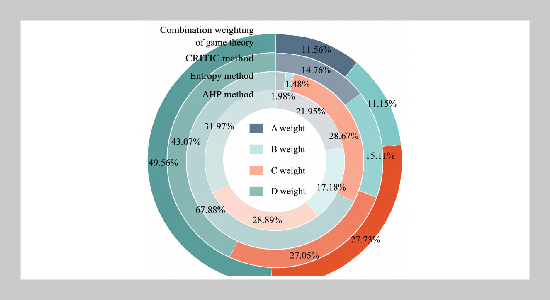
Weight Distribution of Supply Chain Coordination Control Indicators
Copyright The Author(s). This is an open access article distributed under the terms of the Creative Commons Attribution License (CC BY 4.0), which permits unrestricted use, distribution, and reproduction in any medium, provided the original author and source are cited.
Download Citation: BibTeX | http://dx.doi.org/10.6180/jase.202612_35.023
Renewable energy variability and unpredictability hinder supply chain coordination in grid-connected systems; thus, a data-based control approach is designed. All-phase Fourier transform is applied to extract features of renewable generation for enhanced decision making with supply chain data. The transportation, inventory, and demand constraints are considered in a coordination model that is solved by an enhanced PSO incorporating adaptive inertia weight, boundary control, and diversity preservation. Evaluated on IEEE 30-bus with 3000 samples, it achieves 98.2% reliability, 5.6% efficiency gain and 0.22s delay reduction.
Keywords: Grid-integrated renewable energy power system, Supply chain control, All phase Fourier analysis, Enhanced particle swarm optimization algorithm
- [1] M. Gulan and V. Milosavljevi, (2022) “Electrical characterization of the new generation of pulse resonance atmospheric plasma systems” International Journal of Energy Research 46(5): 6337-6350, DOI: https://doi.org/10.1002/er.7573.
- [2] B. Li, X. Guo, T. Li, et al., (2023) “A thermoelectric generation system using waste heat recovery from petrochemical pipeline to power wireless sensor” Energy Sources, Part A: Recovery, Utilization, and Environmental Effects 45(3): 7694-7704. DOI: https://doi.org/10.1080/15567036.2023.2223493.
- [3] D. P. Chinta, G. Veeranna, J. Pothula, et al., (2024) “Application of cooperation search-based I-PD controller with new cost function for frequency control of distributed energy integrated hybrid power system” Journal of Ambient Intelligence and Humanized Computing 15(1): 725-738. DOI: https://doi.org/10.1007/s12652-023-04729-z.
- [4] R. C. Allen, S. G. Baratsas, R. Kakodkar, et al., (2023) “A multi-period integrated planning and scheduling approach for developing energy systems” Optimal Control Applications and Methods 44(2): 355-372. DOI: https://doi.org/10.1002/oca.2866.
- [5] K. Fan, W. Mao, H. Qu, et al., (2023) “Study on government subsidy in a two-level supply chain of direct-fired biomass power generation based on contract coordination” Journal of Industrial and Management Optimization 19(4): 2436-2451. DOI: https://doi.org/10.3934/jimo.2022049.
- [6] F. Zhong, J. Xie, and Y. Shen, (2022) “Bargaining in a multi-echelon supply chain with power structure: KS solution vs. Nash solution” Journal of Industrial and Management Optimization 18(1): 635-654. DOI: https://doi.org/10.3934/jimo.2020172.
- [7] X. Zhang and X. Liang, (2023) “How does the power dynamics in the information technology outsourcing supply chain influence supplier’s talent retention: A multiple case study” Personnel Review 52(4): 1146-1168. DOI: https://doi.org/10.1108/PR-12-2020-0912.
- [8] H. Chu, L. Cui, Y. Li, L. Su, Y. Fu, and Y. Wang, (2024) “Supply Chain Resource Integration Method Under 4PL Mode Based on Associated Data” Journal of Applied Science and Engineering 27(8): 2947-2959. DOI: https://doi.org/10.6180/jase.202408_27(8).0003.
- [9] H. Wu, B. Zhang, W. Qu, et al., (2022) “Integration of a thermochemical energy system driven by solar energy and biomass for natural gas and power production” Science China Technological Sciences 65(6): 1383-1395. DOI: https://doi.org/10.1007/s11431-021-2002-3.
- [10] Y. Mo, Z. Qin, Y. Guo, et al., (2022) “Day-ahead flexibility enhancement via joint optimization for new energy vehicle fleets and electric vehicle charging/hydrogen refuelling stations” IET Renewable Power Generation 16(12): 2644-2657. DOI: https://doi.org/10.1049/rpg2.12457.
- [11] Y. Li and F. Xu, (2022) “All-phase fast Fourier transform and multiple cross-correlation analysis based on Geiger iteration for acoustic emission sources localization in complex metallic structures” Structural Health Monitoring 21(3): 1235-1250. DOI: https://doi.org/10.1177/14759217211027481.
- [12] W. Jiang and W. You, (2022) “A combined denoising method of empirical mode decomposition and singular spectrum analysis applied to Jason altimeter waveforms: A case of the Caspian Sea” Geodesy and Geodynamics 13(4): 327-342. DOI: https://doi.org/10.1016/j.geog.2021.11.004.