




Yang Sun, Hang Li, and Lin Teng
College of Artificial Intelligence, Shenyang Normal University, Shenyang, 110034 China
Received: July 03, 2026
Accepted: August 20, 2026
Publication Date: September 06, 2026
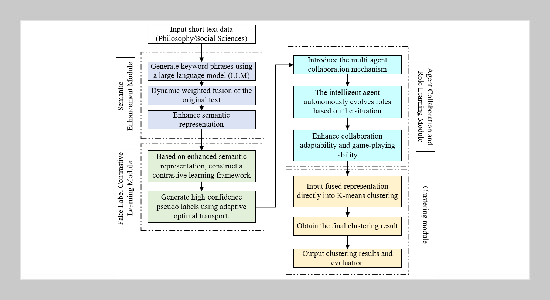
Flowchart of proposed model
Copyright The Author(s). This is an open access article distributed under the terms of the Creative Commons Attribution License (CC BY 4.0), which permits unrestricted use, distribution, and reproduction in any medium, provided the original author and source are cited.
Download Citation: BibTeX | http://dx.doi.org/10.6180/jase.202612_35.021
To address the issues of insufficient global semantic representation and weak local distinctiveness in current short text clustering of philosophy and social science, this paper proposes a novel short text clustering method based on the intelligent agents collaboration with large language model. This method establishes a pseudo-label contrastive learning module based on semantic enhancement. We utilize a large language model to generate keyword phrases and dynamically weightedly integrate them with the original text to enhance semantic representation. Further, it uses the adaptive optimal transport to generate high-confidence pseudo labels. To address the issue of the agent’s insufficient adaptability in complex games, this paper introduces a role learning module, enabling it to autonomously evolve its roles based on changes in the situation, thereby enhancing its collaborative adaptability. Meanwhile, this paper establishes a global and local information fusion semantic representation based on the self-attention mechanism and directly applies it to the clustering algorithm. The proposed method is compared with the mainstream baselines on 8 public short text clustering datasets. The experimental results show that the proposed method outperforms the baselines in all datasets in terms of the ACC metric, with an average improvement of 1.86%. The experimental results indicate that this method is suitable for clustering tasks in multiple scenarios.
Keywords: Short text clustering method, intelligent agents collaboration, large language model, information fusion, self-attention mechanism
- [1] J. Xu, B. Xu, P. Wang, S. Zheng, G. Tian, and J. Zhao, (2017) “Self-taught convolutional neural networks for short text clustering” Neural Networks 88: 22-31. DOI: 10.1016/j.neunet.2016.12.008.
- [2] G. Deena, K. Raja, et al., (2022) “Keyword extraction using latent semantic analysis for question generation” Journal of Applied Science and Engineering 26(4): 501-510. DOI: 10.6180/jase.202304_26(4).0006.
- [3] J. Yu, L. Zhao, S. Yin, and M. Ivanović, (2024) “News recommendation model based on encoder graph neural network and bat optimization in online social multimedia art education” Computer Science and Information Systems 21(3): 989-1012. DOI: 10.2298/CSIS231225025Y.
- [4] B. Lin, N. Cassee, A. Serebrenik, G. Bavota, N. Novielli, and M. Lanza, (2022) “Opinion mining for software development: a systematic literature review” ACM Transactions on Software Engineering and Methodology (TOSEM) 31(3): 1-41. DOI: 10.1145/3490388.
- [5] N. Alturayeif, H. Luqman, and M. Ahmed, (2023) “A systematic review of machine learning techniques for stance detection and its applications” Neural Computing and Applications 35(7): 5113-5144. DOI: 5.10.1007/s00521-023-08285-7.
- [6] X. Wang, G. Chen, G. Qian, P. Gao, X.-Y. Wei, Y. Wang, Y. Tian, and W. Gao, (2023) “Large-scale multi-modal pre-trained models: A comprehensive survey” Machine Intelligence Research 20(4): 447-482. DOI: 10.1007/s11633-022-1410-8.
- [7] E. Ramanujam, K. Shankar, et al. “Multi-lingual Spam SMS detection using a hybrid deep learning technique”. In: 2022 IEEE Silchar Subsection Conference (SILCON). IEEE. 2022, 1-6. DOI: 10.1109/SILCON55242.2022.10028936.
- [8] Y. Chu, H. Cao, Y. Diao, and H. Lin, (2023) “Refined SBERT: Representing sentence BERT in manifold space” Neurocomputing 555: 126453. DOI: 10.1016/j.neucom.2023.126453.
- [9] Z. Li, W. Han, Y. Zhang, Q. Fu, J. Li, L. Qin, R. Dong, H. Sun, Y. Deng, and L. Yang, (2024) “Learning spatiotemporal dynamics with a pretrained generative model” Nature Machine Intelligence 6(12): 1566-1579. DOI: 10.1038/s42256-024-00938-z.
- [10] Q. Wang, J. Huang, S. Lu, Y. Lin, K. Xu, L. Yang, and H. Lin, (2024) “Ipeval: A bilingual intellectual property agency consultation evaluation benchmark for large language models” Journal of Artificial Intelligence Research 2(1): DOI: 10.70891/JAIR.2025.040011.
- [11] S. Basu, S. Hu, D. Massiceti, and S. Feizi. “Strong baselines for parameter-efficient few-shot fine-tuning”. In: Proceedings of the AAAI Conference on Artificial Intelligence. 38. 10. 2024, 11024-11031. DOI: 10.1609/aaai.v38i10.28978.
- [12] F. Liu, Z. Sun, Y. Yang, C. Guo, and S. Zhao, (2024) “Rate-adaptable multitask-oriented semantic communication: An extended rate-distortion theory-based scheme” IEEE Internet of Things Journal 11(9): 15557-15570. DOI: 10.1109/JIOT.2024.3350656.
- [13] K. Chamnanchak, N. Rattanasiri, Y. Imjai, and P. Muroh. “A Comparative Study for Effectiveness of Different Artificial Intelligence Models for Thai Lettuce Price Prediction”. In: 2025 IEEE International Conference on Cybernetics and Innovations (ICCI). ΙΕΕΕ. 2025, 1-6. DOI: 10.1109/ICCI64209.2025.10987352.
- [14] X. Meng, X. Wang, S. Yin, and H. Li, (2023) “Few-shot image classification algorithm based on attention mechanism and weight fusion” Journal of Engineering and Applied Science 70(1): 14. DOI: 10.1186/s44147-023-00186-9.
- [15] A. Petukhova, J. P. Matos-Carvalho, and N. Fachada, (2025) “Text clustering with large language model embeddings” International Journal of Cognitive Computing in Engineering 6: 100-108. DOI: 10.1016/j.ijcce.2024.11.004.
- [16] S. M. Perlaza, G. Bisson, I. Esnaola, A. Jean-Marie, and S. Rini, (2024) “Empirical risk minimization with relative entropy regularization” IEEE Transactions on Information Theory 70(7): 5122-5161. DOI: 10.1109/TIT.2024.3365728.
- [17] J. Yamada and D. Kitayama. “The Analysis of Web Search Snippets Displaying User’s Knowledge”. In: 2021 15th International Conference on Ubiquitous Information Management and Communication (IMCOM). IEEE. 2021, 1-8. DOI: 10.1109/IMCOM51814.2021.9377354.
- [18] X. Chen, K. Li, T. Song, and J. Guo. “Few-shot name entity recognition on stackoverflow”. In: 2024 9th International Conference on Intelligent Computing and Signal Processing (ICSP). IEEE. 2024, 961-965. DOI: 10.1109/ICSP62122.2024.10743392.
- [19] V. Binson, S. Thomas, M. Subramoniam, J. Arun, S. Naveen, and S. Madhu, (2024) “A review of machine learning algorithms for biomedical applications” Annals of Biomedical Engineering 52(5): 1159-1183. DOI: 10.1007/s10439-024-03459-3.
- [20] A. S. Alphonse, S. Abinaya, and N. Verma, (2025) “Improved data labelling method for news headlines classification in cloud environment” Connection Science 37(1): 2461088. DOI: 10.1080/09540091.2025.2461088.
- [21] M. E. Haroutunian, D. G. Asatryan, and K. A. Mastoyan, (2024) “Analyzing the quality of distorted images by the normalized mutual information measure” Mathematical Problems of Computer Science 61: 7-14. DOI: 10.51408/1963-0111.
- [22] S. J. Johnson, M. R. Murty, and I. Navakanth, (2024) “A detailed review on word embedding techniques with emphasis on word2vec” Multimedia Tools and Applications 83(13): 37979-38007. DOI: 10.1007/s11042-023-17007-z
- [23] A. Dharmasiri, M. Naseer, S. Khan, and F. S. Khan. “Cross-modal self-training: Aligning images and pointclouds to learn classification without labels”. In: 2024 IEEE/CVF Conference on Computer Vision and Pattern Recognition Workshops (CVPRW). IEEE. 2024, 708-717. DOI: 10.1109/CVPRW63382.2024.00075.
- [24] Q. Xu, H. Zan, and S. Ji, (2024) “A lightweight mixup-based short texts clustering for contrastive learning” Frontiers in Computational Neuroscience 17: 1334748. DOI: 10.3389/fncom.2023.1334748.
- [25] J. Tussupov, A. Kassymova, A. Mukhanova, A. Bissengaliyeva, Z. Azhibekova, M. Yessenova, and Z. Abuova, (2025) “Analysis of short texts using intelligent clustering methods” Algorithms 18(5): 289. DOI: 10.3390/a18050289.