




Received: July 21, 2026
Accepted: August 19, 2026
Publication Date: September 06, 2026
Hybrid fuzzy Bayesian uncertainty-modeling process for 3D-printed dental models
Copyright The Author(s). This is an open access article distributed under the terms of the Creative Commons Attribution License (CC BY 4.0), which permits unrestricted use, distribution, and reproduction in any medium, provided the original author and source are cited.
Download Citation: BibTeX | http://dx.doi.org/10.6180/jase.202612_35.015
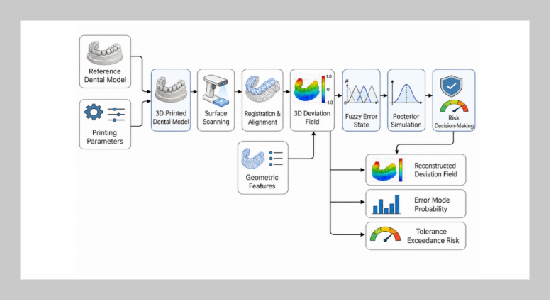
This study proposes a hybrid fuzzy Bayesian model for analyzing the deviation field of 3D-printed dental models. The model represents the dental-model surface as a signed three-dimensional deviation field and integrates printing-process variables, local geometric features, and fuzzy memberships for low-error, medium-error, and high-risk states at each sampled surface point. A Student-t mixture likelihood is then used to identify latent error mechanisms, including low-error behavior, material shrinkage, local warping, and registration or measurement noise. Error-field reconstruction, latent-mode probabilities, and threshold-exceedance risks are estimated through Bayesian posterior inference. A simulation-driven benchmark dataset of 3D dental-model surfaces is constructed, and the proposed method is compared with linear regression, Gaussian mixture regression, Gaussian process regression, and a conventional Bayesian hierarchical model. The proposed model achieves the best overall performance in RMSE, MAE, CRPS, 95% interval coverage, and risk AUC. Specifically, its RMSE is 0.031 mm, its CRPS is 0.019, and its 95% interval coverage is 94.7%. Visualizations of the 3D dental-model surface show that the model reconstructs high-gradient deviations in cusps, margins, and support-adjacent regions more accurately while also generating posterior risk maps for quality control. These findings suggest that hybrid fuzzy Bayesian modeling is suitable for uncertainty quantification, scientific computing, and parameter-level decision support in digital dental additive manufacturing. The benchmark is simulation-driven and should therefore be interpreted as methodological validation rather than direct clinical evidence.
Keywords: 3D printing; dental model; uncertainty quantification; fuzzy Bayesian model; hybrid model; deviation field; posterior simulation; additive manufacturing.
- [1] E. S. Bud, V.-I. Bocanet, M. H. Muntean, A. Vlasa, S. M. Bucur, M. Păcurar, B. R. Dragomir, C. D. Olteanu, and A. Bud, (2021) “Accuracy of Three-Dimensional (3D) Printed Dental Digital Models Generated with Three Types of Resin Polymers by Extra-Oral Optical Scanning” Journal of Clinical Medicine 10(9): 1908. DOI: https://doi.org/10.3390/jcm10091908.
- [2] F. Emir, G. Ceylan, and S. Ayyildiz, (2021) “In Vitro Accuracies of 3D Printed Models Manufactured by Two Different Printing Technologies” European Oral Research 55(2): 80-85. DOI: https://doi.org/10.26590/eor.20210060.
- [3] J.-M. Park, J. Jeon, J.-Y. Koak, S.-K. Kim, and S.-J. Heo, (2021) “Dimensional Accuracy and Surface Characteristics of 3D-Printed Dental Casts” The Journal of Prosthetic Dentistry 126(3): 427-437. DOI: https://doi.org/10.1016/j.prosdent.2020.07.008.
- [4] J. Ko, R. D. Bloomstein, D. Briss, J. N. Holland, H. M. Morsy, F. K. Kasper, and W. Huang, (2021) “Effect of Build Angle and Layer Height on the Accuracy of 3-Dimensional Printed Dental Models” American Journal of Orthodontics and Dentofacial Orthopedics 160(3): 451-458.e2. DOI: https://doi.org/10.1016/j.ajodo.2020.11.039.
- [5] O. Hartley, T. Shanbhag, D. Smith, A. Grimm, Z. Salameh, S. K. Tadakamadla, F. Alifui-Segbaya, and K. E. Ahmed, (2022) “The Effect of Stacking on the Accuracy of 3D-Printed Full-Arch Dental Models” Polymers 14(24): 5465. DOI: https://doi.org/10.3390/polym14245465.
- [6] M. Revilla-León, R. Cascos-Sánchez, J. M. Zeitler, A. B. Barmak, J. C. Kois, and M. Gómez-Polo, (2024) “Influence of Print Orientation and Wet-Dry Storage Time on the Intaglio Accuracy of Additively Manufactured Occlusal Devices” The Journal of Prosthetic Dentistry 131(6): 1226-1234. DOI: https://doi.org/10.1016/j.prosdent.2022.12.005.
- [7] J.-H. Kim, J.-W. Choi, J.-J. Ahn, K.-B. Son, and J.-B. Huh, (2022) “Accuracy Comparison among 3D-Printing Technologies to Produce Dental Models” Applied Sciences 12(17): 8425. DOI: https://doi.org/10.3390/app12178425.
- [8] A. Németh, V. Vitai, M. L. Czumbel, B. Szabó, G. Varga, B. Kerémi, P. Hegyi, P. Hermann, and J. Borbély, (2023) “Clear Guidance to Select the Most Accurate Technologies for 3D Printing Dental Models: A Network Meta-Analysis” Journal of Dentistry 134: 104532. DOI: https://doi.org/10.1016/j.jdent.2023.104532.
- [9] V. Grassia, V. Ronsivalle, G. Isola, L. Nucci, R. Leonardi, and A. Lo Giudice, (2023) “Accuracy (Trueness and Precision) of 3D Printed Orthodontic Models Finalized to Clear Aligners Production, Testing Crowded and Spaced Dentition” BMC Oral Health 23: 352. DOI: https://doi.org/10.1186/s12903-023-03025-8.
- [10] T. ElShebiny, S. Matthaios, L. M. Menezes, I. A. Tsolakis, and J. M. Palomo, (2024) “Effect of Printing Technology, Layer Height, and Orientation on Assessment of 3D-Printed Models” Journal of the World Federation of Orthodontists 13(4): 169-174. DOI: https://doi.org/10.1016/j.ejwf.2024.03.006.
- [11] A. Wen, N. Xiao, Y. Zhu, Z. Gao, Q. Qin, S. Shan, W. Li, Y. Sun, Y. Wang, and Y. Zhao, (2024) “Spatial Trueness Evaluation of 3D-Printed Dental Model Made of Photopolymer Resin: Use of Special Structurized Dental Model” Polymers 16(8): 1083. DOI: https://doi.org/10.3390/polym16081083.
- [12] M. A. Alghauli, S. A. Almuzaini, R. Aljohani, and A. Y. Alqutaibi, (2024) “Impact of 3D Printing Orientation on Accuracy, Properties, Cost, and Time Efficiency of Additively Manufactured Dental Models: A Systematic Review” BMC Oral Health 24: 1550. DOI: https://doi.org/10.1186/s12903-024-05365-5.
- [13] N. Decker, M. Lyu, Y. Wang, and Q. Huang, (2021) “Geometric Accuracy Prediction and Improvement for Additive Manufacturing Using Triangular Mesh Shape Data” Journal of Manufacturing Science and Engineering 143(6): 061006. DOI: https://doi.org/10.1115/1.4049089.
- [14] S. Goguelin, V. Dhokia, and J. M. Flynn, (2021) “Bayesian Optimisation of Part Orientation in Additive Manufacturing” International Journal of Computer Integrated Manufacturing 34(12): 1263-1284. DOI: https://doi.org/10.1080/0951192X.2021.1972466.
- [15] S. Mahadevan, P. Nath, and Z. Hu, (2022) “Uncertainty Quantification for Additive Manufacturing Process Improvement: Recent Advances” ASCE-ASME Journal of Risk and Uncertainty in Engineering Systems, Part B: Mechanical Engineering 8(1): 010801. DOI: https://doi.org/10.1115/1.4053184.