




1Jiangsu Maritime Institute, Sports department, Nanjing, 211170, China
2Department of Physical Education, Nanjing Agricultural University, Nanjing 210095, China
Received: July 21, 2026
Accepted: August 14, 2026
Publication Date: September 06, 2026
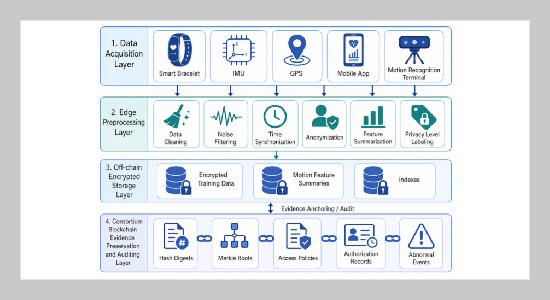
Architecture of the blockchain-enabled distributed sports training data provenance and privacy protection system
Copyright The Author(s). This is an open access article distributed under the terms of the Creative Commons Attribution License (CC BY 4.0), which permits unrestricted use, distribution, and reproduction in any medium, provided the original author and source are cited.
Download Citation: BibTeX | http://dx.doi.org/10.6180/jase.202612_35.014
As intelligent sports equipment and edge terminals become widely deployed, the O&M and training data they generate are collected at high frequency and shared across organizations, yet centralized storage cannot support tamper traceability, privacy, access control, or scalability. This study proposes BSVP-Chain, treating blockchain as an evidence-anchoring layer cooperating with edge preprocessing and off-chain storage rather than a raw-data warehouse, using a four-layer architecture (acquisition, edge preprocessing, off-chain storage, blockchain evidence anchoring/audit) that reduces exposure via edge cleaning, lowers on-chain load via Merkle-tree batch anchoring, and combines smart contracts, ABAC, and differential privacy for authorization and statistical privacy. In simulations with 1 million records, BSVP-Chain cut storage latency by 78.6% and on-chain storage by 96.7% versus full-chain, sustained 380 ms latency under 500 nodes/10,000 concurrent requests, intercepted 99.1% of unauthorized accesses, and limited false-release to 0.7%.
Keywords: blockchain; intelligent sports equipment; operation and maintenance data; training data; privacy protection; smart contracts; access control.
- [1] A. Panarello, N. Tapas, G. Merlino, F. Longo, and A. Puliafito, (2018) “Blockchain and IoT Integration: A Systematic Survey” Sensors 18(8): 2575. DOI: https://doi.org/10.3390/s18082575.
- [2] Q. Wei, B. Li, W. Chang, Z. Jia, Z. Shen, and Z. Shao, (2022) “A Survey of Blockchain Data Management Systems” ACM Transactions on Embedded Computing Systems 21(3): 25:1-25:28. DOI: https://doi.org/10.1145/3502741.
- [3] V. Gugueoth, S. Safavat, S. Shetty, and D. Rawat, (2023) “A Review of IoT Security and Privacy Using Decentralized Blockchain Techniques” Computer Science Review 50: 100585. DOI: https://doi.org/10.1016/j.cosrev.2023.100585.
- [4] D. Commey, B. Mai, S. G. Hounsinou, and G. V. Crosby, (2024) “Securing Blockchain-Based IoT Systems: A Review” IEEE Access 12: 98856-98881. DOI: https://doi.org/10.1109/ACCESS.2024.3428490.
- [5] E. Daniel and F. Tschorsch, (2022) “IPFS and Friends: A Qualitative Comparison of Next Generation Peer-to-Peer Data Networks” IEEE Communications Surveys & Tutorials 24(1): 31-52. DOI: https://doi.org/10.1109/COMST.2022.3143147.
- [6] T. V. Doan, Y. Psaras, J. Ott, and V. Bajpai, (2022) “Toward Decentralized Cloud Storage with IPFS: Opportunities, Challenges, and Future Considerations” IEEE Internet Computing 26(6): 7-15. DOI: https://doi.org/10.1109/MIC.2022.3209804.
- [7] R. De Fazio, V. M. Mastronardi, M. De Vittorio, and P. Visconti, (2023) “Wearable Sensors and Smart Devices to Monitor Rehabilitation Parameters and Sports Performance: An Overview” Sensors 23(4): 1856. DOI: https://doi.org/10.3390/s23041856.
- [8] L. Yang, O. Amin, and B. Shihada, (2024) “Intelligent Wearable Systems: Opportunities and Challenges in Health and Sports” ACM Computing Surveys 56(7): 190:1-190:42. DOI: https://doi.org/10.1145/3648469.
- [9] Z. Li, B. Wang, J. Li, Y. Hua, and S. Zhang, (2022) “Local Differential Privacy Protection for Wearable Device Data” PLOS ONE 17(8): e0272766. DOI: https://doi.org/10.1371/journal.pone.0272766.
- [10] H. Honar Pajooh, M. A. Rashid, F. Alam, and S. N. Demidenko, (2021) “IoT Big Data Provenance Scheme Using Blockchain on Hadoop Ecosystem” Journal of Big Data 8: 114. DOI: https://doi.org/10.1186/s40537-021-00505-w.
- [11] F. Loukil, C. Ghedira-Guegan, K. Boukadi, and A.-N. Benharkat, (2021) “Privacy-Preserving IoT Data Aggregation Based on Blockchain and Homomorphic Encryption” Sensors 21(7): 2452. DOI: https://doi.org/10.3390/s21072452.
- [12] J. Gong, Y. Mei, F. Xiang, H. Hong, Y. Sun, and Z. Sun, (2021) “A Data Privacy Protection Scheme for Internet of Things Based on Blockchain” Transactions on Emerging Telecommunications Technologies 32(5): e4010. DOI: https://doi.org/10.1002/ett.4010.
- [13] S. K. Dwivedi, R. Amin, and S. Vollala, (2023) “Smart Contract and IPFS-Based Trustworthy Secure Data Storage and Device Authentication Scheme in Fog Computing Environment” Peer-to-Peer Networking and Applications 16: 1-21. DOI: https://doi.org/10.1007/s12083-022-01376-7.
- [14] Y. Zhang, K. Gai, J. Xiao, L. Zhu, and K.-K. R. Choo, (2022) “Blockchain-Empowered Efficient Data Sharing in Internet of Things Settings” IEEE Journal on Selected Areas in Communications 40(12): 3422-3436. DOI: https://doi.org/10.1109/JSAC.2022.3213353.