




Duanjiao Li1, Yongchao Liang1, Wenxing Sun1, Zibin Zhu2, Jianguo Zhang3
1Guangdong Power Grid Co., Ltd, Guangzhou Guang Dong, 510030, China
2Zhaoqing Power Supply Bureau, Guangdong Power Grid, Zhaoqing GuangDong, 526060, China
3Shenzhen Institute of Artificial Intelligence and Robotics for Society, Shenzhen Guangdong, 518129, China
Received: July 21, 2026
Accepted: August 16, 2026
Publication Date: September 06, 2026
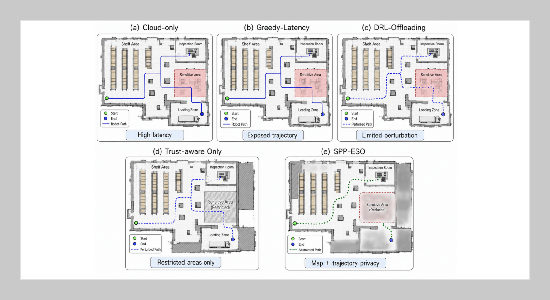
Real-scene visual comparison of local map fusion and trajectory privacy under different algorithms
Copyright The Author(s). This is an open access article distributed under the terms of the Creative Commons Attribution License (CC BY 4.0), which permits unrestricted use, distribution, and reproduction in any medium, provided the original author and source are cited.
Download Citation: BibTeX | http://dx.doi.org/10.6180/jase.202612_35.013
Multi-robot systems in intelligent warehousing, industrial inspection, disaster relief, and UAV collaboration face complex tasks including target detection, map fusion, path planning, status diagnosis, and log uploading. Limited onboard computing, heterogeneous edge resources, and fluctuating links expose trajectories, maps, images, and status data during offloading, and traditional latency- or energy-only optimization fails to address scalability, security, and privacy together. This study proposes SPP-ESO, a security- and privacy-aware edge offloading strategy based on a three-layer robot-edge-cloud architecture, integrating task profiling, privacy level identification, dynamic trust assessment, candidate node filtering, multi-objective reinforcement learning, differential privacy perturbation, data minimization, and edge-failure migration into a unified model optimizing latency, energy, load balancing, security risk, privacy risk, and failure penalty together. With 200 robots, SPP-ESO achieves 218 ms average latency, 4.73 J energy consumption, 96.4% task completion, 3.6% SLA violation, 3.1% attack success, and 0.22 privacy risk, outperforming local-only, cloud-only, greedy-latency, DRL-offloading, and trust-aware baselines. At 300 robots under high concurrency, completion rate remains ~94%.
Keywords: multi-robot system, scalable information system, edge computing, secure offloading, privacy protection, trust assessment, differential privacy, multi-agent reinforcement learning
- [1] M. Afrin, J. Jin, A. Rahman, A. Rahman, J. Wan, and E. Hossain, (2021) “Resource Allocation and Service Provisioning in Multi-Agent Cloud Robotics: A Comprehensive Survey” IEEE Communications Surveys & Tutorials 23(2): 842-870. DOI: https://doi.org/10.1109/COMST.2021.3061435.
- [2] N. Tahir and R. Parasuraman, (2025) “Edge Computing and Its Application in Robotics: A Survey” Journal of Sensor and Actuator Networks 14(4): 65. DOI: https://doi.org/10.3390/jsan14040065.
- [3] P. Huang, L. Zeng, X. Chen, K. Luo, Z. Zhou, and S. Yu, (2022) “Edge Robotics: Edge-Computing-Accelerated Multirobot Simultaneous Localization and Mapping” IEEE Internet of Things Journal 9(15): 14087-14102. DOI: https://doi.org/10.1109/JIOT.2022.3146461.
- [4] G. Li, R. Han, S. Wang, F. Gao, Y. C. Eldar, and C. Xu, (2025) “Edge Accelerated Robot Navigation With Collaborative Motion Planning” IEEE/ASME Transactions on Mechatronics 30(2): 1166-1178. DOI: https://doi.org/10.1109/TMECH.2024.3419436.
- [5] M. Groshev, G. Baldoni, L. Cominardi, A. de la Oliva, and R. Gazda, (2023) “Edge Robotics: Are We Ready? An Experimental Evaluation of Current Vision and Future Directions” Digital Communications and Networks 9(1): 166-174. DOI: https://doi.org/10.1016/j.dcan.2022.04.032.
- [6] A. Islam, A. Debnath, M. Ghose, and S. Chakraborty, (2021) “A Survey on Task Offloading in Multi-Access Edge Computing” Journal of Systems Architecture 118: 102225. DOI: https://doi.org/10.1016/j.sysarc.2021.102225.
- [7] F. Saeik, M. Avgeris, D. Spatharakis, N. Santi, D. Dechouniotis, J. Violos, A. Leivadeas, N. Athanasopoulos, N. Mitton, and S. Papavassiliou, (2021) “Task Offloading in Edge and Cloud Computing: A Survey on Mathematical, Artificial Intelligence and Control Theory Solutions” Computer Networks 195: 108177. DOI: https://doi.org/10.1016/j.comnet.2021.108177.
- [8] P. Ranaweera, A. D. Jurcut, and M. Liyanage, (2021) “Survey on Multi-Access Edge Computing Security and Privacy” IEEE Communications Surveys & Tutorials 23(2): 1078-1124. DOI: https://doi.org/10.1109/COMST.2021.3062546.
- [9] M. Yahuza, M. Y. I. B. Idris, A. W. B. Abdul Wahab, A. T. S. Ho, S. Khan, S. N. B. Musa, and A. Z. B. Taha, (2020) “Systematic Review on Security and Privacy Requirements in Edge Computing: State of the Art and Future Research Opportunities” IEEE Access 8: 76541-76567. DOI: https://doi.org/10.1109/ACCESS.2020.2989456.
- [10] T. Li, X. He, S. Jiang, and J. Liu, (2022) “A Survey of Privacy-Preserving Offloading Methods in Mobile-Edge Computing” Journal of Network and Computer Applications 203: 103395. DOI: https://doi.org/10.1016/j.jnca.2022.103395.
- [11] Z. Wang, Y. Sun, D. Liu, J. Hu, X. Pang, Y. Hu, and K. Ren, (2024) “Location Privacy-Aware Task Offloading in Mobile Edge Computing” IEEE Transactions on Mobile Computing 23(3): 2269-2283. DOI: https://doi.org/10.1109/TMC.2023.3254553.
- [12] D.-G. Zhang, H.-Z. An, J. Zhang, T. Zhang, W.-M. Dong, and X.-R. Jiang, (2024) “Novel Privacy Awareness Task Offloading Approach Based on Privacy Entropy” IEEE Transactions on Network and Service Management 21(3): 3598-3608. DOI: https://doi.org/10.1109/TNSM.2024.3355967.
- [13] K. Li, X. Wang, Q. He, M. Yang, M. Huang, and S. Dustdar, (2023) “Task Computation Offloading for Multi-Access Edge Computing via Attention Communication Deep Reinforcement Learning” IEEE Transactions on Services Computing 16(4): 2985-2999. DOI: https://doi.org/10.1109/TSC.2022.3225473.
- [14] Z. Cao, X. Deng, S. Yue, P. Jiang, J. Ren, and J. Gui, (2024) “Dependent Task Offloading in Edge Computing Using GNN and Deep Reinforcement Learning” IEEE Internet of Things Journal 11(12): 21632-21646. DOI: https://doi.org/10.1109/JIOT.2024.3374969.
- [15] D. C. Nguyen, M. Ding, P. N. Pathirana, A. Seneviratne, J. Li, and H. V. Poor, (2021) “Federated Learning for Internet of Things: A Comprehensive Survey” IEEE Communications Surveys & Tutorials 23(3): 1622-1658. DOI: https://doi.org/10.1109/COMST.2021.3075439.