


School of Mechanical Engineering, Yangzhou Polytechnic University, Yang Zhou 225009, China
Received: April 29, 2026
Accepted: August 14, 2026
Publication Date: August 26, 2026
Digital Twin-Based Architecture for Monitoring and Optimization in Injection Molding
Copyright The Author(s). This is an open access article distributed under the terms of the Creative Commons Attribution License (CC BY 4.0), which permits unrestricted use, distribution, and reproduction in any medium, provided the original author and source are cited.
Download Citation: BibTeX | http://dx.doi.org/10.6180/jase.202612_35.011
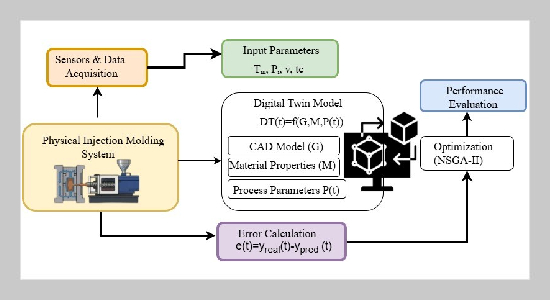
Injection molding is widely used for manufacturing high-precision plastic components, but complex interactions between material properties and process parameters often lead to defects such as warpage, shrinkage, and incomplete filling. Traditional optimization approaches have limited adaptability to dynamic manufacturing environments. This study proposes an integrated digital twin-driven framework combined with the Non-Dominated Sorting Genetic Algorithm II (NSGA-II) for injection molding optimization. This study contributes to Industry 4.0 by integrating digital twin technology and AI-based optimization for real-time, data-driven decision-making in smart manufacturing systems. The proposed AI-driven digital twin framework also enables predictive maintenance by continuously monitoring process conditions and identifying potential equipment and process anomalies before defects occur. The framework integrates CAD-based mold design, multi-physics simulation, and virtual-physical synchronization to monitor material flow, predict thermal and pressure distributions, and identify potential defects. NSGA-II optimizes key process parameters, including melt temperature, injection pressure, injection speed, and cooling time, to simultaneously minimize cycle time, warpage, and defect rate. Experimental results demonstrate significant improvements, reducing cycle time from 40 s to 26 s, warpage from 1.83 mm to 1.12 mm, and defect rate from 15% to 7%. Validation results show prediction errors below 5%, confirming the effectiveness and reliability of the proposed framework.
Keywords: Digital Twin, Injection Molding, Multi-Objective Optimization, NSGA-II, Process Simulation, Warpage Reduction, Cycle Time Optimization, Intelligent Manufacturing
- [1] W. Wang et al., (2022) “BIM Information Integration Based VR Modeling in Digital Twins in Industry 5.0” Journal of Industrial Information Integration 28: 100351. DOI: https://doi.org/10.1016/j.jii.2022.100351.
- [2] Y. Zhao, N. Wang, Z. Liu, and E. Mu, (2022) “Construction Theory for a Building Intelligent Operation and Maintenance System Based on Digital Twins and Machine Learning” Buildings 12(2): 87. DOI: https://doi.org/10.3390/buildings12020087.
- [3] L. Wang et al., (2025) “The Development of Prefabricated Buildings and Intelligent Construction Based on Digital Twins” Journal of Intelligent Construction 3(1): 1-25. DOI: https://doi.org/10.26599/JIC.2025.9180080.
- [4] H. Qu, L. Fang, and J. Tan, (2026) “An embodied intelligence-based online optimization methodology for injection molding process using multi-cavity hot-runner” Journal of Industrial Information Integration 49: 101009. DOI: https://doi.org/10.1016/j.jii.2025.101009.
- [5] I. Khan, A. Al Rashid, and M. Koç, (2025) “Integration of machine learning and digital twin in additive manufacturing of polymeric-based materials and products” Progress in Additive Manufacturing 10(12): 10685-10737. DOI: https://doi.org/10.1007/s40964-025-01257-4.
- [6] M. Abed, A. Mohammad, D. Axinte, A. Gameros, and D. Askew, (2026) “Digital-twin-assisted multi-stage machining of thin-wall structures using interchangeable robotic and human-assisted automation” Robotics and Computer-Integrated Manufacturing 97: 103077. DOI: https://doi.org/10.1016/j.rcim.2025.103077.
- [7] J. Kombaya Touckia, N. Hamani, and L. Kermad, (2022) “Digital twin framework for reconfigurable manufacturing systems (RMSs): design and simulation” The International Journal of Advanced Manufacturing Technology 120(7): 5431-5450. DOI: https://doi.org/10.1007/s00170-022-09118-y.
- [8] L. Zhang, L. Feng, J. Wang, and K.-Y. Lin, (2022) “Integration of Design, Manufacturing, and Service Based on Digital Twin to Realize Intelligent Manufacturing” Machines 10(4): 275. DOI: https://doi.org/10.3390/machines10040275.
- [9] M. Kariminejad, D. Tormey, and M. McAfee, (2025) “Developing a Digital Twin of part cooling in an injection moulding process through a Dynamic Mode Decomposition-Kalman Filter approach” Computers in Industry 172: 104333. DOI: https://doi.org/10.1016/j.compind.2025.104333.
- [10] Z. Huang, M. Fey, C. Liu, E. Beysel, X. Xu, and C. Brecher, (2023) “Hybrid learning-based digital twin for manufacturing process: Modeling framework and implementation” Robotics and Computer-Integrated Manufacturing 82: 102545. DOI: https://doi.org/10.1016/j.rcim.2023.102545.
- [11] M.-H. Hung et al., (2022) “A Novel Implementation Framework of Digital Twins for Intelligent Manufacturing Based on Container Technology and Cloud Manufacturing Services” IEEE Transactions on Automation Science and Engineering 19(3): 1614-1630. DOI: https://doi.org/10.1109/TASE.2022.3143832.
- [12] S. Nasiri, M. R. Khosravani, T. Reinicke, and J. Ovtcharova, (2024) “Digital Twin Modeling for Smart Injection Molding” Journal of Manufacturing and Materials Processing 8(3): 102. DOI: https://doi.org/10.3390/jmmp8030102.
- [13] I. Polezi Munhoz et al., (2026) “Integrating artificial intelligence and digital twins into a data architecture for small-batch manufacturing” The International Journal of Advanced Manufacturing Technology 144(7): 4667-4686. DOI: https://doi.org/10.1007/s00170-026-18133-2.
- [14] M. van Dyck, D. Lüttgens, F. T. Piller, and S. Brenk, (2023) “Interconnected digital twins and the future of digital manufacturing: Insights from a Delphi study” Journal of Product Innovation Management 40(4): 475-505. DOI: https://doi.org/10.1111/jpim.12685.
- [15] J. Gotlih, M. Brezocnik, S. Pal, I. Drstvensek, T. Karner, and T. Brajlih, (2022) “A Holistic Approach to Cooling System Selection and Injection Molding Process Optimization Based on Non-Dominated Sorting” Polymers 14(22): 4842. DOI: https://doi.org/10.3390/polym14224842.
- [16] J. Gim, H. Yang, and L.-S. Turng, (2023) “Transfer learning of machine learning models for multi-objective process optimization of a transferred mold to ensure efficient and robust injection molding of high surface quality parts” Journal of Manufacturing Processes 87: 11-24. DOI: https://doi.org/10.1016/j.jmapro.2022.12.055.
- [17] Y. Li, J. C. Chen, and W. M. Ali, (2022) “Process optimization and in-mold sensing enabled dimensional prediction for high precision injection molding” The International Journal of Advanced Manufacturing Technology 16(3): 997-1013. DOI: https://doi.org/10.1007/s12008-021-00800-1.