




Received: May 04, 2026
Accepted: July 12, 2026
Publication Date: August 26, 2026
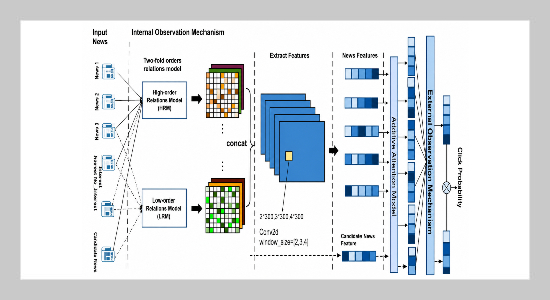
Belief-aware knowledge graph recommendation framework with internal and external observation mechanisms.
Copyright The Author(s). This is an open access article distributed under the terms of the Creative Commons Attribution License (CC BY 4.0), which permits unrestricted use, distribution, and reproduction in any medium, provided the original author and source are cited.
Download Citation: BibTeX | http://dx.doi.org/10.6180/jase.202612_35.009
In the multimedia environment, news recommendation not only influences user behavior but also profoundly impacts cognitive structures and the evolution of public opinion. Existing methods often treat recommendation and public opinion analysis separately, making it difficult to depict the unified mechanism of “information input cognitive update dissemination and diffusion.” To address this issue, this paper proposes a knowledge graph-based collaborative modeling framework for news recommendation and public opinion[cite: 5]. This method uses the user’s cognitive network as its core, introducing internal and external observation mechanisms to unify the modeling of news semantic representation, cognitive evolution, and information dissemination processes[cite: 5]. Specifically, the knowledge graph is used to construct structured semantic relationships and capture complex dependencies through high- and low-order relationship modeling; simultaneously, an attention-based observation mechanism characterizes the dynamic impact of news on user cognition, thereby achieving collaborative optimization of recommendation and public opinion[cite: 5]. Experimental results show that the proposed method significantly outperforms existing methods on multiple real-world datasets, improving recommendation performance (Precision, Recall, NDCG) and achieving significant advantages in public opinion prediction (MAE, F1) and stability and polarization control[cite: 5]. Further analysis verifies the effectiveness of the model in terms of diversity, interpretability, and public opinion guidance capabilities[cite: 5].
Keywords: News Recommendation; Public Opinion Analysis; Knowledge Graph; Cognitive Network; Information Diffusion
- [1] J. Huang, (2025) “An Information Dissemination Strategy in Social Networks Based on Graph and Content Analysis” Egyptian Informatics Journal 29: 100563. DOI: 10.1016/j.eij.2024.100563.
- [2] Y. Liu, S. Song, and H. Lv. “Identification of Key Nodes in Public Opinion Communication by Integrating Knowledge Graph”. In: Proceedings of the 9th International Conference on Cyber Security and Information Engineering. 2024, 109–114. DOI: 10.1145/3689236.3689858.
- [3] X. Hu, L. Chen, A. Yin, M. Li, and Y. Sun. “Multi-Dimensional Public Opinion Risk Assessment Indicator System Based on Knowledge Graph”. In: Proceedings of the 5th International Conference on Electronic Information Engineering and Computer Science (EIECS). 2025, 1339–1346. DOI: 10.1109/EIECS67708.2025.11283566.
- [4] R. A. Dar, R. Hashmy, M. S. Anwar, P. Böhm, and J. Frnda, (2025) “Semantic Knowledge Graph Fusion for Fake News Detection: Unifying Content-Based Features and Evidence-Based Analysis in the COVID-19 Infodemic” PLoS One 20(7): e0321919. DOI: 10.1371/journal.pone.0321919.
- [5] C. Zhang, M. Li, and D. Wu, (2022) “Federated Multidomain Learning with Graph Ensemble Autoencoder GMM for Emotion Recognition” IEEE Transactions on Intelligent Transportation Systems 24(7): 7631–7641. DOI: 10.1109/TITS.2022.3203800.
- [6] J. Wang, T. Duan, S. Yao, and Y. Wang. “Construction and Application of a Multimodal Knowledge Graph for Social Media Opinion Analysis Based on Large Language Models”. In: Proceedings of the International Conference on Artificial Intelligence, Big Data and Algorithms (CAIBDA). 2025, 399–405. DOI: 10.1109/CAIBDA65784.2025.11182762.
- [7] X. Mou, Y. Xiao, W. He, R. Wang, S. Duan, and Q. Li, (2025) “An Information Dissemination Model Based on Rumor and Antirumor and Cognitive Game” IEEE Transactions on Computational Social Systems 12(5): 2480–2493. DOI: 10.1109/TCSS.2025.3526587.
- [8] C. Duan, W. Zhang, Q. Cui, Y. Pei, B. He, and Q. Huang, (2025) “Enhancing MOOC Recommendation Through Preference-Aware Knowledge Graph Diffusion and Temporal Sequence Modeling” Information 16(12): 1061. DOI: 10.3390/info16121061.
- [9] M. Zhang, Q. Dong, and X. Wu, (2024) “How Misinformation Diffuses on Online Social Networks: Radical Opinions, Adaptive Relationship, and Algorithmic Intervention” IEEE Transactions on Computational Social Systems 12(5): 2047–2061. DOI: 10.1109/TCSS.2024.3502662.
- [10] H. Li, L. Jiang, and J. Li, (2024) “Continuous-Time Dynamic Graph Networks Integrated with Knowledge Propagation for Social Media Rumor Detection” Mathematics 12(22): 3453. DOI: 10.3390/math12223453.
- [11] Q. Zhao and Y. Wang. “Public Opinion Analysis and Risk Prediction in International Markets by Integrating BERT and Knowledge Graphs”. In: Proceedings of the International Conference on Computers, Information Processing and Advanced Education (CIPAE). 2025, 914–919. DOI: 10.1109/CIPAE66821.2025.00161.
- [12] H. Xu, M. Xu, X. Deng, and B. Wang, (2025) “Sentiment Diffusion in Online Social Networks: A Survey from the Computational Perspective” ACM Computing Surveys 57(12): 1–35. DOI: 10.1145/3736750.
- [13] H. Xu, C. Gao, X. Li, and Z. Wang, (2025) “SIGRL: Sociologically-Informed Graph Representation Learning for Social Influence Prediction” IEEE Transactions on Network Science and Engineering 12(5): 4164–4181. DOI: 10.1109/TNSE.2025.3569545.
- [14] C. Zhang, G. Shan, and B. H. Roh, (2025) “FMD-IoV: Security and Robust Enhancement for Federated Multi-Domain Learning-Based IoV” IEEE Transactions on Intelligent Transportation Systems 26(9): 14225–14236. DOI: 10.1109/TITS.2025.3527455.
- [15] X. Chen, (2025) “Collaborative Causal Inference and Multi-Agent Dynamic Intervention for ’Dual Carbon’ Public Opinion Driven by Reinforced Large Language Models and Diffusion Models” Systems 13(8): 689. DOI: 10.3390/systems13080689.