

Weijian Shen, Bingjun Yang, Le Yang, and Chaobiao Meng
School of Hydraulic Engineering, Zhejiang University of Water Resources and Electric Power, Hangzhou 310018, Zhejiang, China
Received: May 22, 2026
Accepted: July 24, 2026
Publication Date: August 26, 2026
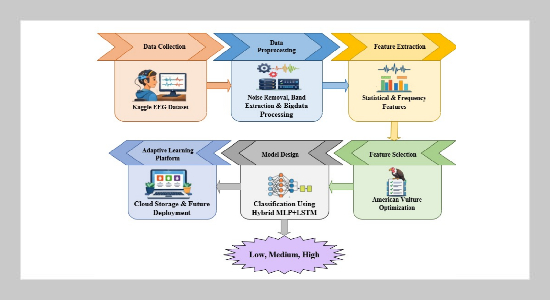
The Overall Proposed Work
Copyright The Author(s). This is an open access article distributed under the terms of the Creative Commons Attribution License (CC BY 4.0), which permits unrestricted use, distribution, and reproduction in any medium, provided the original author and source are cited.
Download Citation: BibTeX | http://dx.doi.org/10.6180/jase.202612_35.007
Education is going through a remarkable transformation brought about by the convergence of cloud computing and big data, which have enabled educational institutions to develop very different and individualized learning experiences for each student depending on his/her needs. But, even with the technology in place, the tracking of engagement in ideological education has not been able to break its limitations, causing disengagement, which is consequently leading to slow overall learning. The authors of the paper propose to create a flexible and tolerant cloud-based educational platform using big data analytics powered by AI in the Higher Education sector. One of the main goals of the research is to establish a system that will employ AI for the real-time classification of student engagement based on EEG signals and behavioral data and will thus adapt the content and the learning paths accordingly. The investigation will utilize a combination of Multilayer Perceptron (MLP) and Long Short-Term Memory networks (LSTM) African Vultures Optimization Algorithm (AVOA) will be used for feature selection, and cloud-based data storage will be provided to make the system scalable. The performance results of the proposed system have shown a very significant improvement over traditional models, with the MLP-LSTM combination achieving an accuracy of 92.6%, precision of 92.1%, recall of 91.8%, and F1 score of 91.9%.
Keywords: EEG Analysis, Student Engagement, Feature Optimization, AVOA, Cognitive Monitoring, Intelligent Systems
- [1] S. E. Bibri, (2019) “The Sciences Underlying Smart Sustainable Urbanism: Unprecedented Paradigmatic and Scholarly Shifts in Light of Big Data Science and Analytics” Smart Cities 2(2): 179-213. DOI: https://doi.org/10.3390/smartcities2020013.
- [2] H. Kusumastuti, D. Pranita, M. Viendyasari, M. S. Rasul, and S. Sarjana, (2024) “Leveraging Local Value in a Post-Smart Tourism Village to Encourage Sustainable Tourism” Sustainability 16(2): 873. DOI: https://doi.org/10.3390/su16020873.
- [3] H. S. Lallie, A. Thompson, E. Titis, and P. Stephens, (2025) “Analysing Cyber Attacks and Cyber Security Vulnerabilities in the University Sector” Computers 14(2): 49. DOI: https://doi.org/10.3390/computers14020049.
- [4] X. Ju and H. Xiang, (2025) “Software Technology Helps Ideological Education Form a New Educational Paradigm” Discover Artificial Intelligence 5(1): 382. DOI: https://doi.org/10.1007/s44163-025-00626-w.
- [5] D. Wu et al., (2025) “Wuhan University Pioneers the ‘AI + Professional Knowledge Graph Spanning the Teaching-Learning-Management-Evaluation Chain” Frontiers in Digital Education 2(1): 3. DOI: https://doi.org/10.1007/s44366-025-0042-2.
- [6] W. Tang and S. Yang, (2023) “Enterprise Digital Management Efficiency under Cloud Computing and Big Data” Sustainability 15(17): 13063. DOI: https://doi.org/10.3390/su151713063.
- [7] X.-S. Zhai, X.-Y. Chu, M. Chen, J. Shen, and F.-L. Lou, (2023) “Can Edu-Metaverse Reshape Virtual Teaching Community (VTC) to Promote Educational Equity? An Exploratory Study” IEEE Transactions on Learning Technologies 16(6): 1130-1140. DOI: https://doi.org/10.1109/TLT.2023.3276876.
- [8] M. Huang, Y. E. Tang, Y. Liu, and Q. Wang, (2025) “A Trinity Teaching Mode Grounded in the MOA Framework: Insights from Wuhan University’s Internet Marketing Course” Frontiers in Digital Education 2(1): 13. DOI: https://doi.org/10.1007/s44366-025-0049-8.
- [9] S. H. Mian, B. Salah, W. Ameen, K. Moiduddin, and H. Alkhalefah, (2020) “Adapting Universities for Sustainability Education in Industry 4.0: Channel of Challenges and Opportunities” Sustainability 12(15): 6100. DOI: https://doi.org/10.3390/su12156100.
- [10] A. Nambiar and D. Mundra, (2022) “An Overview of Data Warehouse and Data Lake in Modern Enterprise Data Management” Big Data and Cognitive Computing 6(4): 132. DOI: https://doi.org/10.3390/bdcc6040132.
- [11] Kaggle. Student Engagement Dataset. Accessed: Dec. 29, 2025. 2025. URL: https://www.kaggle.com/datasets/ziya07/student-engagement-dataset-using-eeg.
- [12] M. K. Syed, H. Wang, A. A. Siddiqi, S. Qureshi, and M. A. Gouda, (2025) “EEG-Based Attention Classification for Enhanced Learning Experience” Applied Sciences 15(15): 8668. DOI: https://doi.org/10.3390/app15158668.
- [13] A. Das, S. Singh, J. Kim, T. A. Ahanger, and A. A. Pise, (2025) “Enhanced EEG Signal Classification in Brain Computer Interfaces Using Hybrid Deep Learning Models” Scientific Reports 15(1): 27161. DOI: https://doi.org/10.1038/s41598-025-07427-2.
- [14] L. Wei, Y. Yu, Y. Qin, and S. Zhang, (2025) “A Survey of EEG-Based Approaches to Classroom Attention Assessment in Education” Information 16(10): 860. DOI: https://doi.org/10.3390/info1610860.
- [15] M. K. Titkanlou, D. T. Pham, and R. Mouček, (2025) “Classification of EEG Signal Using Deep Learning Architectures Based Motor-Imagery for an Upper-Limb Rehabilitation Exoskeleton” SN Computer Science 6(3): 193. DOI: https://doi.org/10.1007/s42979-025-03743-6.