
College of Business Administration, Gingko College of Hospitality Management, Chengdu City, 611743, Sichuan Province, China
Received: May 13, 2026
Accepted: July 29, 2026
Publication Date: August 26, 2026
Applying Artificial Intelligence To Develop Adaptive Talent Management And Succession Planning Systems In HRM
Copyright The Author(s). This is an open access article distributed under the terms of the Creative Commons Attribution License (CC BY 4.0), which permits unrestricted use, distribution, and reproduction in any medium, provided the original author and source are cited.
Download Citation: BibTeX | http://dx.doi.org/10.6180/jase.202612_35.006
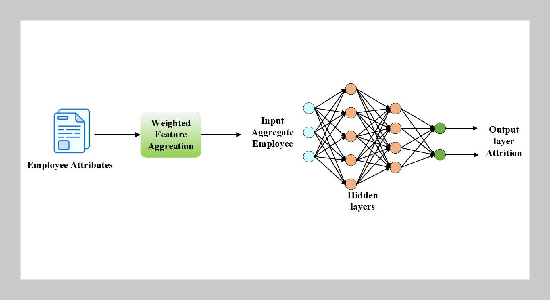
Human Resource Management (HRM) is increasingly driven by artificial intelligence, yet many HR analytics models remain static and fail to capture evolving career patterns. This study proposes an adaptive AI framework integrating Deep Neural Networks (DNN) and Long Short-Term Memory (LSTM) models for employee attrition prediction and career-stage progression modeling. Using the IBM HR Analytics dataset, the framework employs weighted feature aggregation, DNN-based classification, and LSTM-driven temporal analysis, alongside an adaptive retraining mechanism. Results show improved performance with 95.58% accuracy, 1.00 precision, 72.34 recall, 83.95 F1-score, and 0.84 ROC-AUC. The model also enhances minority-class recall and PR-AUC under class imbalance. Overall, the framework offers a scalable and intelligent solution for succession planning and data-driven workforce management in dynamic organizational environments.
Keywords: Adaptive Learning, Talent Management, Succession Planning, Employee Attrition, Deep Neural Networks
- [1] D. Hudiyah, B. Sutarto, L. Marthalia, G. Prayudo, and P. Prihatini, (2025) “The Role of Human Resource Management in the Succession Planning Process” Research Horizon 5(3): 751-762. DOI: https://doi.org/10.54518/rh.5.3.2025.630.
- [2] A. M. Căvescu and N. Popescu, (2025) “Predictive Analytics in Human Resources Management: Evaluating AIHR’s Role in Talent Retention” AppliedMath 5(3): 99. DOI: https://doi.org/10.3390/appliedmath5030099.
- [3] J. Roul, L. M. Mohapatra, A. K. Pradhan, and A. V. S. Kamesh, (2024) “Analysing the Role of Modern Information Technologies in HRM: Management Perspective and Future Agenda” Kybernetes 54(14): 7409-7434. DOI: https://doi.org/10.1108/K-11-2023-2512.
- [4] Z. Yifan, (2025) “Innovation and Optimization Path of Flexible Human Resource Management in Projects in the Digital and Intelligent Era” Journal of Business Economics Research 1(7): DOI: https://doi.org/10.63887/jber.2025.1.7.6.
- [5] I. S. Coffie, R. Müller, M. Marfo, E. C. Ocloo, and N. de Klerk, (2024) “Succession Planning Practices and Succession Success in Family-Owned Businesses: The Role of Leadership Style as Internal Branding Mechanism” Journal of Family Business Management 15(3): 684-704. DOI: https://doi.org/10.1108/JFBM-09-2024-0207.
- [6] S. Mahabub, M. R. Hossain, and E. Z. Snigdha, (2025) “Data-Driven Decision-Making and Strategic Leadership: AI-Powered Business Operations for Competitive Advantage and Sustainable Growth” Journal of Computer Science and Technology Studies 7(1): 326-336. DOI: https://doi.org/10.32996/jcsts.2025.7.1.24.
- [7] K. K. R. Yanamala, (2024) “Strategic Implications of AI Integration in Workforce Planning and Talent Forecasting” Journal of Advanced Computer Systems 4(1): 1-9. DOI: https://doi.org/10.69987/JACS.2024.40101.
- [8] F. Bildirici, T. D. Medeni, I. T. Medeni, D. Soylu, and I. E. Kökdemir, (2025) “Artificial Intelligence Supported Career Platform Model: A Proposal for Adaptive Development in Companies and Talents” Kamu Yönetimi ve Teknoloji Dergisi 7(2): 209-230. URL: https://dergipark.org.tr/en/pub/kaytek/article/1763861.
- [9] R. Vedapradha, R. Hariharan, E. Sudha, and V. Divyashree, (2024) “Artificial Intelligence – Talent Acquisition in HEIs Recruitments” International Journal of Information and Learning Technology 41(3): 230-243. DOI: https://doi.org/10.1108/IJILT-09-2023-0176.
- [10] L. O. Arini, D. N. Ardillah, and S. Shaddiq, (2025) “Aligning Human Resource Information Systems with the Imperatives of Society 5.0: A Strategic Framework for Digital Talent Management in the Indonesian Banking Sector” Jurnal Riset Multidisiplin Edukasi 2(7): 300-322. DOI: https://doi.org/10.71282/jurmie.v2i7.656.
- [11] J. Barach, (2026) “Enhancing Ransomware Resilience in Cloud-Based HR Systems Through Moving Target Defense” Computers, Materials & Continua 86(2): 1. DOI: https://doi.org/10.32604/cmc.2025.071705.
- [12] R. K. Ramasamy, M. Muniandy, and P. Subramanian, (2025) “A Predictive Framework for Sustainable Human Resource Management Using tNPS-Driven Machine Learning Models” Sustainability 17(13): 5882. DOI: https://doi.org/10.3390/su17135882.
- [13] F. Guerranti and G. M. Dimitri, (2023) “A Comparison of Machine Learning Approaches for Predicting Employee Attrition” Applied Sciences 13(1): 267. DOI: https://doi.org/10.3390/app13010267.
- [14] IBM. IBM HR Analytics Employee Attrition & Performance. Dataset. 2026. URL: https://www.kaggle.com/datasets/pavansubhasht/ibm-hr-analytics-attrition-dataset.
- [15] M. S. Alshiddy and B. N. Aljaber, (2023) “Employee Attrition Prediction using Nested Ensemble Learning Techniques” International Journal of Advanced Computer Science and Applications 14(7): DOI: https://doi.org/10.14569/IJACSA.2023.01407101.
- [16] W. Li, (2023) “A Transformer-Based Deep Learning Framework to Predict Employee Attrition” PeerJ Computer Science 9: e1570. DOI: https://doi.org/10.7717/peerj-cs.1570.