

Received: June 15, 2026
Accepted: July 27, 2026
Publication Date: August 26, 2026
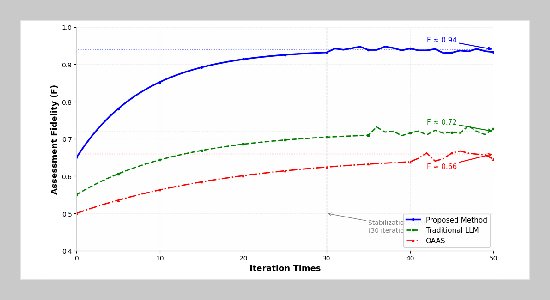
Trend Curve of Assessment Fidelity with Iteration Times
Copyright The Author(s). This is an open access article distributed under the terms of the Creative Commons Attribution License (CC BY 4.0), which permits unrestricted use, distribution, and reproduction in any medium, provided the original author and source are cited.
Download Citation: BibTeX | http://dx.doi.org/10.6180/jase.202612_35.005
The digital transformation of education has put forward higher requirements for the full-cycle operation of teaching activities. Traditional teaching modes suffer from insufficient personalized adaptation, distorted assessment results, and uneven distribution of learning resources, which restrict the high-quality development of modern education. This paper proposes a full-cycle teaching framework driven by generative intelligent algorithms, aiming to address three core challenges: teaching innovation, assessment fidelity, and equalization of learning opportunities. First, a hybrid generative teaching content generation model combining conditional variational autoencoder (CVAE) and large language model (LLM) is constructed to realize adaptive generation of personalized teaching resources. Second, a multi-dimensional assessment fidelity evaluation function is established to quantify the deviation between automated assessment results and manual evaluation standards, and an error correction module based on generative adversarial network (GAN) is embedded to optimize assessment accuracy. Third, a resource allocation optimization algorithm oriented to learning opportunity equalization is designed to dynamically distribute teaching resources according to learners’ ability distribution. A series of comparative experiments are conducted on datasets collected from university general courses. The experimental results show that the proposed framework improves the richness of innovative teaching content by 32.7%, reduces the assessment deviation by 28.4%, and effectively narrows the learning gap among different student groups. The proposed generative intelligent teaching system can stably support the full-cycle teaching process, provide a feasible technical path for intelligent, fair and innovative modern education, and has good application and promotion value in the field of educational informatization.
Keywords: Generative Intelligent Algorithm, Full-cycle Teaching, Teaching Innovation, Assessment Fidelity, Learning Opportunity Equalization, Educational Artificial Intelligence
- [1] T. Wang and S. Yin, (2026) “Enhancing Sustainability of Online Education via a Validated Cloud Management Framework” IFS/ACM Transactions on Machine Learning 3(1): 9-19. DOI: https://doi.org/10.70891/TML.2026.040004.
- [2] N. Kerimbayev, K. Adamova, R. Shadiev, and Z. Altinay, (2025) “Intelligent educational technologies in individual learning: a systematic literature review” Smart Learning Environments 12(1): 1. DOI: https://doi.org/10.1186/s40561-024-00360-3.
- [3] C. A. Lu, (2025) “Tracing the evolution of artificial intelligence education at Stanford University” TechTrends 69(2): 447-453. DOI: https://doi.org/10.1007/s11528-025-01046-4.
- [4] V. Nandini and P. Uma Maheswari, (2020) “Automatic assessment of descriptive answers in online examination system using semantic relational features” The Journal of Supercomputing 76(6): 4430-4448. DOI: https://doi.org/10.1007/s11227-018-2381-y.
- [5] Y. Watanobe, M. M. Rahman, U. K. Rage, and R. Penugonda. “Online automatic assessment system for program code: Architecture and experiences”. In: International Conference on Industrial, Engineering and Other Applications of Applied Intelligent Systems. Springer. 2021, 272-283. DOI: https://doi.org/10.1007/978-3-030-79463-7_23.
- [6] Z. Ullah, A. Lajis, M. Jamjoom, A. Altalhi, A. Al-Ghamdi, and F. Saleem, (2018) “The effect of automatic assessment on novice programming: Strengths and limitations of existing systems” Computer Applications in Engineering Education 26(6): 2328-2341. DOI: https://doi.org/10.1002/cae.21974.
- [7] J. Qiu, G. Lu, T. Liu, D. Zhang, S. Xiao, and T. Yu, (2025) “Optoelectronic generative adversarial networks” Communications Physics 8(1): 162. DOI: https://doi.org/10.1038/s42005-025-02081-6.
- [8] Y. Ding, Z. Li, and N. Zhou, (2025) “Quantum generative adversarial network based on the quantum Born machine” Advanced Engineering Informatics 68: 103622. DOI: https://doi.org/10.1016/j.aei.2025.103622.
- [9] Y. Jiang and S. Yin, (2023) “Heterogenous-view occluded expression data recognition based on cycle-consistent adversarial network and K-SVD dictionary learning under intelligent cooperative robot environment” Computer Science and Information Systems 20(4): 1869-1883. DOI: https://doi.org/10.2298/CSIS221228034.
- [10] X. Huang and C. Qiao, (2024) “Enhancing computational thinking skills through artificial intelligence education at a STEAM high school” Science & Education 33(2): 383-403. DOI: https://doi.org/10.1007/s11191-022-00392-6.
- [11] R. Zhao, L. Zhang, B. Fu, C. Hu, J. Su, and Y. Chen. “Conditional variational autoencoder for sign language translation with cross-modal alignment”. In: Proceedings of the AAAI Conference on Artificial Intelligence 38(17): 19643-19651. DOI: https://doi.org/10.1609/aaai.v38i17.29937.
- [12] X. Tang, J. Yan, Y. Li, X. Zhang, and Z. Song, (2024) “Semi-supervised deep conditional variational autoencoder for soft sensor modeling” IEEE Sensors Journal 24(5): 7153-7164. DOI: https://doi.org/10.1109/JSEN.2024.3351431.
- [13] Q. Li, X. Wan, H. Guo, W. Wang, M. Liu, and Y. Cui, (2026) “Uncertainty-aware multi-modal time series anomaly detection via reduced-order evidence fusion” Pattern Recognition 114212. DOI: https://doi.org/10.1016/j.patcog.2026.114212.
- [14] S. Agostinelli, A. del-Río-Ortega, B. Estrada-Torres, R. Goñi-Medina, A. Marrella, M. Resinas, and J. Rossi, (2026) “PPIPilot: Automating the suggestion and computation of Process Performance Indicators from event logs” Information Systems 102765. DOI: https://doi.org/10.1016/j.is.2026.102765.
- [15] J. William McKenna and M. Parenti, (2017) “Fidelity assessment to improve teacher instruction and school decision making” Journal of Applied School Psychology 33(4): 331-346. DOI: https://doi.org/10.1080/15377903.2017.1316334.
- [16] J. D. Richardson, S. G. Hudspeth Dalton, J. Shafer, and J. Patterson, (2016) “Assessment fidelity in aphasia research” American Journal of Speech-Language Pathology 25(4S): S788-S797. DOI: https://doi.org/10.1044/2016_AJSLP-15-0146.
- [17] Z. Wang, L. Chen, S. Song, P. X. Cong, and Q. Ruan, (2020) “Automatic cyber security risk assessment based on fuzzy fractional ordinary differential equations” Alexandria Engineering Journal 59(4): 2725-2731. DOI: https://doi.org/10.1016/j.aej.2020.05.014.
- [18] H. Qin, (2025) “Maximal Information Coefficient-Based Undersampling Method for Highly-Imbalanced Learning” IEEE Access 13: 4126-4135. DOI: https://doi.org/10.1109/ACCESS.2025.3525475.
- [19] G. Charizanos, H. Demirhan, and D. İçen, (2024) “A Monte Carlo fuzzy logistic regression framework against imbalance and separation” Information Sciences 655: 119893. DOI: https://doi.org/10.1016/j.ins.2023.119893.