




Received: July 21, 2026
Accepted: August 08, 2026
Publication Date: August 26, 2026
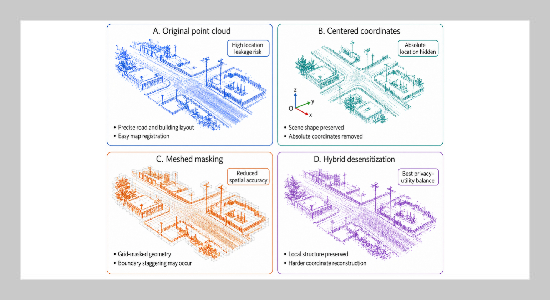
Visualization of sensitive geospatial coordinate de-identification in LiDAR point clouds
Copyright The Author(s). This is an open access article distributed under the terms of the Creative Commons Attribution License (CC BY 4.0), which permits unrestricted use, distribution, and reproduction in any medium, provided the original author and source are cited.
Download Citation: BibTeX | http://dx.doi.org/10.6180/jase.202612_35.002
Cross-domain LiDAR point clouds have become an important data foundation for smart cities, high-precision map updating, road inspection, industrial-park digital twins, and critical infrastructure monitoring, yet they are usually collected in a decentralized manner by different institutions, regions, and sensing platforms, so direct centralized sharing may increase the risk of exposing sensitive geographic coordinates, facility outlines, and road topology. Because existing centralized point-cloud learning methods still struggle to balance cross-domain generalization, privacy protection, and system scalability, this paper proposes a scalable federated learning system for cross-domain LiDAR point cloud processing. The system adopts a three-layer architecture of edge point-cloud clients, regional coordination nodes, and a cloud-based secure aggregation server, in which point-cloud sampling, coordinate anonymization, local geometric feature extraction, and semantic segmentation are performed locally. Collaborative modeling without raw point-cloud upload is enabled through cross-domain category prototype alignment, client-adaptive weight aggregation, differential privacy, secure aggregation, Top-k sparsification, and 8-bit quantization. In simulations across four cross-domain scenarios, the method achieves an average mIoU of 67.2%, exceeding FedAvg (58.8%) and FedBN (62.0%), and retains 61.4% under severe Non-IID conditions. At a privacy budget of ε = 2, the attack success rate falls from 63.5% to 24.8% while mIoU remains 67.2%, and with 100 clients single-round communication drops from 21.96 GB to 7.92 GB. The system thus improves semantic performance, reduces sensitive-information leakage, and maintains communication efficiency and training stability as the number of clients grows.
Keywords: federated learning; LiDAR point cloud; cross-domain learning; sensitive geographic information protection; scalable information systems; differential privacy; edge-cloud collaboration
- [1] Y. Guo, H. Wang, Q. Hu, H. Liu, L. Liu, and M. Bennamoun, (2021) “Deep Learning for 3D Point Clouds: A Survey” IEEE Transactions on Pattern Analysis and Machine Intelligence 43(12): 4338-4364. DOI: 10.1109/TPAMI.2020.3005434.
- [2] L. Ma, Y. Li, J. Li, W. Tan, Y. Yu, and M. A. Chapman, (2021) “Multi-Scale Point-Wise Convolutional Neural Networks for 3D Object Segmentation From LiDAR Point Clouds in Large-Scale Environments” IEEE Transactions on Intelligent Transportation Systems 22(2): 821-836. DOI: 10.1109/TITS.2019.2961060.
- [3] H.-X. Cheng, X.-F. Han, and G.-Q. Xiao, (2023) “TranSRVNet: LiDAR Semantic Segmentation With Transformer” IEEE Transactions on Intelligent Transportation Systems 24(6): 5895-5907. DOI: 10.1109/TITS.2023.3248117.
- [4] F. Wang, Z. Wu, Y. Yang, W. Li, Y. Liu, and Y. Zhuang, (2023) “Real-Time Semantic Segmentation of LiDAR Point Clouds on Edge Devices for Unmanned Systems” IEEE Transactions on Instrumentation and Measurement 72: 1-11. DOI: 10.1109/TIM.2023.3292948.
- [5] A. Piroli, V. Dallabetta, J. Kopp, D. Meissner, M. Walessa, and K. Dietmayer, (2024) “Label-Efficient Semantic Segmentation of LiDAR Point Clouds in Adverse Weather Conditions” IEEE Robotics and Automation Letters 9(6): 5575-5582. DOI: 10.1109/LRA.2024.3396099.
- [6] Q. Li, Z. Wen, Z. Wu, S. Hu, N. Wang, Y. Li, X. Liu, and B. He, (2023) “A Survey on Federated Learning Systems: Vision, Hype and Reality for Data Privacy and Protection” IEEE Transactions on Knowledge and Data Engineering 35(4): 3347-3366. DOI: 10.1109/TKDE.2021.3124599.
- [7] P. Kairouz, H. B. McMahan, B. Avent, A. Bellet, M. Bennis, A. N. Bhagoji, K. Bonawitz, Z. Charles, G. Cormode, R. Cummings, et al., (2021) “Advances and Open Problems in Federated Learning” Foundations and Trends in Machine Learning 14(1-2): 1-210. DOI: 10.1561/2200000083.
- [8] H. Zhu, J. Xu, S. Liu, and Y. Jin, (2021) “Federated Learning on Non-IID Data: A Survey” Neurocomputing 465: 371-390. DOI: 10.1016/j.neucom.2021.07.098.
- [9] X. Yin, Y. Zhu, and J. Hu, (2021) “A Comprehensive Survey of Privacy-Preserving Federated Learning: A Taxonomy, Review, and Future Directions” ACM Computing Surveys 54(6): Article 131, 1-36. DOI: 10.1145/3460427.
- [10] D. C. Nguyen, M. Ding, Q.-V. Pham, P. N. Pathirana, L. B. Le, A. Seneviratne, J. Li, D. Niyato, and H. V. Poor, (2021) “Federated Learning Meets Blockchain in Edge Computing: Opportunities and Challenges” IEEE Internet of Things Journal 8(16): 12806-12825. DOI: 10.1109/JIOT.2021.3072611.
- [11] P. Prakash, J. Ding, R. Chen, X. Qin, Q. Cui, Y. Guo, and M. Pan, (2022) “IoT Device Friendly and Communication-Efficient Federated Learning via Joint Model Pruning and Quantization” IEEE Internet of Things Journal 9(15): 13638-13650. DOI: 10.1109/JIOT.2022.3145865.
- [12] A. El Ouadrhiri and A. Abdelhadi, (2022) “Differential Privacy for Deep and Federated Learning: A Survey” IEEE Access 10: 22359-22380. DOI: 10.1109/ACCESS.2022.3151670.
- [13] D. R. Harris. “Leveraging Differential Privacy in Geospatial Analyses of Standardized Healthcare Data”. In: 2020 IEEE International Conference on Big Data (Big Data). 2020, 3119-3122. DOI: 10.1109/BigData50022.2020.9378390.
- [14] R. Cura, J. Perret, and N. Paparoditis, (2017) “A Scalable and Multi-Purpose Point Cloud Server (PCS) for Easier and Faster Point Cloud Data Management and Processing” ISPRS Journal of Photogrammetry and Remote Sensing 127: 39-56. DOI: 10.1016/j.isprsjprs.2016.06.012.
- [15] Y. Lin, G. Vosselman, Y. Cao, and M. Y. Yang, (2021) “Local and Global Encoder Network for Semantic Segmentation of Airborne Laser Scanning Point Clouds” ISPRS Journal of Photogrammetry and Remote Sensing 176: 151-168. DOI: 10.1016/j.isprsjprs.2021.04.016.