


Received: May 24, 2026
Accepted: August 03, 2026
Publication Date: August 22, 2026
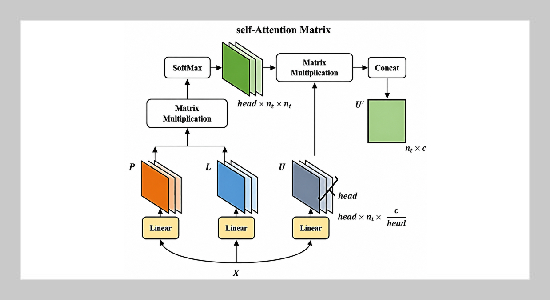
The architectural flow of the increased SAtt system with dynamic attention head weightings
Copyright The Author(s). This is an open access article distributed under the terms of the Creative Commons Attribution License (CC BY 4.0), which permits unrestricted use, distribution, and reproduction in any medium, provided the original author and source are cited.
Download Citation: BibTeX | http://dx.doi.org/10.6180/jase.202611_34.063
In recent years, neural network-based approaches have revolutionized the field of machine translation (MT), with Transformer models and their self-attention mechanisms becoming the dominant paradigm. This research presents an improved neural network approach for English translation, focusing on refining output quality and reducing redundancy through an enhanced self-attention mechanism. The Monarch Butterfly Optimized
Bidirectional Encoder Representations from Transformers with self-attention (MBO-BERT-SAtt) is a model that dynamically weighs contextual information to produce fluent and lexically diverse translations while minimizing repetitive elements. The research utilizes a 2000-pair English-Japanese parallel translation dataset, a large-scale bilingual corpus combining Japanese-English parallel texts. Data preprocessing includes normalization and tokenization of long sentence pairs to improve model training efficiency. The model incorporates a dynamic attention head weighting mechanism, which selectively prunes redundant heads during training to optimize translation performance and computational resources. For evaluation, key metrics such as BLEU, and METEOR are used to quantify translation accuracy, fluency, and redundancy reduction, respectively. The Python implementation of the proposed approach achieves 97.4% recall, 98.5% accuracy, 96.6% F1-score, 70.5 BLEU, 67.6 METEOR, 1.0 s translation time, and 5.4% error rate. Human evaluation further confirms enhanced readability and contextual coherence. This approach demonstrates that refining neural translation models through targeted SAtt mechanisms and redundancy-aware training pipelines leads to more precise, natural, and efficient English translations. The results highlight the potential of combining neural network advancements with linguistic insights for next-generation MT systems capable of handling complex language phenomena such as repetition.
Keywords: Self-Attention Mechanism, Translation Quality Enhancement, Redundancy Reduction, Translation Refinement, English Translation, Bidirectional Encoder Representations from Transformers with self-attention (MBO-BERT-SAtt)
- [1] L. He, J. Guo, and J. Lin, (2022) “Design of Shared Internet of Things System for English Translation Teaching Using Deep Learning Text Classification” Wireless Communications and Mobile Computing 2022: 3576419. DOI: 10.1155/2022/3576419.
- [2] L. Su, (2024) “Study on an Intelligent English Translation Method Using an Improved Convolutional Neural Network Model” International Journal of e-Collaboration 20(1): 1–14. DOI: 10.4018/IJeC.357556.
- [3] Y. Yuxiu, (2024) “Application of Translation Technology Based on AI in Translation Teaching” System and Soft Computing 6: 200072. DOI: 10.1016/j.sasc.2024.200072.
- [4] Y. A. Mohamed, A. Khanan, M. Bashir, A. H. H. Mohamed, M. A. Adiel, and M. A. Elsadig, (2024) “The Impact of Artificial Intelligence on Language Translation: A Review” IEEE Access 12: 25553–25579. DOI: 10.1109/ACCESS.2024.3366802.
- [5] P. L. Liu and C. J. Chen, (2023) “Using an AI-Based Object Detection Translation Application for English Vocabulary Learning” Educational Technology & Society 26(3): 5–20. DOI: 10.30191/ETS.202307_26(3).0002.
- [6] X. Liu, J. He, M. Liu, Z. Yin, L. Yin, and W. Zheng, (2023) “A Scenario-Generic Neural Machine Translation Data Augmentation Method” Electronics 12(10): 2320. DOI: 10.3390/electronics12102320.
- [7] A. Ekuerhare and O. P. Udoka, (2024) “The Effect of Globalization on Language Services and Translation Strategies” International Journal of Advanced Multidisciplinary Research Studies 4(6): 507–516. DOI: 10.62225/2583049X.2024.4.6.3467.
- [8] R. Mundlamuri, G. R. Gunnam, N. K. Mysari, and J. Pujuri, (2025) “The Evolution of AI: From Classical Machine Learning to Modern Large Language Models” IEEE Access 13: DOI: 10.1109/ACCESS.2025.3621344.
- [9] B. Zhang, B. Haddow, and A. Birch. “Prompting Large Language Model for Machine Translation: A Case Study”. In: International Conference on Machine Learning. PMLR, 2023, 41092–41110.
- [10] J. Son and B. Kim, (2023) “Translation Performance from the User’s Perspective of Large Language Models and Neural Machine Translation Systems” Information 14(10): 574. DOI: 10.3390/info14100574.
- [11] J. Su, J. Chen, H. Jiang, C. Zhou, H. Lin, Y. Ge, Q. Wu, and Y. Lai, (2021) “Multi-Modal Neural Machine Translation with Deep Semantic Interactions” Information Sciences 554: 47–60. DOI: 10.1016/j.ins.2020.11.024.
- [12] F. Ma, (2022) “Application of Convolutional Neural Network Based on Deep Learning in College English Translation Teaching Management” Mobile Information Systems 2022: 9673133. DOI: 10.1155/2022/9673133.
- [13] X. Jiang, (2022) “Research on the Analysis of Correlation Factors of English Translation Ability Improvement Based on Deep Neural Network” Computational Intelligence and Neuroscience 2022: 9345354. DOI: 10.1155/2022/9345354.
- [14] N. Q. Zhao, (2025) “AI-Driven English Translation: Leveraging Machine Learning and Deep Learning for Enhanced Accuracy” International Journal of Information and Communication Technology 26(18): 1–17. DOI: 10.1504/IJICT.2025.10071429.
- [15] Q. Guo, (2025) “Deep Reinforcement Learning Method for Optimizing English Translation Algorithms” International Journal of High Speed Electronics and Systems: DOI: 10.1142/S0129156425405686.