




Received: May 07, 2026
Accepted: June 26, 2026
Publication Date: August 22, 2026
Informer encoder–decoder model for athlete injury risk prediction
Copyright The Author(s). This is an open access article distributed under the terms of the Creative Commons Attribution License (CC BY 4.0), which permits unrestricted use, distribution, and reproduction in any medium, provided the original author and source are cited.
Download Citation: BibTeX | http://dx.doi.org/10.6180/jase.202611_34.062
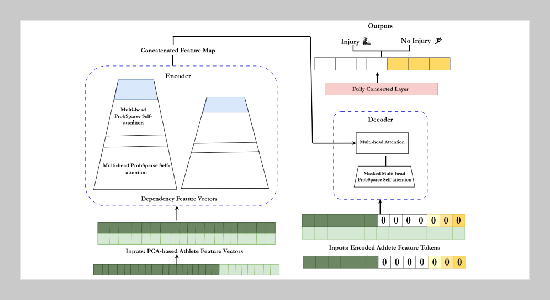
Sports injuries are increasingly common among athletes, impacting performance and recovery. Current models struggle to simulate the complex interactions of physiological, biomechanical, and workload factors, limiting their predictive accuracy. This study proposes a robust framework for accurately predicting sports injuries through multimodal monitoring. By integrating physiological, biomechanical, environmental, and workload parameters, the model processes data using algorithms for missing values, normalization, and noise reduction, followed by Principal Component Analysis. An Informer-based Deep Learning model with a ProbSparse attention mechanism effectively captures complex feature interactions. Experimental results show the model achieves accuracy, precision, recall, F1-score, and ROC-AUC of 99.63%, 99.63%, 99.63%, 99.62%, and 99.95%, respectively, outperforming traditional models like Logistic Regression and Support Vector Machine. This framework enhances early injury detection, supporting better athlete health management and training optimization.
Keywords: ports Injury Prediction, Informer Model, Wearable Sensors, Predictive Analytics, Athlete Monitoring
- [1] L. Yang, O. Amin, and B. Shihada, (2024) “Intelligent wearable systems: Opportunities and challenges in health and sports” ACM Computing Surveys 56(7): DOI: 10.1145/3648469.
- [2] A. Alzahrani and A. Ullah, (2024) “Advanced biomechanical analytics: Wearable technologies for precision health monitoring in sports performance” Digital Health 10: 1–18.
- [3] M. Kovoor, M. Durairaj, M. S. Karyakarte, M. Z. Hussain, M. Ashraf, and L. P. Maguluri, (2024) “Sensor-enhanced wearables and automated analytics for injury prevention in sports” Measurement: Sensors 32: 101054. DOI: 10.1016/j.measen.2024.101054.
- [4] A. Arzehgar et al., (2025) “Sensor-based technologies for motion analysis in sports injuries: A scoping review” BMC Sports Science, Medicine and Rehabilitation 17(1): 15. DOI: 10.1186/s13102-025-01063-z.
- [5] C. Tang, W. Yi, Z. Zhang, E. Occhipinti, and L. G. Occhipinti, (2026) “AI-Driven Smart Sportswear for Real-Time Fitness Monitoring Using Textile Strain Sensors” IEEE Transactions on Biomedical Engineering 73(2): 555–565. DOI: 10.1109/TBME.2025.3588051.
- [6] M. Sharifi-Renani, M. H. Mahoor, and C. W. Clary, (2023) “BioMAT: An open-source biomechanics multi-activity transformer for joint kinematic predictions using wearable sensors” Sensors 23(13): 5778. DOI: 10.3390/s23135778.
- [7] D. Hollinger, M. C. J. S, H. Chen, and M. Zabala, (2024) “The Effect of Sensor Feature Inputs on Joint Angle Prediction across Simple Movements” Sensors 24(11): 3657. DOI: 10.3390/s24113657.
- [8] P.-E. Dandrieux et al., (2023) “Relationship between a daily injury risk estimation feedback based on machine learning techniques and actual injury risk in athletics: Protocol for a prospective cohort study over an athletics season” BMJ Open 13(5): e069423. DOI: 10.1136/bmjopen-2022-069423.
- [9] T. Tan et al., (2023) “A scoping review of portable sensing for out-of-lab anterior cruciate ligament injury prevention and rehabilitation” NPJ Digital Medicine 6(1): 46. DOI: 10.1038/s41746-023-00782-2.
- [10] C. C. Claros-Olivares, M. N. Anderson, W. Qian, A. J. Brockmeier, and T. A. Buckley, (2025) “A Machine Learning Model for Post-Concussion Musculoskeletal Injury Risk in Collegiate Athletes” Sports Medicine 55(8): 1971–1982. DOI: 10.1007/s40279-025-02196-4.
- [11] A. Shaw, P. Newman, J. Witchalls, and T. Hedger, (2023) “Externally validated machine learning algorithm accurately predicts medial tibial stress syndrome in military trainees: A multicohort study” BMJ Open Sport and Exercise Medicine 9(2-e001566): DOI: 10.1136/bmjsem-2023-001566.
- [12] Anjalibhegam. Multimodal sports injury prediction dataset. Accessed March 19, 2026. 2026.
- [13] L. Xiang, Y. Gu, A. Wang, V. Shim, Z. Gao, and J. Fernandez, (2023) “Foot pronation prediction with inertial sensors during running: A preliminary application of data-driven approaches” Journal of Human Kinetics 87: 29–40. DOI: 10.5114/jhk/163059.
- [14] A. Benjaminse, M. Mendicino, E. M. Nijmeijer, P. Margherita, A. Gokeler, and S. Di Paolo, (2026) “On-Field Assessment of Joint Load in Football Using Machine Learning (Part II)” Sensors 26(8): 2562. DOI: 10.3390/s26082562.
- [15] X. Liu, Z. Chen, B. Zheng, Q. Guo, Y. Yu, D. Zhang, and A. Wulamu, (2022) “Spatiotemporal and kinematic characteristics augmentation using Dual-GAN for ankle instability detection” Mathematical Biosciences and Engineering 19(10): 10037–10059. DOI: 10.3934/mbe.2022469.