




Nguyen Thi Diep1 and Nguyen Kien Trung2
1Faculty of Control and Automation, Electric Power University, 235 Hoang Quoc Viet, Hanoi 100000, VietNam
2School of Electrical and Electronic Engineering, Hanoi University of Science and Technology, 01 Dai Co Viet, Hanoi 100000, VietNam
Received: January 10, 2026
Accepted: July 10, 2026
Publication Date: August 22, 2026
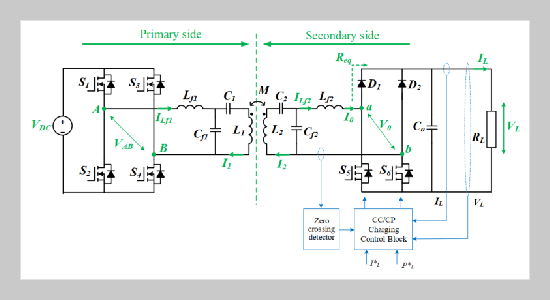
Structure of the proposed wireless charging system for AGVs
Copyright The Author(s). This is an open access article distributed under the terms of the Creative Commons Attribution License (CC BY 4.0), which permits unrestricted use, distribution, and reproduction in any medium, provided the original author and source are cited.
Download Citation: BibTeX | http://dx.doi.org/10.6180/jase.202611_34.061
Wireless power transfer has emerged as an attractive solution for charging automated guided vehicles (AGVs) in modern industrial environments. In practice, many AGVs adopt opportunity charging, where vehicles are recharged during short idle periods along their operating routes. Under such conditions, constant-current (CC) charging ensures battery safety at low states of charge, while constant-power (CP) charging maximizes energy delivery within limited charging time. Consequently, CC/CP charging control is particularly suitable for wireless AGV opportunity charging systems. This paper proposes an efficiency-oriented CC/CP charging control strategy based on an optimized dual-side LCC compensation topology and a secondary-side control scheme using a semi-active rectifier with pulse-density modulation (PDM). The proposed approach integrates the optimized dual-side LCC circuit with the semi-active rectifier and PDM control to enable efficient CC/CP regulation with a simple control structure while maintaining high power transfer efficiency over a wide load range. Simulation and experimental results verify the effectiveness of the proposed approach, demonstrating accurate CC/CP regulation, fast dynamic response, and robust operation under wide load variations, with peak efficiencies of 96.6% in simulation and 93.1% in the experimental prototype.
Keywords: Automated guided vehicle; Wireless charging; Dual-side LCC compensation; CC/CP charging control; Opportunity charging
- [1] Z. Zhang, J. Chen, and Q. Guo, (2022) “Application of Automated Guided Vehicles in Smart Automated Ware house Systems: A Survey” Computer Modeling in Engineering and Sciences 134(3): 1529–1563. DOI: 10.32604/cmes.2022.021451.
- [2] D.Colling, J. Oehler, and K. Furmans, (2019) “Battery Charging Strategies for AGV Systems” Logistics Journal: Proceedings (15): DOI: 10.2195/lj_Proc_colling_en_201912_01.
- [3] Q.S. Kabir and Y. Suzuki, (2018) “Increasing Manufacturing Flexibility through Battery Management of Automated Guided Vehicles” Computers & Industrial Engineering 117: 225–236. DOI: 10.1016/j.cie.2018.01.026.
- [4] Y. Hao, J. Wang, and Y. Liu. “Research on Wireless Power Transfer System of Automated Guided Vehicle Based on Magnetic Coupling Resonance”. In: 2019 22nd International Conference on Electrical Machines and Systems (ICEMS). 2019, 1–4. DOI: 10.1109/ICEMS.2019.8922021.
- [5] H. Matsumoto, Y. Shibako, and Y. Neba, (2018) “Contactless Power Transfer System for AGVs” IEEE Transactions on Industrial Electronics 65(1): 251–260. DOI: 10.1109/TIE.2017.2721913.
- [6] T.-S. Lee, S.-J. Huang, and M.-J. Wu, (2023) “Enhancement of Wireless Power Transfer for Automated Guided Vehicles Considering Disturbance Suppression” IEEE Access 11: 21508–21518. DOI: 10.1109/ACCESS.2023.3251890.
- [7] C. Bharatiraja, A. Mahesh, and B. Lehman, (2025) “Power Electronic Converters in Inductive Wireless Charging Applications for Electric Transportation” IEEE Journal of Emerging and Selected Topics in Power Electronics 13(2): 2647–2683. DOI: 10.1109/JESTPE.2025.3526763.
- [8] W. Li, C. C. Mi, S. Li, J. Deng, T. Kan, and H. Zhao, (2015) “Integrated LCC Compensation Topology for Wireless Charger in Electric and Plug-in Electric Vehicles” IEEE Transactions on Industrial Electronics 62(7): 4215–4225. DOI: 10.1109/TIE.2014.2384003.
- [9] W. Li, H. Zhao, J. Deng, S. Li, and C. C. Mi, (2016) “Comparison Study on SS and Double-Sided LCC Compensation Topologies for EV/PHEV Wireless Chargers” IEEE Transactions on Vehicular Technology 65(6): 4429–2239. DOI: 10.1109/TVT.2015.2479938.
- [10] M. Venkatesan, N. Rajamanickam, P. Vishnuram, M. Bajaj, V. Blazek, L. Prokop, and S. Misak, (2022) “A Review of Compensation Topologies and Control Techniques of Bidirectional Wireless Power Transfer Systems for Electric Vehicle Applications” Energies 15(20): 1–34. DOI: 10.3390/en15207816.
- [11] C. Cheng, F. Lu, Z. Zhou, W. Li, Z. Deng, F. Li, and C. C. Mi, (2020) “A Load-Independent LCC-Compensated Wireless Power Transfer System for Multiple Loads with a Compact Coupler Design” IEEE Transactions on Industrial Electronics 67(6): 4507–4515. DOI: 10.1109/TIE.2019.2931260.
- [12] J. Deng, B. Pang, W. Shi, and Z. Wang, (2017) “Magnetic Integration of LCC Compensation Topology with Minimized Extra Coupling Effects for Wireless EV Charger” Energy Procedia 105: 2281–2286. DOI: 10.1016/j.egypro.2017.03.659.
- [13] F. Lu, H. Zhang, H. Hofmann, W. Su, and C. C. Mi, (2018) “A Dual-Coupled LCC-Compensated IPT System With a Compact Magnetic Coupler” IEEE Transactions on Power Electronics 33(7): 6391–6402. DOI: 10.1109/TPEL.2017.2748391.
- [14] E. ElGhanam, M. Hassan, and A. Osman, (2021) “Design of a High Power, LCC-Compensated, Dynamic, Wireless Electric Vehicle Charging System with Improved Misalignment Tolerance” Energies 14(4): 885. DOI: 10.3390/en14040885.
- [15] S. Li, W. Li, J. Deng, T. D. Nguyen, and C. C. Mi, (2015) “A Double-Sided LCC Compensation Network and Its Tuning Method for Wireless Power Transfer” IEEE Transactions on Vehicular Technology 64(6): 2261–2273. DOI: 10.1109/TVT.2014.2347006.
- [16] H. Feng, T. Cai, S. Duan, J. Zhao, X. Zhang, and C. Chen, (2016) “An LCC Compensated Resonant Converter Optimized for Robust Reaction to Large Coupling Variation in Dynamic Wireless Power Transfer” IEEE Transactions on Industrial Electronics 63(10): 6591–6601. DOI: 10.1109/TIE.2016.2589922.
- [17] H. R. Cha, R. Y. Kim, K. H. Park, and Y. J. Choi, (2019) “Modeling and Control of Double-Sided LCC Compensation Topology with Semi-Bridgeless Active Rectifier for Inductive Power Transfer System” Energies 12(20): 3921. DOI: 10.3390/en12203921.
- [18] Y. Chen, J. Wu, H. Zhang, L. Guo, F. Lu, N. Jin, and D.-H. Kim, (2023) “A Parameter Tuning Method for a Double-Sided Compensated IPT System With Constant-Voltage Output and Efficiency Optimization” IEEE Transactions on Power Electronics 38(3): 4124–4139. DOI: 10.1109/TPEL.2022.3218709.
- [19] Z. Yan, Y. Zhang, and Y. Liu, (2019) “An LCC-P Compensated Wireless Power Transfer System with Constant Current Output and Reduced Receiver Size” Energies 12(1): 172. DOI: 10.3390/en12010172.
- [20] N. T. Diep, T. D. Hiep, and N. K. Trung, (2023) “Constant Current Charging and Transfer Efficiency Improvements for a Dynamic Wireless Charging System” Engineering, Technology & Applied Science Research 13(6): 12320–12326. DOI: 10.48084/etasr.6315.
- [21] V.-B. Vu, D.-H. Tran, and W. Choi, (2018) “Implementation of the Constant Current and Constant Voltage Charge of Inductive Power Transfer Systems with the Double-Sided LCC Compensation Topology for Electric Vehicle Battery Charge Applications” IEEE Transactions on Power Electronics 33(9): 7398–7410. DOI: 10.1109/TPEL.2017.2766605.
- [22] Z. Li, K. Song, J. Jiang, and C. Zhu, (2018) “Constant Current Charging and Maximum Efficiency Tracking Control Scheme for Supercapacitor Wireless Charging” IEEE Transactions on Power Electronics 33(10): 9088–9100. DOI: 10.1109/TPEL.2018.2793312.
- [23] Z. Li, X. Huang, K. Song, J. Jiang, C. Zhu, and Z. Du. “Constant Current Charging and the Maximum System Efficiency Tracking for Wireless Charging Systems Employing Dual-side Control”. In: 2018 International Power Electronics Conference (IPEC-Niigata 2018 – ECCE Asia). 2018, 84–87. DOI: 10.23919/IPEC.2018.8507468.
- [24] K. Song, Z. Li, Z. Du, G. Wei, and C. Zhu. “Design for Constant Output Voltage and Current Controllability of Primary Side Controlled Wireless Power Transfer System”. In: 2017 IEEE PELS Workshop on Emerging Technologies: Wireless Power Transfer (WoW). Chongqing, China, 2017, 1–6. DOI: 10.1109/WoW.2017.7959358.
- [25] K. Song, Z. Li, J. Jiang, and C. Zhu, (2018) “Constant Current/Voltage Charging Operation for Series-Series and Series-Parallel Compensated Wireless Power Transfer Systems Employing Primary-Side Controller” IEEE Transactions on Power Electronics 33(9): 8065–8080. DOI: 10.1109/TPEL.2017.2767099.
- [26] I.-W. Iam, C.-K. Choi, C.-S. Lam, P.-I. Mak, and R. P. Martins, (2024) “A Constant-Power and Optimal-Transfer-Efficiency Wireless Inductive Power Transfer Converter for Battery Charger” IEEE Transactions on Industrial Electronics 71(1): 450–461. DOI: 10.1109/TIE.2023.3241408.
- [27] Z. Wang, H. Niu, K. He, X. Liu, and F. Gao. “Constant Power Control of LCC-LCC Compensated Wireless Charging Systems Based on Sensitivity Analysis”. In: 2025 IEEE 16th International Symposium on Power Electronics for Distributed Generation Systems (PEDG). Nanjing, China, 2025, 286–290. DOI: 10.1109/PEDG62294.2025.11060185.