





J.E. Moshe Dayan and A. Immanuel Selvakumar
Department of Electrical and Electronics Engineering, Karunya Institute of Technology and Sciences, Coimbatore 641114,
Tamilnadu. India
Received: April 25, 2026
Accepted: May 16, 2026
Publication Date: August 19, 2026
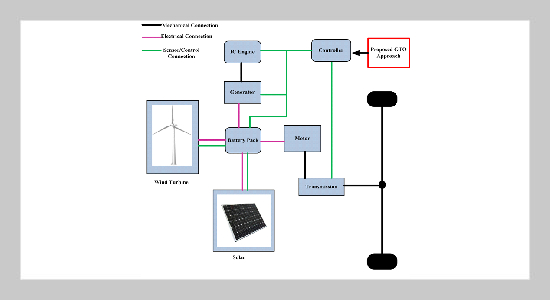
Configuration of solar and wind powered electric auto rickshaw
Copyright The Author(s). This is an open access article distributed under the terms of the Creative Commons Attribution License (CC BY 4.0), which permits unrestricted use, distribution, and reproduction in any medium, provided the original author and source are cited.
Download Citation: BibTeX | http://dx.doi.org/10.6180/jase.202611_34.059
Transportation is one of the main energy-related industries, and the energy sector has a major impact on the atmosphere and a large amount of global carbon pollution. The most popular mode of transportation for short-distance travel is the three-wheeler auto rickshaw, particularly when utilized as a taxi because of its compact design and minimal upkeep. But a plethora of trucks, buses, and rickshaws. These cars release a great deal of different poisonous and damaging particles and gases, and they require a lot of gasoline. This paper proposes a solar and wind-powered electric auto rickshaw. The proposed method is the Giant Trevally Optimizer (GTO). The objective of this proposed method is to reduce the total operation cost and emission of the system. The GTO method is utilized to provide an optimal solution by minimizing the cost of the system. By then, the performance of the proposed method is implemented in the MATLAB platform and compared to various existing techniques. The proposed method shows better results in all existing systems, like particle swarm optimization (PSO), artificial bee colony (ABC), and artificial neural network (ANN). In the proposed approach, the efficiency is 98%, which is higher than that of other existing systems.
Keywords: Electric Vehicle, Renewable Energy, Solar, Wind, Sickle Type Turbine
- [1] M. Waseem, A. F. Sherwani, and M. Suhaib, (2019) “Integration of Solar Energy in Electrical, Hybrid, Autonomous Vehicles: A Technological Review” SN Applied Sciences 1: 1459. DOI: 10.1007/s42452-019-1458-4.
- [2] S. D. Vidhya and M. Balaji, (2019) “Modelling, Design and Control of a Light Electric Vehicle with Hybrid Energy Storage System for Indian Driving Cycle” Measurement and Control 52: 1420–1433. DOI: 10.1177/0020294019858212.
- [3] G. Mathesh and R. Saravanakumar, (2023) “A Novel Digital Control Scheme for Power Management in a Hybrid Energy-Source Environment Pertaining to Electric Vehicle Applications” Frontiers in Energy Research 11: 1130401. DOI: 10.3389/fenrg.2023.1130401.
- [4] R. K. Majji, C. Bharatiraja, and S. Padmanaban, (2026) “Grid-Integrated Solar PV Converter Operation Using Data-Driven Hybrid Control Approach” Results in Engineering 21: 108814. DOI: 10.1016/j.rineng.2025.108814.
- [5] G. Ramanathan, C. Bharatiraja, and J. L. Munda, (2024) “PV-Assisted Grid-Connected Multi-Output Electric Vehicle Charger with PV2V, G2V and PV2G Functions” PLOS ONE 19(6): e0304637. DOI: 10.1371/journal.pone.0304637.
- [6] S. Singh, P. Chauhan, and N. J. Singh, (2021) “Feasibility of a Grid-Connected Solar-Wind Hybrid System with an Electric Vehicle Charging Station” Journal of Modern Power Systems and Clean Energy 9(2): 295–306. DOI: 10.35833/MPCE.2019.000387.
- [7] K. Prakash, K. A. Mamun, F. R. Islam, A. A. Chand, K. A. Prasad, K. K. Goundar, and S. Maharaj. “Hybrid Electric Vehicle: Designing a Control of Solar/Wind/Battery/Capacitor/Fuel Cell Hybrid System”. In: Proceedings of the 29th Australasian Universities Power Engineering Conference (AUPEC). 2019, 1–6. DOI: 10.1109/AUPEC48475.2019.211000.
- [8] F. Ahmad, M. Khalid, and B. K. Panigrahi, (2021) “Development in Energy Storage System for Electric Transportation: A Comprehensive Review” Journal of Energy Storage 43: 103153. DOI: 10.1016/j.est.2021.103153.
- [9] A. K. Podder, S. A. Supti, S. Islam, M. Malvoni, A. Jayakumar, S. Deb, and N. M. Kumar, (2022) “Feasibility Assessment of Hybrid Solar Photovoltaic-Biogas Generator Based Charging Station: A Case of Easy Bike and Auto Rickshaw Scenario in a Developing Nation” Sustainability 14(1): 166. DOI: 10.3390/su14010166.
- [10] P. Shrivastava, M. S. Alam, and M. S. J. Asghar, (2019) “Design and Techno-Economic Analysis of Plug-In Electric Vehicle-Integrated Solar PV Charging System for India” IET Smart Grid 2(2): 224–232. DOI: 10.1049/iet-stg.2018.0156.
- [11] A. S. Ponrekha, M. S. P. Subathra, C. Bharatiraja, M. K. Nallapaneni, and H. H. Alhelou, (2025) “A Topology Review and Comparative Analysis on Transformerless Grid-Connected Photovoltaic Inverters and Leakage Current Reduction Techniques” IET Renewable Power Generation 19(1): e12655. DOI: 10.1049/rpg2.12655.