




Department of Information Technology, Shanxi Professional College of Finance, Shanxi, Taiyuan 030008, China
Received: May 20, 2026
Accepted: July 13, 2026
Publication Date: August 19, 2026
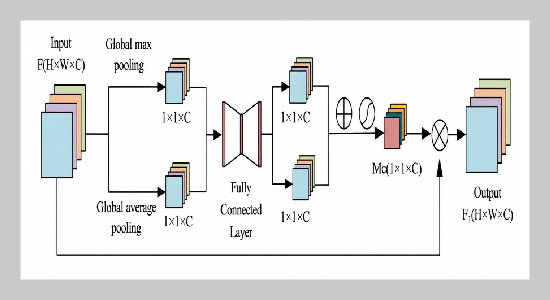
Channel attention submodule.
Copyright The Author(s). This is an open access article distributed under the terms of the Creative Commons Attribution License (CC BY 4.0), which permits unrestricted use, distribution, and reproduction in any medium, provided the original author and source are cited.
Download Citation: BibTeX | http://dx.doi.org/10.6180/jase.202611_34.058
Finding industrial surface flaws is essential to ensuring production safety and manufacturing quality. However, flaws in real-world industrial settings frequently exhibit traits such as large-scale changes, complex forms, high background similarity, and inadequate sample labeling, which pose serious obstacles to automated identification. This research suggests an industrial defect detection technique that combines static-dynamic graph relationship
modeling with multi-scale feature improvement to address these problems. This method introduces multi-scale dilated convolution in the feature extraction stage to balance local details with global contextual information, and combines a channel-space attention mechanism to adaptively highlight defect-related features and suppress background interference. To further enhance the model’s discriminative stability and generalization capacity, a static-dynamic graph joint category relationship modeling module is built in a high-level semantic space to describe the structural relationships and dynamic similarities between defect categories. On several publicly accessible industrial defect datasets, experimental results demonstrate that the suggested approach outperforms current approaches in terms of detection performance. The proposed AM-GCN achieves 94.0% AUROC (DAGM 2007) and 90.1% mAP(NEU-DET),outperforming baselines by 0.9% and 1.9%, showing clear improvement from static–dynamic GNN modeling. Concurrently, interpretability research confirms that the model’s concentration on critical fault regions during the decision-making process is more rational and focused, indicating strong engineering application potential.
Keywords: Industrial defect detection; Multi-scale features; Attention mechanism; Graph neural network; Industrial vision
- [1] G. Fu, W. Le, Z. Zhang, J. Li, Q. Zhu, F. Niu, H. Chen, F. Sun, and Y. Shen, (2023) “A surface defect inspection model via rich feature extraction and residual-based progressive integration” Machines 11(1): 124. DOI: 10.3390/machines11010124.
- [2] X. Jia, X. Zhou, Z. Shi, Q. Xu, and G. Zhang, (2025) “Geoiou-sea-yolo: An advanced model for detecting unsafe behaviors on construction sites” Sensors 25(4): 1238. DOI: 10.3390/s25041238.
- [3] C. Nie, C. Zhou, T. Wang, X. Wang, H. Zhou, and H. Feng, (2025) “Linear rolling guide surface wear-state identification based on multi-scale fuzzy entropy and random forest” Lubricants 13(8): 323. DOI: 10.3390/lubricants13080323.
- [4] H. Chen, Y. Pang, Q. Hu, and K. Liu, (2020) “Solar cell surface defect inspection based on multispectral convolutional neural network” Journal of Intelligent Manufacturing 31(2): 453–468. DOI: 10.1007/s10845-018-1458-z.
- [5] C. Zhang, B.-H. Roh, and G. Shan. “Poster: Dynamic clustered federated framework for multi-domain network anomaly detection”. In: Companion of the 19th International Conference on Emerging Networking EXperiments and Technologies (CoNEXT 2023). New York: Association for Computing Machinery, 2023, 71–72. DOI: 10.1145/3624354.3630086.
- [6] L. Yuan, (2025) “Mine gas time-series data prediction and fluctuation monitoring method based on decomposition-enhanced cross-graph forecasting and anomaly finding” Sensors 25(22): 7014. DOI: 10.3390/s25227014.
- [7] Y. L. He, Z. H. Liu, W. Zhang, D. R. Dai, Z. W. Pang, M. X. Xu, and D. Gerada, (2025) “Eccentricity fault diagnosis of permanent magnet synchronous generators based on 2D recursive fusion graph and CBAM-ConvNeXt-FPN” Measurement Science and Technology 36(5): 056110. DOI: 10.1088/1361-6501/adcd8e.
- [8] Y. Zhang, H. G. Soon, D. Ye, J. Y. H. Fuh, and K. Zhu, (2019) “Powder-bed fusion process monitoring by machine vision with hybrid convolutional neural networks” IEEE Transactions on Industrial Informatics 16(9): 5769–5779. DOI: 10.1109/TII.2019.2956078.
- [9] X. Lv, Y. Lan, B. Wu, L. Niu, L. Li, and W. Du, (2025) “REL-YOLO: Surface defect detection of elevator wire rope based on improved YOLOv8” Journal of Supercomputing 81(10): 1110. DOI: 10.1007/s11227-025-07585-0.
- [10] V. Sampath, I. Maurtua, J. J. Aguilar, A. Rivera-Pinto, and J. Molina, (2023) “Attention-guided multitask learning for surface defect identification” IEEE Transactions on Industrial Informatics 19(9): 9713–9723. DOI: 10.1109/TII.2023.3234030.
- [11] J. Chen, M. Feng, and T. S. Wirjanto. “Prospective multi-graph cohesion for multivariate time series anomaly detection”. In: Proceedings of the Eighteenth ACM International Conference on Web Search and Data Mining. 2025, 98–106. DOI: 10.1145/3701551.3703494.
- [12] P. Patil, S. Naskar, and P. J. Guruprasad, (2025) “Multi-scale stochastic dynamic analysis of a damaged pretwisted composite strip” Journal of Composite Materials 59(6): 755–780. DOI: 10.1177/00219983241297095.
- [13] J. Gao, A. P. French, M. P. Pound, Y. He, T. P. Pridmore, and J. G. Pieters, (2020) “Deep convolutional neural networks for image-based Convolvulus sepium detection in sugar beet fields” Plant Methods 16(1): 1–12. DOI: 10.1186/s13007-020-00570-z.
- [14] Y. Liu, H. Pu, and D. W. Sun, (2021) “Efficient extraction of deep image features using convolutional neural network (CNN) for applications in detecting and analysing complex food matrices” Trends in Food Science & Technology 113: 193–204. DOI: 10.1016/j.tifs.2021.04.042.
- [15] S. U. Jan, Y. D. Lee, and I. S. Koo, (2021) “A distributed sensor-fault detection and diagnosis framework using machine learning” Information Sciences 547: 777–796. DOI: 10.1016/j.ins.2020.08.068.
- [16] C. Hu and Y. Wang, (2020) “An efficient convolutional neural network model based on object-level attention mechanism for casting defect detection on radiography images” IEEE Transactions on Industrial Electronics 67(12): 10922–10930. DOI: 10.1109/TIE.2019.2962437.
- [17] S. Nosratabadi, A. Mosavi, P. Duan, P. Ghamisi, F. Filip, S. S. Band, and A. H. Gandomi, (2020) “Data science in economics: Comprehensive review of advanced machine learning and deep learning methods” Mathematics 8(10): 1799. DOI: 10.3390/math8101799.
- [18] T. Cuong-Le, T. Nghia-Nguyen, S. Khatir, P. Trong-Nguyen, S. Mirjalili, and K. D. Nguyen, (2022) “An efficient approach for damage identification based on improved machine learning using PSO-SVM” Engineering with Computers 38(4): 3069–3084. DOI: 10.1007/s00366-021-01299-6.
- [19] J. Zhou, D. Zhang, W. Ren, and Z. Weishi, (2022) “Auto color correction of underwater images utilizing depth information” IEEE Geoscience and Remote Sensing Letters 19: 1–5. DOI: 10.1109/LGRS.2022.3170702.