




Xiaojing Chu1, Chenhong Feng1 , and Yongming Ding2
1School of Automotive Engineering, Tianjin Vocational Institute
2Tianjin Shitong Network Technology Co., Ltd
Received: April 25, 2026
Accepted: May 27, 2026
Publication Date: August 19, 2026
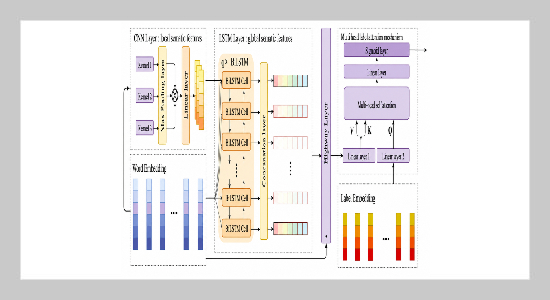
CNN-BiLSTM model structure.
Copyright The Author(s). This is an open access article distributed under the terms of the Creative Commons Attribution License (CC BY 4.0), which permits unrestricted use, distribution, and reproduction in any medium, provided the original author and source are cited.
Download Citation: BibTeX | http://dx.doi.org/10.6180/jase.202611_34.057
This paper proposes a unique approach based on big data analysis to address the challenge of predicting the state of health (SOH) of lithium batteries for future energy vehicles. By combining a convolutional neural network (CNN) with a bidirectional long and short-term memory neural network (BiLSTM) and automatically modifying the model parameters using the Bayesian optimization (BO) technique, an accurate forecast of the battery state of health is obtained. Several health parameters are extracted from the NASA-provided public lithium battery dataset, such as the constant current charging time (CCCT) and discharge voltage plateau time (DVPT). The next step is to employ wavelet packet transform to lessen data noise. The experimental results show that the proposed method outperforms both a single neural network model and the conventional approach, with both average absolute error and root mean square error being less than 1%. Thus, this work offers a technical route and theoretical support for the safe and dependable functioning of electric car power batteries in addition to an effective SOH estimation method. Specifically, the proposed BO-CNN-BiLSTM model achieves a minimum MAE of 0.288% and RMSE of 0.365%, significantly lower than baseline models such as CNN and LSTM.
Keywords: lithium battery; SOH; big data analytics; Bi-LSTM; Bayesian optimization algorithm.
- [1] Z. He, X. Shen, Y. Sun, et al., (2021) “State-of-health estimation based on real data of electric vehicles concerning user behavior” Journal of Energy Storage 41: 102867. DOI: 10.1016/j.est.2021.102867.
- [2] S. Hong, T. Yue, and H. Liu, (2022) “Vehicle energy system active defense: A health assessment of lithium-ion batteries” International Journal of Intelligent Systems 37(12): 10081–10099. DOI: 10.1002/int.22309.
- [3] J. Zhao and A. F. Burke, (2022) “Electric vehicle batteries: Status and perspectives of data-driven diagnosis and prognosis” Batteries 8(10): 142. DOI: 10.3390/batteries8100142.
- [4] Z. Wang, G. Feng, D. Zhen, et al., (2021) “A review on online state of charge and state of health estimation for lithium-ion batteries in electric vehicles” Energy Reports 7: 5141–5161. DOI: 10.1016/j.egyr.2021.08.113.
- [5] Z. Xu, J. Wang, P. D. Lund, et al., (2021) “Estimation and prediction of state of health of electric vehicle batteries using discrete incremental capacity analysis based on real driving data” Energy 225: 120160. DOI: 10.1016/j.energy.2021.120160.
- [6] Y. Toughzaoui, S. B. Toosi, H. Chaoui, et al., (2022) “State of health estimation and remaining useful life assessment of lithium-ion batteries: A comparative study” Journal of Energy Storage 51: 104520. DOI: 10.1016/j.est.2022.104520.
- [7] P. Li, Z. Zhang, R. Grosu, et al., (2022) “An end-to-end neural network framework for state-of-health estimation and remaining useful life prediction of electric vehicle lithium batteries” Renewable and Sustainable Energy Reviews 156: 111843. DOI: 10.1016/j.rser.2021.111843.
- [8] J. Hong, Z. Wang, W. Chen, et al., (2021) “Online accurate state of health estimation for battery systems on real-world electric vehicles with variable driving conditions considered” Journal of Cleaner Production 294: 125814. DOI: 10.1016/j.jclepro.2021.125814.
- [9] Y. Zhang and Y. F. Li, (2022) “Prognostics and health management of Lithium-ion battery using deep learning methods: A review” Renewable and Sustainable Energy Reviews 161: 112282. DOI: 10.1016/j.rser.2022.112282.
- [10] J. Tian, X. Liu, S. Li, et al., (2023) “Lithium-ion battery health estimation with real-world data for electric vehicles” Energy 270: 126855. DOI: 10.1016/j.energy.2023.126855.
- [11] S. K. Assayed, C. S. Shieh, et al., (2025) “Engineering intelligent healthcare systems: Understanding medical queries with AI and NLP” Journal of Engineering and Applied Science 72(1): 212. DOI: 10.1186/s44147-025-00800-y.
- [12] X. Li, K. Dai, Z. Wang, et al., (2020) “Lithium-ion batteries fault diagnostic for electric vehicles using sample entropy analysis method” Journal of Energy Storage 27: 101121. DOI: 10.1016/j.est.2019.101121.
- [13] C. Zhang, S. Zhao, Z. Yang, et al., (2022) “A reliable data-driven state-of-health estimation model for lithium-ion batteries in electric vehicles” Frontiers in Energy Research 10: 1013800. DOI: 10.3389/fenrg.2022.1013800.
- [14] X. Hu, Y. Che, X. Lin, et al., (2020) “Health prognosis for electric vehicle battery packs: A data-driven approach” IEEE/ASME Transactions on Mechatronics 25(6): 2622–2632. DOI: 10.1109/TMECH.2020.2986364.
- [15] M. Elmahallawy, T. Elfouly, A. Alouani, et al., (2022) “A comprehensive review of lithium-ion batteries modeling, and state of health and remaining useful lifetime prediction” IEEE Access 10: 119040–119070. DOI: 10.1109/ACCESS.2022.3221137.
- [16] C. Zhang, G. Shan, B. H. Roh, and J. Jiang, (2025) “FM2 Learning: LLM-based federated multi-task multi-domain learning for consumer electronics and IoT enhancement” IEEE Transactions on Consumer Electronics 71(4): 11977–11988. DOI: 10.1109/TCE.2025.3603592.