





Shuang Cui1 and Chunxin Zhang2
1School of Hunan Mass Media Vocational and Technical College; Changsha Hunan 410000 China
2School of Informatics, Xiamen University, Xiamen, P.R. China
Received: May 13, 2026
Accepted: July 28, 2026
Publication Date: August 19, 2026
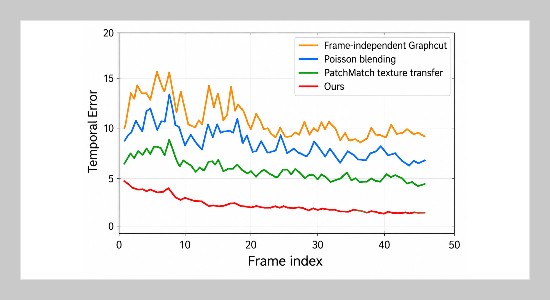
Temporal Differential Error (TDE) of different methods in animation sequences.
Copyright The Author(s). This is an open access article distributed under the terms of the Creative Commons Attribution License (CC BY 4.0), which permits unrestricted use, distribution, and reproduction in any medium, provided the original author and source are cited.
Download Citation: BibTeX | http://dx.doi.org/10.6180/jase.202611_34.056
Animated texture replacement is an important research problem in computer graphics and digital content generation. Its core challenge lies in simultaneously ensuring spatial continuity, temporal consistency, and lighting stability during texture stitching. Traditional texture synthesis methods are primarily designed for static images, and their direct application to animation sequences often leads to seam jitter, texture flickering, and lighting drift, thereby degrading visual quality. To address these limitations, this paper proposes a Graphcut based animated texture replacement method. Within a block-level texture synthesis framework, the proposed approach constructs a pixel-level energy function and employs a Maximum Flow–Minimum Cut model to determine globally optimal seams in overlapping regions, thereby ensuring spatial consistency. Furthermore, temporal consistency constraints are introduced to suppress inter-frame texture fluctuations, while a customized lighting model maintains stable and controllable illumination throughout continuous animation sequences. To accelerate the computationally intensive block matching stage, CUDA-based parallel processing is incorporated, significantly improving execution efficiency. Experimental results demonstrate that the proposed method achieves an average Temporal Difference Error (TDE) of approximately 2.3, representing about a 61% reduction compared with the best-performing baseline method, while also achieving the lowest Temporal Illumination Variance (TIV), indicating superior temporal stability and illumination consistency. Overall, the proposed framework provides high-quality texture synthesis with improved computational performance, making it suitable for texture replacement tasks in complex animation scenes.
Keywords: Animated texture replacement; Graphcut algorithm; Temporal consistency; Lighting customization; Texture composition; CUDA parallel acceleration
- [1] K. Zhang, D. Zhu, X. Min, and G. Zhai. “Textured Mesh Saliency: Bridging Geometry and Texture for Human Perception in 3D Graphics”. In: Proceedings of the AAAI Conference on Artificial Intelligence. 39. 9. 2025, 9977–9984. DOI: 10.1609/aaai.v39i9.33082.
- [2] P. Tu, L.-Y. Wei, and M. Zwicker. “Compositional Neural Textures”. In: SIGGRAPH Asia 2024 Conference Papers. New York: ACM, 2024, 1–11. DOI: 10.1145/3680528.3687561.
- [3] H. Wu, Z. Wang, Y. Li, X. Liu, and T.-Y. Lee, (2024) “Suitable and Style-Consistent Multi-Texture Recommendation for Cartoon Illustrations” ACM Transactions on Multimedia Computing, Communications and Applications 20(7): 1–26. DOI: 10.1145/3652518.
- [4] Y. Zeng, L. Ma, and P. V. Sander. “GSWT: Gaussian Splatting Wang Tiles”. In: SIGGRAPH Asia 2025 Conference Papers. New York: ACM, 2025, 1–11. DOI: 10.1145/3757377.3763967.
- [5] X. Liang, W. Yao, X. Fang, and C. Zhang, (2025) “FMIF: Facial Multi-Feature Information Fusion for Driver Fatigue Detection” Signal, Image and Video Processing 19(2): Article 121. DOI: 10.1007/s11760-024-03573-8.
- [6] Z. Ou, X. Liu, C. Li, Z. Wen, P. Li, Z. Gao, and H. Wu, (2024) “Body Part Segmentation of Anime Characters” Computer Animation and Virtual Worlds 35(6): e2295. DOI: 10.1002/cav.2295.
- [7] T. Elsner, J. Berger, T. Wu, V. Czech, L. Gao, and L. Kobbelt. “Retargeting Visual Data with Deformation Fields”. In: European Conference on Computer Vision. Cham: Springer, 2024, 271–288. DOI: 10.1007/978-3-031-72949-2_16.
- [8] W. Gong and Q. Hou, (2026) “Advanced Techniques in Digital Media Processing for Special Effects Enhancement in Film and Television Post-Production” Multimedia Systems 32(1): 17. DOI: 10.1007/s00530-025-02077-w.
- [9] I. Oliveira, T. Pinto, S. Afonso, M. Karaś, U. Szymanowska, B. Gonçalves, and A. Vilela, (2025) “Sustainability in Bio-Based Edible Films, Coatings, and Packaging for Small Fruits” Applied Sciences 15(3): 1462. DOI: 10.3390/app15031462.
- [10] M. Vijendran, J. Deng, S. Chen, E. S. L. Ho, and H. P. H. Shum, (2024) “Artificial Intelligence for Geometry-Based Feature Extraction, Analysis and Synthesis in Artistic Images: A Survey” Artificial Intelligence Review 58(2): Article 64. DOI: 10.48550/arXiv.2412.01450.
- [11] J. Ma, E. Lu, R. Paiss, S. Zada, A. Holynski, T. Dekel, and F. Cole. “VidPanos: Generative Panoramic Videos from Casual Panning Videos”. In: SIGGRAPH Asia 2024 Conference Papers. New York: ACM, 2024, 1–11. DOI: 10.1145/3680528.3687664.
- [12] M. Xu, X. Tao, J. Liu, L. Pan, and Z. Huang, (2025) “Research on the Innovation of Rattan Weaving Art Design Form and Inheritance of Cultural Symbols of Maonan Flower Bamboo Hat Based on Complex Geometry and AI Algorithm” Journal of Combinatorial Mathematics and Combinatorial Computing 127: 9365–9383. DOI: 10.61091/jcmcc127a-522.
- [13] G. Zou, J. Jiang, and Q. Chen, (2024) “Accelerated Reconstruction of Scenes Using CUDA-Based Parallel Computing” IEEE Access 13: 10489–10498. DOI: 10.1109/ACCESS.2024.3523099.
- [14] M. Li, Z. Bi, T. Wang, Y. Wen, Q. Niu, X. Song, and M. Liu, (2024) “Deep Learning and Machine Learning with GPGPU and CUDA: Unlocking the Power of Parallel Computing” arXiv: DOI: 10.48550/arXiv.2410.05686.
- [15] G. Mellone, C. G. De Vita, E. Di Nardo, G. Coviello, D. Di Luccio, P. P. C. Aucelli, and R. Montella. “G-Litter Marine Litter Dataset Augmentation with Diffusion Models and Large Language Models on GPU Acceleration”. In: 2025 33rd Euromicro International Conference on Parallel, Distributed, and Network-Based Processing (PDP). 2025, 526–535. DOI: 10.1109/PDP66500.2025.00081.