





Xiaoju Yin1 , Wei Zhang1, Jian Wang2, Yong Guo3, Zijing Wang1, and Tienan Yang3
1School of New Energy, Shenyang Institute of Engineering, No. 18, Puchang Road, Shenbei New District, Shenyang, Liaoning
110136, P. R. China
2Shenyang Urban Investment New Energy Group Co., Ltd., Shenyang, Liaoning 110000, P. R. China
3Huaneng International Power Co., Ltd., Yingkou Power Plant, Yingkou, Liaoning 115007, P. R. China
Received: June 06, 2026
Accepted: June 24, 2026
Publication Date: August 19, 2026
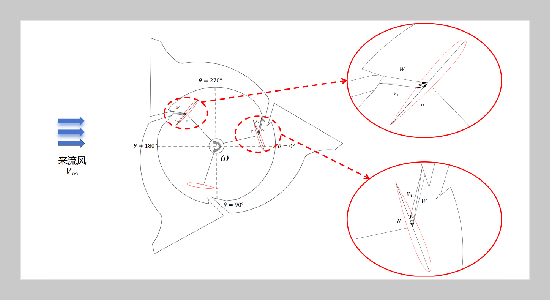
Velocity triangle and aerodynamic analysis of the VAWT rotation cycle.
Copyright The Author(s). This is an open access article distributed under the terms of the Creative Commons Attribution License (CC BY 4.0), which permits unrestricted use, distribution, and reproduction in any medium, provided the original author and source are cited.
Download Citation: BibTeX | http://dx.doi.org/10.6180/jase.202611_34.055
The unsteady dynamic stall phenomenon in lift-type vertical axis wind turbines (VAWTs) severely limits their commercial deployment. This study proposes a strategy that integrates a circular-array air guide structure with blade pitch angle adjustment. The proposed “flow field enhancement–blade adaptation” coupling strategy employs the SST k-ω turbulence model to perform transient flow field analysis of a three-bladed VAWT under various operating conditions. Through numerical simulation, a combination of air guide structure and blade pitch angle β = 10° was identified as the most effective configuration. The numerical results show that the synergistic combination of the air guide structure and a blade pitch angle of β = 10° increases the peak power coefficient by 4.58% compared with the β = 0° baseline, while the average torque is increased by 48.3% relative to a conventional VAWT without the guide structure. The results indicate that under the modified flow conditions produced by the guide structure, a positive pitch angle—which is typically suboptimal for an unguided VAWT becomes the most effective setting, highlighting the importance of treating the guide structure and blade pitch as a coupled system, offering a promising approach for urban VAWT applications.
Keywords: VAWT, dynamic stall, air guide structure, pitch angle, coupled configuration, numerical simulation.
- [1] C. Sarmiento-Laurel, A. J. Díaz, I. Torres, R. Cáceres-González, and L. Silva-Llanca, (2025) “3D numerical analysis of an H-rotor darrieus vertical axis wind turbine in transient regime” Energy 324: 135849. DOI: 10.1016/j.energy.2025.135849.
- [2] S. Roga, S. Bardhan, Y. Kumar, and S. K. Dubey, (2022) “Recent technology and challenges of wind energy generation: A review” Sustainable Energy Technologies and Assessments 52: 102239. DOI: 10.1016/j.seta.2022.102239.
- [3] F. Ghafoorian, S. R. Mirmotahari, and H. Wan, (2024) “Numerical study on aerodynamic performance improvement and efficiency enhancement of the savonius vertical axis wind turbine with semi-directional airfoil guide vane” Ocean Engineering 307: 118186. DOI: 10.1016/j.oceaneng.2024.118186.
- [4] A. Ulus and S. I. Moldovan, (2025) “Optimization of Vertical Axis Wind Turbine Systems to Capture Vehicle-Induced Highway Winds” Energies 18: 3139. DOI: 10.3390/en18123139.
- [5] M. Khudri Johari, M. Azim A Jalil, and M. Faizal Mohd Shariff, (2018) “Comparison of horizontal axis wind turbine (HAWT) and vertical axis wind turbine (VAWT)” International Journal of Engineering and Technology 7: 74–80. DOI: 10.14419/ijet.v7i4.13.21333.
- [6] A. Abdolahifar, H. Montazeri, and A. Zanj, (2026) “Towards enhanced startup performance of Darrieus vertical-axis wind turbines: Key flow features at moderate tip speed ratios” Renewable Energy 256: 123778. DOI: 10.1016/j.renene.2025.123778.
- [7] M. Ahmadi-Baloutaki, R. Carriveau, and D. S.-K. Ting, (2016) “A wind tunnel study on the aerodynamic interaction of vertical axis wind turbines in array configurations” Renewable Energy 96: 904–913. DOI: 10.1016/j.renene.2016.05.060.
- [8] J. Joseph, S. Sridhar, S. A., and J. Radhakrishnan, (2024) “Analyzing dynamic stall on tubercle mounted VAWT blades: A simplistic experimental approach using an oscillating rig” Sustainable Energy Technologies and Assessments 71: 103962. DOI: 10.1016/j.seta.2024.103962.
- [9] O. Erkan, M. Özkan, Y. Çelik, and M. S. U. Khalid, (2025) “Taguchi-based multi-factor analysis of self-starting behavior in vertical axis wind turbine farms” Energy 341: 139495. DOI: 10.1016/j.energy.2025.139495.
- [10] Y. Wang, X. Sun, X. Dong, B. Zhu, D. Huang, and Z. Zheng, (2016) “Numerical investigation on aerodynamic performance of a novel vertical axis wind turbine with adaptive blades” Energy Conversion and Management 108: 275–286. DOI: 10.1016/j.enconman.2015.11.003.
- [11] Q. Cheng, X. Liu, H. S. Ji, K. C. Kim, and B. Yang, (2017) “Aerodynamic Analysis of a Helical Vertical Axis Wind Turbine” Energies 10: 575. DOI: 10.3390/en10040575.
- [12] Y. Li, S. Zhao, K. Tagawa, and F. Feng, (2018) “Starting performance effect of a truncated-cone-shaped wind gathering device on small-scale straight-bladed vertical axis wind turbine” Energy Conversion and Management 167: 70–80. DOI: 10.1016/j.enconman.2018.04.062.
- [13] T. Jiang, Q. Mo, and L. Luo, (2025) “Study on the Effect of Pitch Angle on the Aerodynamic Characteristics of a Vertical Axis Wind Turbine with a Dimple-Gurney Flap” Journal of Physics: Conference Series 3086: 012001. DOI: 10.1088/1742-6596/3086/1/012001.
- [14] E. Fatahian, F. Ismail, M. H. H. Ishak, and W. S. Chang, (2024) “Novel passive flow control method using leading-edge prism-shaped cylinder: Performance enhancement of vertical-axis wind turbines” Physics of Fluids 36: 115170. DOI: 10.1063/5.0233464.
- [15] A. Gupta, U. Ali, H. A. Abderrahmane, and I. Janajreh, (2025) “Blade pitching in vertical axis wind turbines: A double multiple stream tube theoretical approach to performance enhancement” Heliyon 11: e42101. DOI: 10.1016/j.heliyon.2025.e42101.
- [16] A. Escudero Romero, A. P. Blasetti, J. G. Acosta-López, M.-Á. Gómez-García, and H. de Lasa, (2024) “Vorticity and Its Relationship to Vortex Separation, Dynamic Stall, and Performance, in an H-Darrieus Vertical-Axis Wind Turbine Using CFD Simulations” Processes 12: 1556. DOI: 10.3390/pr12081556.
- [17] Q. Zhang, W. Miao, K. Zhao, C. Li, L. Chang, M. Yue, and Z. Xu, (2025) “Influence of Geometric Effects on Dynamic Stall in Darrieus-Type Vertical-Axis Wind Turbines for Offshore Renewable Applications” Journal of Marine Science and Engineering 13: 1327. DOI: 10.3390/jmse13071327.
- [18] G. Tong, Y. Li, K. Tagawa, and F. Feng, (2023) “Effects of blade airfoil chord length and rotor diameter on aerodynamic performance of straight-bladed vertical axis wind turbines by numerical simulation” Energy 265: 126325. DOI: 10.1016/j.energy.2022.126325.
- [19] Y. Yang, Z. Guo, Q. Song, Y. Zhang, and Q. Li, (2018) “Effect of Blade Pitch Angle on the Aerodynamic Characteristics of a Straight-bladed Vertical Axis Wind Turbine Based on Experiments and Simulations” Energies 11: 1514. DOI: 10.3390/en11061514.
- [20] M. Islam, D. Ting, and A. Fartaj, (2008) “Aerodynamic models for Darrieus-type straight-bladed vertical axis wind turbines” Renewable and Sustainable Energy Reviews 12: 1087–1109. DOI: 10.1016/j.rser.2006.10.023.
- [21] M. H. Shojaeefard, M. Tahani, M. B. Ehghaghi, H. Fallah Ardeshir, and M. Beglari, (2012) “Corrigendum to Numerical study of the effects of some geometric characteristics of a centrifugal pump impeller that pumps a viscous fluid [Computers and Fluids 60 (2012) 61-70]” Computers and Fluids 64: 157. DOI: 10.1016/j.compfluid.2012.06.014.
- [22] S. Ouchene, A. Smaili, and H. Fellouah, (2024) “On the estimation of the angle of attack for vertical axis wind turbines” International Journal of Numerical Methods for Heat and Fluid Flow 34: 2626–2653. DOI: 10.1108/hff-09-2022-0566.
- [23] F. R. Menter, (1994) “Two-equation eddy-viscosity turbulence models for engineering applications” AIAA Journal 32: 1598–1605. DOI: 10.2514/3.12149.
- [24] W.-H. Chen, C.-Y. Chen, C.-Y. Huang, and C.-J. Hwang, (2017) “Power output analysis and optimization of two straight-bladed vertical-axis wind turbines” Applied Energy 185: 223–232. DOI: 10.1016/j.apenergy.2016.10.076.
- [25] A. S. Saad, I. I. El-Sharkawy, S. Ookawara, and M. Ahmed, (2020) “Performance enhancement of twisted-bladed Savonius vertical axis wind turbines” Energy Conversion and Management 209: 112673. DOI: 10.1016/j.enconman.2020.112673.
- [26] N. Kalassov, Z. Baizhuma, R. Manatbayev, A. Yershina, M. Isataev, A. Kalassova, Z. Seidulla, B. Bektibay, and B. Amir, (2025) “Integrated Approach to Aerodynamic Optimization of Darrieus Wind Turbine Based on the Taguchi Method and Computational Fluid Dynamics (CFD)” Applied Sciences 15: 5739. DOI: 10.3390/app15105739.
- [27] M. Elkhoury, T. Kiwata, K. Nagao, T. Kono, and F. ElHajj, (2018) “Wind tunnel experiments and Delayed Detached Eddy Simulation of a three-bladed micro vertical axis wind turbine” Renewable Energy 129: 63–74. DOI: 10.1016/j.renene.2018.05.096.
- [28] A. L. G. Santos, J. C. Martins, L. A. Isoldi, G. d. C. Dias, L. A. O. Rocha, J. A. Souza, and E. D. dos Santos, (2024) “Numerical Analysis of the Influence of Rectangular Deflectors and Geometry of L-Shaped Channel over the Performance of a Savonius Turbine” Journal of Marine Science and Engineering 13: 28. DOI: 10.3390/jmse13010028.