



Received: May 04, 2026
Accepted: June 19, 2026
Publication Date: August 19, 2026
Quantitative Evaluation of Forecasting Performance Metrics
Copyright The Author(s). This is an open access article distributed under the terms of the Creative Commons Attribution License (CC BY 4.0), which permits unrestricted use, distribution, and reproduction in any medium, provided the original author and source are cited.
Download Citation: BibTeX | http://dx.doi.org/10.6180/jase.202611_34.054
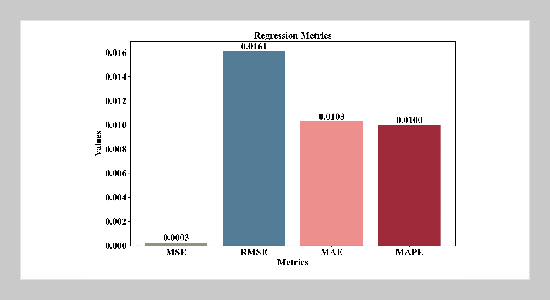
Recent advances in artificial intelligence (AI) and deep learning (DL) have significantly improved the ability to analyze and forecast economic and labor market trends. However, accurately predicting sector-specific employment remains challenging due to nonlinear relationships among macroeconomic variables and long term temporal dependencies that traditional econometric and recurrent models often fail to capture. To address these limitations, this study proposes a multivariate deep learning approach based on the Patch Time Series Transformer (PatchTST) architecture. The model is designed to forecast labor market dynamics, identify sectoral employment trends, and analyze evolving patterns of future skill demand. The proposed framework utilizes structured data from the International Labour Organization Statistics (ILOSTAT), incorporating key indicators such as employment, unemployment, inflation, and productivity. Data preprocessing techniques, including missing value imputation, temporal alignment, outlier treatment, and z-score normalization, are applied to ensure data quality and consistency. The time series data are further transformed into modelcompatible inputs using sliding-window sequences and patch-based segmentation, enabling efficient learning within the Transformer architecture. PatchTST leverages multi-head selfattention mechanisms to capture complex temporal patterns and inter-sectoral relationships, allowing for accurate multi-horizon forecasting. Experimental results demonstrate strong predictive performance, with a Mean Absolute Error (MAE) of 0.0103 , Root Mean Squared Error (RMSE) of 0.0161 , Mean Squared Error (MSE) of 0.0003 , and an R2 value of 0.9906 , indicating a close fit between predicted and actual values. Overall, the findings suggest that the proposed model provides a robust, scalable, and data-driven solution for workforce planning and future skill demand analysis.
Keywords: AI, Labor market forecasting; Sectoral employment forecasting; Future skill demand; DL forecasting; Multivariate time series prediction.
- [1] J. M. Orozco-Castañeda, L. P. Sierra-Suárez, and P. Vidal, (2024) “Labor Market Forecasting in Unprecedented Times: A Machine Learning Approach” Bulletin of Economic Research 76(4): 893–915. DOI: 10.1111/boer.12451.
- [2] D. Liu, Q. Shen, and J. Liu, (2026) “The Health-Wealth Gradient in Labor Markets: Integrating Health, Insurance, and Social Metrics to Predict Employment Density” Computation 14(1): 22. DOI: 10.3390/computation14010022.
- [3] F. Webb, D. Stimpson, M. Purcell, and E. López, (2023) “Organizational Labor Flow Networks and Career Forecasting” Entropy 25(5): 784. DOI: 10.3390/e25050784.
- [4] A. I. Simsek, E. Koç, B. Desticioglu Tasdemir, A. Aksöz, M. Turkoglu, and A. Sengur, (2024) “Deep Learning Forecasting Model for Market Demand of Electric Vehicles” Applied Sciences 14(23): 10974. DOI: 10.3390/app142310974.
- [5] M. Rožman, D. Oreški, and P. Tominc, (2023) “Artificial-Intelligence-Supported Reduction of Employees’ Workload to Increase the Company’s Performance in Today’s VUCA Environment” Sustainability 15(6): 5019. DOI: 10.3390/su15065019.
- [6] N. Sancar and N. Cavus, (2025) “Smart Skills for Smart Cities: Developing and Validating an AI Soft Skills Scale in the Framework of the SDGs” Sustainability 17(16): 7281. DOI: 10.3390/su17167281.
- [7] R. Caetano, J. M. Oliveira, and P. Ramos, (2025) “Transformer-Based Models for Probabilistic Time Series Forecasting with Explanatory Variables” Mathematics 13(5): 814. DOI: 10.3390/math13050814.
- [8] L. Su, X. Zuo, R. Li, X. Wang, H. Zhao, and B. Huang, (2025) “A Systematic Review for Transformer-Based Long-Term Series Forecasting” Artificial Intelligence Review 58(3): 80. DOI: 10.1007/s10462-024-11044-2.
- [9] O. Ergunova, G. Mukhanova, and A. Somov, (2026) “AI-Supported Student Skills Profiling Integrating AI and EdTech into Inclusive and Adaptive Learning” Social Sciences 15(3): 209. DOI: 10.3390/socsci15030209.
- [10] A. Choiri, (2025) “The Role of Artificial Intelligence (AI) in Economic and Labor Market Transformation” Digital Marketing, Consumer Behavior, and Economic Trends Journal 1(1): 1–9. DOI: 10.70865/dmcbej.v1i1.11.
- [11] Global Trends at a Glance. Accessed April 11, 2026. 2026.
- [12] A. Weichselbraun, N. Süsstrunk, R. Waldvogel, A. Glatzl, A. M. P. Brașoveanu, and A. Scharl, (2024) “Anticipating Job Market Demands—A Deep Learning Approach to Determining the Future Readiness of Professional Skills” Future Internet 16(5): 144. DOI: 10.3390/fi16050144.
- [13] C. Magazzino, M. Mele, and M. Mutascu, (2025) “An Artificial Neural Network Experiment on the Prediction of the Unemployment Rate” Journal of Policy Modeling 47(3): 471–491. DOI: 10.1016/j.jpolmod.2024.10.004.
- [14] H. Zhou, S. Zhang, J. Peng, S. Zhang, J. Li, H. Xiong, and W. Zhang. “Informer: Beyond Efficient Transformer for Long Sequence Time-Series Forecasting”. In: Proceedings of the AAAI Conference on Artificial Intelligence. 35. 12. 2021, 11106–11115. DOI: 10.1609/aaai.v35i12.17325.
- [15] Y. Liu, T. Hu, H. Zhang, H. Wu, S. Wang, L. Ma, and M. Long, (2024) “iTransformer: Inverted Transformers are Effective for Time Series Forecasting” arXiv abs/2310.06625: DOI: 10.48550/arXiv.2310.06625.