




Yanli Zhu1 , Haibo Liu1, Peimin Li1, Dianguo Ma1, Junyu Zhang1, Guangsheng Lv1, Hongjie Fang1, Qingyun Yang1, and Lincai Zhang1
1School of Mechanical and Electrical Engineering, Zaozhuang University, Zaozhuang, 277160, China
Received: April 03, 2026
Accepted: June 04, 2026
Publication Date: August 19, 2026
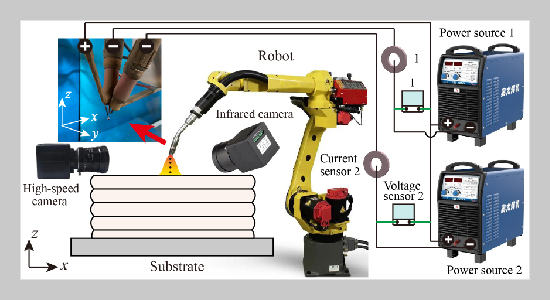
Integral frame of experimental setup
Copyright The Author(s). This is an open access article distributed under the terms of the Creative Commons Attribution License (CC BY 4.0), which permits unrestricted use, distribution, and reproduction in any medium, provided the original author and source are cited.
Download Citation: BibTeX | http://dx.doi.org/10.6180/jase.202611_34.053
The low forming efficiency and high heat accumulation existed in TIG additive manufacturing process hinder its further development and application. A novel twin tungsten electrode– wire electrode indirect arc (TTWIA) additive manufacturing has great potential to solve the above problem due to its high wire deposition rate and lower heat input. Different from TIG, the substrate heat input of TTWIA excluded the heat production in the electrode region and the resistive heating, and the wire melting heat of TTWIA was predominantly composed of the heat production in the electrode region. Consequently, the molten pool temperature of TTWIA was relatively lower, and the wire deposition rate of TTWIA was more than 2.75 times higher than that of conventional TIG under the identical experimental conditions. Moreover, the surface roughness and material utilization rate of the component fabricated by TTWIA could reach 1.21 mm and 83.74%, respectively. Additionally, the top and bottom regions of the component fabricated by TTWIA featured coarse columnar grains, while the middle region showed fine equiaxed grains. Furthermore, the tensile strength and elongation of the component approached those of original wire, and possessed significant anisotropy
Keywords: Wire and arc additive manufacturing, TTWIA, Wire deposition rate, Arc shape, Droplet transfer, Forming
- [1] S. Gain and D. Veeman, (2025) “A review on advances and challenges in wire arc additive manufacturing: Process parameters, microstructural evolution and material performance across alloys” Journal of Alloys and Compounds 1029: 180735. DOI: 10.1016/j.jallcom.2025.180735.
- [2] Y. H. Kim, D. R. Gunasegaram, P. W. Cleary, and A. B. Murphy, (2025) “Numerical modelling of wire arc additive manufacturing: methods, status, trends, and opportunities” Journal of Physics D: Applied Physics 58: 143001. DOI: 10.1088/1361-6463/adb3b0.
- [3] Q. Han, X. Li, M. Dong, and G. Zhang, (2021) “Enhanced curve-fitting model of the bead section profile and the corresponding overlapping model for twin-electrode gas tungsten arc–based additive manufacturing” International Journal of Advanced Manufacturing Technology 116: 1151–1167. DOI: 10.1007/s00170-021-07501-9.
- [4] M. B. Schwedersky, Á. F. d. Rosa, M. d. A. Souza, and R. H. G. e. Silva, (2025) “Arc characteristic of multi-cathode three-electrode GTAW (TE-GTAW)” Welding in the World 69: 2609–2617. DOI: 10.1007/s40194-024-01887-2.
- [5] Z. Zeng, Z. Zhang, X. Jin, H. Huang, L. Zhang, and J. Zhang, (2025) “Microstructure evolution and properties of Inconel 625 alloy fabricated by hot-wire TIG additive manufacturing” Journal of Alloys and Compounds 1032: 181113. DOI: 10.1016/j.jallcom.2025.181113.
- [6] T. Zhang, L. Wang, C. Xu, J. Cheng, and K. Wang, (2023) “Early-warning system for copper alloy abnormal molten pool in wire-arc additive manufacturing via convolutional neural network method” Journal of Materials Engineering and Performance 32: 11230–11239. DOI: 10.1007/s11665-023-07949-8.
- [7] S.-C. Park, H.-S. Bang, and W.-J. Seong, (2020) “Effects of material properties on angular distortion in wire arc additive manufacturing: experimental and computational analyses” Materials 13: 1399. DOI: 10.3390/ma13061399.
- [8] X. Zhang, F. Martina, J. Ding, X. Wang, and S. W. Williams, (2017) “Fracture toughness and fatigue crack growth rate properties in wire + arc additive manufactured Ti-6Al-4V” Fatigue & Fracture of Engineering Materials & Structures 40: 790–803. DOI: 10.1111/ffe.12547.
- [9] F. Wang, S. Williams, and M. Rush, (2011) “Morphology investigation on direct current pulsed gas tungsten arc welded additive layer manufactured Ti6Al4V alloy” International Journal of Advanced Manufacturing Technology 57: 597–603. DOI: 10.1007/s00170-011-3299-1.
- [10] T. Hauser, R. T. Reisch, P. P. Breese, B. S. Lutz, M. Pantano, Y. Nalam, K. Bela, T. Kamps, J. Volpp, and A. F. H. Kaplan, (2021) “Porosity in wire arc additive manufacturing of aluminium alloys” Additive Manufacturing 41: 101993. DOI: 10.1016/j.addma.2021.101993.
- [11] J. Wang, D. Wu, P. Liao, C. Y. Tian, M. Q. Li, and J. C. Feng, (2013) “Metal transfer and arc behaviour of novel consumable and non-consumable electrode indirect arc droplet welding” Science and technology of welding and joining 18: 261–270. DOI: 10.1179/1362171812Y.0000000103.
- [12] T. A. Rodrigues, V. R. Duarte, R. M. Miranda, T. G. Santos, and J. P. Oliveira, (2021) “Ultracold-wire and arc additive manufacturing (UC-WAAM)” Journal of Materials Processing Technology 296: 117196. DOI: 10.1016/j.jmatprotec.2021.117196.
- [13] Y. Zhu, Z. Wang, R. Liu, and L. Liu, (2022) “Study on arc behavior and droplet transfer in twin-electrode TIG-MIG indirect arc welding” International Journal of Advanced Manufacturing Technology 120: 6821–6831. DOI: 10.1007/s00170-022-09131-1.
- [14] Y. Zhu, R. Liu, and L. Liu, (2023) “A comparison of single and twin tungsten electrode – wire electrode IAW” Materials and manufacturing processes 38: 1436–1444. DOI: 10.1080/10426914.2022.2146715.
- [15] Y. Zhu, Z. Zhou, C. Liu, P. Li, H. Fang, Q. Yang, and J. Lu, (2025) “Research on deposition forming of two tungsten electrode – wire electrode indirect arc welding” Journal of Materials Engineering: DOI: 10.11868/j.issn.1001-4381.2025.000295.
- [16] Y. Zhu, S. Gao, S. Yu, and D. Ma, (2025) “Forming characteristic analysis in twin tungsten electrode – Wire electrode indirect arc based additive manufacturing” Vacuum 232: 113902. DOI: 10.1016/j.vacuum.2024.113902.
- [17] Y. Zhu, H. He, D. Ma, H. Liu, P. Li, and L. Zhang, (2026) “Influences of process parameters on twin tungsten electrode – wire electrode indirect arc additive manufacturing process” Journal of Applied Science and Engineering 32: 26032040. DOI: 10.6180/jase.202609_32.040.
- [18] C. Jing, Z. Chen, B. Liu, T. Xu, J. Wang, T. Lu, J. Lu, Y. Guo, and C. Liu, (2022) “Improving mechanical strength and isotropy for wire-arc additive manufactured 304L stainless steels via controlling arc heat input” Materials Science & Engineering A 845: 143223. DOI: 10.1016/j.msea.2022.143223.
- [19] L. Wang, J. Xue, and Q. Wang, (2019) “Correlation between arc mode, microstructure, and mechanical properties during wire arc additive manufacturing of 316L stainless steel” Materials Science & Engineering A 751: 183–190. DOI: 10.1016/j.msea.2019.02.078.
- [20] W. Ou, W. Zhao, G. Guo, J. Dai, and L. Fan, (2025) “Wire-droplet-substrate integrated model for heat transfer and deposition geometry prediction in GMAW-based wire arc additive manufacturing” Welding in the World 69: 2941–2959. DOI: 10.1007/s40194-025-01931-9.
- [21] S. Pattanayak and S. K. Sahoo, (2021) “Gas metal arc welding based additive manufacturing—a review” CIRP Journal of Manufacturing Science and Technology 33: 398–442. DOI: 10.1016/j.cirpj.2021.04.010.
- [22] M. R. Zahidin, F. Yusof, S. H. A. Rashid, S. Mansor, S. Raja, M. F. Jamaludin, Y. H. Manurung, M. S. Adenan, and N. I. S. Hussein, (2023) “Research challenges, quality control and monitoring strategy for wire arc additive manufacturing” Journal of Materials Research and Technology 24: 2769–2794. DOI: 10.1016/j.jmrt.2023.03.200.
- [23] X. Ba, S. Su, Y. Li, and L. Liu, (2025) “Effect of current process on BCTW-GIA additive manufacturing” Materials and Manufacturing Processes 40: 1535–1545. DOI: 10.1080/10426914.2025.2522051.
- [24] C. Ma, Y. Liu, C. Li, H. Dong, D. Li, X. Wu, P. Liu, Q. Sun, H. Jin, and F. Zhang, (2020) “Mechanical properties of carbon steel by compound arc and vibration shock forging-rolling” Journal of Manufacturing Processes 60: 11–22. DOI: 10.1016/j.jmapro.2020.10.005.
- [25] P. Dirisu, G. Supriyo, F. Martina, X. Xu, and S. Williams, (2020) “Wire plus arc additive manufactured functional steel surfaces enhanced by rolling” International Journal of Fatigue 130: 105237. DOI: 10.1016/j.ijfatigue.2019.105237.
- [26] D. Yang, G. Wang, and G. Zhang, (2017) “Thermal Analysis for Single-Pass Multi-Layer GMAW Based Additive Manufacturing Using Infrared Thermography” Journal of Materials Processing Technology 244: 215–224. DOI: 10.1016/j.jmatprotec.2017.01.024.
- [27] G. R. Peacock, (2000) “Thermal imaging of liquid steel and slag in a pouring stream” Proceedings of SPIE 4020: 50–60. DOI: 10.1117/12.381579.
- [28] R. T. C. Choo, J. Szekely, and R. C. Westhoff, (1992) “On the calculation of the free surface temperature of gas-tungsten-arc weld pools from first principles: Part I. modeling the welding arc” Metallurgical and Materials Transactions B 23B: 357–369. DOI: 10.1007/BF02656291.
- [29] V. M. J. Varghese, M. R. Suresh, and D. S. Kumar, (2013) “Recent developments in modeling of heat transfer during TIG welding – a review” International Journal of Advanced Manufacturing Technology 64: 749–754. DOI: 10.1007/s00170-012-4048-9.
- [30] J. Hu and H. L. Tsai, (2007) “Heat and mass transfer in gas metal arc welding. Part I: The arc” International Journal of Heat and Mass Transfer 50: 833–846. DOI: 10.1016/j.ijheatmasstransfer.2006.08.025.