




Haixing Guo1, Xiaolong Ren1, Hengbin Si1, Mengting Wang1, Qing Wu1, Xi Chen1, Shuang Tian1, and Xuan Zhen2
1State Grid Shaanxi Information and Telecommunication Company, Xi’an, Shaanxi, China
2School of Informatics, Xiamen University, Xiamen, P.R. China
Received: April 20, 2026
Accepted: June 13, 2026
Publication Date: August 17, 2026
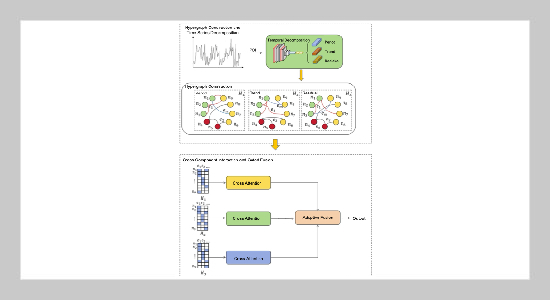
Framework of HMGNN
Copyright The Author(s). This is an open access article distributed under the terms of the Creative Commons Attribution License (CC BY 4.0), which permits unrestricted use, distribution, and reproduction in any medium, provided the original author and source are cited.
Download Citation: BibTeX | http://dx.doi.org/10.6180/jase.202611_34.052
Electric vehicles (EVs) are undergoing rapid expansion, leading to an explosive increase in ownership. Thissurge, however, poses unprecedented challenges to power grid operation and charging infrastructure planning. In particular, accurately forecasting charging demand has become increasingly difficult. Conventional graph-based or single-modal models often fail to capture the complex and nonlinear nature of charging behaviors because (1) transportation networks exhibit pronounced spatiotemporal heterogeneity, and (2) charging stations are characterized by intricate, multi-scale interdependencies. To overcome these limitations, this study introduces a multimodal hypergraph-based charging demand forecasting framework. The proposed approach constructs multidimensional spatiotemporal hypergraphs from heterogeneous multimodal data, thereby uncovering higher-order correlations among charging stations across different spatial and temporal scales. By dynamically modeling these evolving inter-station relationships, the framework enhances the accuracy of charging demand prediction and provides a robust analytical foundation for the optimal planning and management of EV charging infrastructure. Building upon the proposed methodology, this study validates its effectiveness using a real-world EV charging demand dataset collected from an urban area and further develops an intelligent charging station operation system. Extensive experiments and ablation analyses demonstrate that the proposed multimodal hypergraph based framework consistently outperforms unimodal and conventional graph-based baselines, confirming its superior capability in capturing complex spatiotemporal dependencies and improving
forecasting accuracy.
Keywords: Charging Demand Forecasting, Multimodal, Hypergraph, Spatial-Temporal Data Mining
- [1] Z. Deng, F. Deng, M. Yang, X. Guo, J. Si, B. Yu, and B. Feng. “Transformer-Based Multi-Industry Electricity Demand Forecasting”. In: International Conference on Applied Intelligence. Singapore: Springer Nature Singapore, 2023. DOI: 10.1007/978-981-97-0827-7_3.
- [2] H. Qu, H. Kuang, Q. Wang, et al., (2024) “A Physics-Informed and Attention-Based Graph Learning Approach for Regional Electric Vehicle Charging Demand Prediction” IEEE Transactions on Intelligent Transportation Systems: DOI: 10.1109/TITS.2024.3401850.
- [3] S. Guo, Y. Lin, N. Feng, C. Song, and H. Wan, (2019) “Attention Based Spatial-Temporal Graph Convolutional Networks for Traffic Flow Forecasting” Proceedings of the AAAI Conference on Artificial Intelligence 33(1): 922–929. DOI: 10.1609/aaai.v33i01.3301922.
- [4] X. L. Li and P. Liang. “Prefix-Tuning: Optimizing Continuous Prompts for Generation”. In: Proceedings of the 59th Annual Meeting of the Association for Computational Linguistics and the 11th International Joint Conference on Natural Language Processing. Online: Association for Computational Linguistics, 2021, 4582–4597. DOI: 10.18653/v1/2021.acl-long.353.
- [5] D. P. Kingma and J. Ba. Adam: A Method for Stochastic Optimization. 2014. arXiv: 1412.6980 [cs.LG].
- [6] Y.-C. Chen, L. Li, L. Yu, A. El Kholy, F. Ahmed, Z. Gan, Y. Cheng, and J. Liu. “UNITER: Universal Image-Text Representation Learning”. In: European Conference on Computer Vision. 2020, 104–120. DOI: 10.1007/978-3-030-58577-8_7.
- [7] L. Han, B. Du, L. Sun, Y. Fu, Y. Lv, and H. Xiong. “Dynamic and Multi-Faceted Spatio-Temporal Deep Learning for Traffic Speed Forecasting”. In: Proceedings of the 27th ACM SIGKDD Conference on Knowledge Discovery and Data Mining. 2021, 547–555. DOI: 10.1145/3447548.3467275.
- [8] W. Fedus, B. Zoph, and N. Shazeer, (2022) “Switch Transformers: Scaling to Trillion Parameter Models with Simple and Efficient Sparsity” Journal of Machine Learning Research 23(120): 1–39.
- [9] S. Yu, F. Xia, S. Li, et al., (2023) “Spatio-Temporal Graph Learning for Epidemic Prediction” ACM Transactions on Intelligent Systems and Technology 14(2): 1–25. DOI: 10.1145/3579815.
- [10] M. Chen, H. Yang, S. Li, et al., (2024) “STAA: Spatio-Temporal Alignment Attention for Short-Term Precipitation Forecasting” IEEE Geoscience and Remote Sensing Letters: DOI: 10.1109/LGRS.2024.3431099.
- [11] B. Lim, S. O. Arik, N. Loeff, and T. Pfister, (2021) “Temporal Fusion Transformers for Interpretable Multi-Horizon Time Series Forecasting” International Journal of Forecasting 37(4): 1748–1764. DOI: 10.1016/j.ijforecast.2021.03.012.
- [12] W. Liao, B. Bak-Jensen, J. R. Pillai, et al., (2022) “Short-Term Power Prediction for Renewable Energy Using Hybrid Graph Convolutional Network and Long Short-Term Memory Approach” Electric Power Systems Research 211: 108614. DOI: 10.1016/j.epsr.2022.108614.
- [13] Q. Liu, Y. Zeng, L. Chen, et al. “Social-Aware Optimal Electric Vehicle Charger Deployment on Road Network”. In: Proceedings of the 27th ACM SIGSPATIAL International Conference on Advances in Geographic Information Systems. 2019. DOI: 10.1145/3347146.3359382.
- [14] J. Li, R. R. Selvaraju, A. D. Gotmare, S. Joty, C. Xiong, and S. C. H. Hoi. Align before Fuse: Vision and Language Representation Learning with Momentum Distillation. 2021. arXiv: 2107.07651 [cs.CV].
- [15] C. Jia, Y. Yang, Y. Xia, Y.-T. Chen, Z. Parekh, H. Pham, Q. V. Le, Y. Sung, Z. Li, and T. Duerig. “Scaling Up Visual and Vision-Language Representation Learning with Noisy Text Supervision”. In: Proceedings of the 38th International Conference on Machine Learning. 2021, 4904–4916.
- [16] L. Liu and L. Chen, (2023) “Research Progress about Deep Reinforcement Learning” Mechatronic Systems and Control 51(4): 210–217. DOI: 10.2316/J.2023.201-0371.
- [17] M. Xu. Text2Vec: A Tool for Text to Vector. 2022.
- [18] Z. A. Sahili and M. Awad. Spatio-Temporal Graph Neural Networks: A Survey. 2023. arXiv: 2301.10569 [cs.LG].
- [19] Y. Zhang, Y. Li, L. Cui, et al. Siren’s Song in the AI Ocean: A Survey on Hallucination in Large Language Models. 2023. arXiv: 2309.01219 [cs.CL].
- [20] I. Goodfellow, Y. Bengio, and A. Courville. Deep Learning. Cambridge, MA: MIT Press, 2016.
- [21] A. Graves. “Long Short-Term Memory”. In: Supervised Sequence Labelling with Recurrent Neural Networks. Berlin: Springer, 2012, 37–45. DOI: 10.1007/978-3-642-24797-2_4.
- [22] Y. Li, R. Yu, C. Shahabi, and Y. Liu. Diffusion Convolutional Recurrent Neural Network: Data-Driven Traffic Forecasting. 2017. arXiv: 1707.01926 [cs.LG].
- [23] J. Chung, C. Gulcehre, K. Cho, and Y. Bengio. Empirical Evaluation of Gated Recurrent Neural Networks on Sequence Modeling. 2014. arXiv: 1412.3555 [cs.NE].