




Received: April 24, 2026
Accepted: July 08, 2026
Publication Date: August 17, 2026
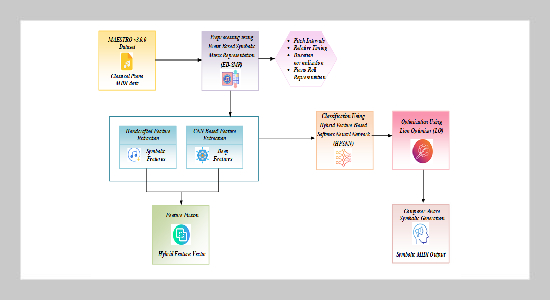
Block Diagram of the Proposed Method
Copyright The Author(s). This is an open access article distributed under the terms of the Creative Commons Attribution License (CC BY 4.0), which permits unrestricted use, distribution, and reproduction in any medium, provided the original author and source are cited.
Download Citation: BibTeX | http://dx.doi.org/10.6180/jase.202611_34.051
The rapid growth of digital music collections has increased the demand for automatic composer identification and musical style recognition. This study proposes a hybrid framework using the MAESTRO v3.0.0 symbolic MIDI dataset. EB-SMR preprocesses MIDI by extracting pitch, onset, duration, and velocity, followed by tempo, pitch, and duration normalization. The data are converted into piano-roll representations. Handcrafted symbolic features capturing melodic, rhythmic, and dynamic properties are combined with Convolutional Neural Network (CNN)-based deep features, enabling improved feature learning for composer-aware music generation and style recognition tasks. These complementary features are fused into a unified representation and classified using a Hybrid Feature-Based Softmax Neural Network (HFSNN), while the Lion optimizer is employed as a training strategy to improve convergence efficiency during optimization. The framework incorporates composer-aware music generation by sampling musical events from class-conditional distributions to produce stylistically coherent MIDI sequences. Experimental results show that the hybrid framework achieves 0.97, outperforming CNN-only and handcrafted-feature models. Combining symbolic descriptors and CNN features improves style/composer recognition, enables composer-aware MIDI generation, but is limited to piano MIDI; future work explores multimodal and multi-instrument representations.
Keywords: Symbolic Music Analysis, Musical Instrument Digital Interface, Hybrid Feature Extraction, Piano-Roll Representation, Composer Classification
- [1] I. Abarkan, M. Rabi, F. P. V. Ferreira, R. Shamass, V. Limbachiya, Y. S. Jweihan, and L. F. Pinho Santos, (2024) “Machine learning for optimal design of circular hollow section stainless steel stub columns: A comparative analysis with Eurocode 3 predictions” Engineering Applications of Artificial Intelligence 132: 107952. DOI: 10.1016/j.engappai.2024.107952.
- [2] C.-Y. Chang and Y.-P. Chen, (2020) “AntsOMG: A Framework Aiming to Automate Creativity and Intelligent Behavior with a Showcase on Cantus Firmus Composition and Style Development” Electronics 9(8): 1212. DOI: 10.3390/electronics9081212.
- [3] P. Ferreira, R. Limongi, and L. P. Fávero, (2023) “Generating Music with Data: Application of Deep Learning Models for Symbolic Music Composition” Applied Sciences 13(7): 4543. DOI: 10.3390/app13074543.
- [4] J.-Y. Guo and P. Wang, (2025) “Music Emotion Classification Based on Heterogeneous Graph Neural Networks” IEEE Access 13: 76473–76480. DOI: 10.1109/ACCESS.2025.3562532.
- [5] Q. He, (2022) “A Music Genre Classification Method Based on Deep Learning” Mathematical Problems in Engineering 2022(1): 9668018. DOI: 10.1155/2022/9668018.
- [6] Y. S. Jweihan, M. J. Al-Kheetan, and M. Rabi, (2023) “Empirical Model for the Retained Stability Index of Asphalt Mixtures Using Hybrid Machine Learning Approach” Applied System Innovation 6(5): 93. DOI: 10.3390/asi6050093.
- [7] M. Miller, J. Rauscher, D. A. Keim, and M. El-Assady, (2022) “CorpusVis: Visual Analysis of Digital Sheet Music Collections” Computer Graphics Forum 41(3): 283–294. DOI: 10.1111/cgf.14540.
- [8] M. Rabi, (2024) “Bond prediction of stainless-steel reinforcement using artificial neural networks” Proceedings of the Institution of Civil Engineers – Construction Materials 177(2): 87–97. DOI: 10.1680/jcoma.22.00098.
- [9] M. Rabi, Y. S. Jweihan, I. Abarkan, F. P. V. Ferreira, R. Shamass, V. Limbachiya, K. D. Tsavdaridis, and L. F. Pinho Santos, (2024) “Machine learning-driven web-post buckling resistance prediction for high-strength steel beams with elliptically-based web openings” Results in Engineering 21: 101749. DOI: 10.1016/j.rineng.2024.101749.
- [10] S. Sarfarazi, R. Shamass, M. Rabi, I. Abarkan, F. P. V. Ferreira, and K. D. Tsavdaridis, (2026) “Inverse machine learning for the design of perforated beams: Parent section and material prediction” Engineering Applications of Artificial Intelligence 164: Part A: 113275. DOI: 10.1016/j.engappai.2025.113275.
- [11] Y. Shi, (2025) “A CNN-Based Approach for Classical Music Recognition and Style Emotion Classification” IEEE Access 13: 20647–20666. DOI: 10.1109/ACCESS.2025.3535411.
- [12] L. Turchet and J. Pauwels, (2022) “Music Emotion Recognition: Intention of Composers-Performers Versus Perception of Musicians, Non-Musicians, and Listening Machines” IEEE/ACM Transactions on Audio, Speech, and Language Processing 30: 305–316. DOI: 10.1109/TASLP.2021.3138709.
- [13] S.-L. Wu and Y.-H. Yang, (2023) “MuseMorphose: Full-Song and Fine-Grained Piano Music Style Transfer With One Transformer VAE” IEEE/ACM Transactions on Audio, Speech, and Language Processing 31: 1953–1967. DOI: 10.1109/TASLP.2023.3270726.
- [14] K. Zhang, (2021) “Music Style Classification Algorithm Based on Music Feature Extraction and Deep Neural Network” Wireless Communications and Mobile Computing 2021(1): 9298654. DOI: 10.1155/2021/9298654.
- [15] S. Zhang, Y. Liu, and M. Zhou, (2025) “Graph Neural Network and LSTM Integration for Enhanced Multi-Label Style Classification of Piano Sonatas” Sensors 25(3): 666. DOI: 10.3390/s25030666.