





Arangarajan Vinayagam1, Kavitha M V2, Deepa A3, Senthil Kumar H4, Arivoli Sundaramurthy5, and Saravanan K6
1Department of Electrical and Electronics Engineering, New Horizon College of Engineering, Bangalore, India
2Department of Electronics and Communication Engineering, Cambridge Institute of Technology, Bangalore, India
3Department of Electronics and Communication Engineering, Gopalan College of Engineering and Management, Bangalore, India
4Department of Computer Science and Engineering, Presidency University, Bangalore, India
5Department of Electrical and Electronics Engineering, PSG Institute of Technology and Applied Research, Coimbatore, India
6Department of Electrical and Electronics Engineering, SRM Institute of Science and Technology, Kattankulathur-603203,
Chengalpattu, Tamil Nadu, India
Received: May 07, 2026
Accepted: June 02, 2026
Publication Date: August 17, 2026
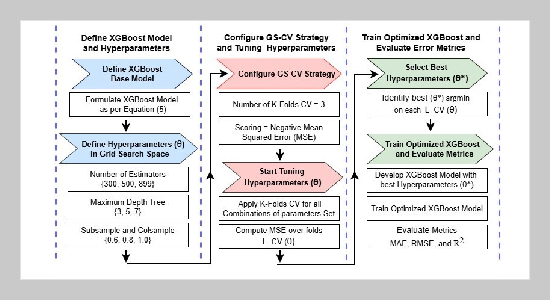
Process Steps of GS-CV Strategy
Copyright The Author(s). This is an open access article distributed under the terms of the Creative Commons Attribution License (CC BY 4.0), which permits unrestricted use, distribution, and reproduction in any medium, provided the original author and source are cited.
Download Citation: BibTeX | http://dx.doi.org/10.6180/jase.202611_34.050
Wind power forecasting is very crucial to ensure stable renewable energy (RE) integration and the stability of power systems. In this research work, several machine learning (ML) models, such as linear regression (LR), random forest (RF), gradient boosting (GB), extreme GB (XGBoost), and grid search cross-validation (GS-CV) optimized XFGBoost are analyzed in terms of their performance for wind power forecasting using a real-life large dataset having weather and temporal features. Performance of these models is analyzed using metrics such as mean absolute error (MAE), root mean square error (RMSE), and correlation factor (R2). It is found that XGBoost with GS-CV approach consistently performs better than other models with the minimum prediction error and maximum R2 value. The results show that hyperparameter-optimized XGBoost can greatly enhance forecasting accuracy and generalization, providing a practical data-driven solution for wind power forecasting and decision-making.
Keywords: Renewable Energy, Machine Learning, Gradient Boosting, Extreme Gradient Boosting, Random Forest, Wind Power Prediction
- [1] E. A. Tuncar, Ş. Sağlam, and B. Oral, (2024) “A Review of Short-Term Wind Power Generation Forecasting Methods in Recent Technological Trends” Energy Reports 12: 197–209. DOI: 10.1016/j.egyr.2024.01.12.3.
- [2] H. R. Alsamamra, S. Salah, and J. H. Shoqeir, (2024) “Performance Analysis of ARIMA Model for Wind Speed Forecasting in Jerusalem, Palestine” Energy Exploration & Exploitation 42(5): 1727–1746. DOI: 10.1177/01445987241234567.
- [3] A. Alkesaiberi, F. Harrou, and Y. Sun, (2022) “Efficient Wind Power Prediction Using Machine Learning Methods: A Comparative Study” Energies 15(7): 2327. DOI: 10.3390/en15072327.
- [4] Z.-Y. Fu, G.-Q. Li, W.-D. Tang, Z.-H. Pan, and W.-C. Zhang, (2025) “Novel Nonlinear Wind Power Prediction Based on Improved Iterative Algorithm” Systems Science & Control Engineering 13(1): 2448626. DOI: 10.1080/21642583.2025.2448626.
- [5] Z. Ti, X. W. Deng, and M. Zhang, (2021) “Artificial Neural Networks Based Wake Model for Power Prediction of Wind Farm” Renewable Energy 172: 618–631. DOI: 10.1016/j.renene.2021.03.056.
- [6] D. A. Savio, V. A. Juliet, B. Chokkalingam, S. Padmanaban, J. B. Holm-Nielsen, and F. Blaabjerg, (2019) “Photovoltaic Integrated Hybrid Microgrid Structured Electric Vehicle Charging Station and Its Energy Management Approach” Energies 12(1): 168. DOI: 10.3390/en12010168.
- [7] J. Ferrero Bermejo, J. F. Gomez Fernandez, F. Olivencia Polo, and A. Crespo Márquez, (2019) “A Review of the Use of Artificial Neural Network Models for Energy and Reliability Prediction: Solar PV, Hydraulic and Wind Energy Sources” Applied Sciences 9(9): 1844. DOI: 10.3390/app9091844.
- [8] Z. Liu, H. Guo, Y. Zhang, and Z. Zuo, (2025) “A Comprehensive Review of Wind Power Prediction Based on Machine Learning: Models, Applications, and Challenges” Energies 18(2): 350. DOI: 10.3390/en18020350.
- [9] Z. Mustaffa and M. H. Sulaiman, (2025) “Random Forest Based Wind Power Prediction Method for Sustainable Energy System” Cleaner Energy Systems 12: 100210. DOI: 10.1016/j.cles.2025.100210.
- [10] T. A. Rajaperumal and C. C. Columbus, (2025) “Enhanced Wind Power Forecasting Using Machine Learning, Deep Learning Models and Ensemble Integration” Scientific Reports 15(1): 20572. DOI: 10.1038/s41598-025-20572-3.
- [11] R. A. Sobolewski, M. Tchakorom, and R. Couturier, (2023) “Gradient boosting-based approach for short-and medium-term wind turbine output power prediction” Renewable Energy 203: 142–160. DOI: 10.1016/j.renene.2022.12.040.
- [12] S. Ponrekha A, M. S. P. Subathra, C. Baratiraja, and N. Manoj Kumar, (2025) “A Topology Review and Comparative Analysis on Transformerless Grid-Connected Photovoltaic Inverters and Leakage Current Reduction Techniques” IET Renewable Power Generation 19(1): e12655. DOI: 10.1049/rpg2.12655.
- [13] X. Xiong, X. Guo, P. Zeng, R. Zou, and X. Wang, (2022) “A Short-Term Wind Power Forecast Method via XGBoost Hyper-Parameters Optimization” Frontiers in Energy Research 10: 905155. DOI: 10.3389/fenrg.2022.905155.
- [14] S. Guan, Y. Wang, L. Liu, J. Gao, Z. Xu, and S. Kan, (2023) “Ultra-Short-Term Wind Power Prediction Method Combining Financial Technology Feature Engineering and XGBoost Algorithm” Heliyon 9(6): e16938. DOI: 10.1016/j.heliyon.2023.e16938.
- [15] Xiangcheng, J. Wang, Z. Geng, Y. Jin, and J. Xu, (2023) “Short-Term Wind Power Prediction Method Based on Genetic Algorithm Optimized XGBoost Regression Model” Journal of Physics: Conference Series 2527(1): 012061. DOI: 10.1088/1742-6596/2527/1/012061.
- [16] N. T. Tran, T. T. G. Tran, T. A. Nguyen, and M. B. Lam, (2023) “A new grid search algorithm based on XGBoost model for load forecasting” Bulletin of Electrical Engineering and Informatics 12(4): 1857–1866. DOI: 10.11591/eei.v12i4.4907.
- [17] B. İsen. Wind Turbine SCADA Dataset. Accessed: February 13, 2026. 2018.
- [18] C. El-Morr, M. Jammal, H. Ali-Hassan, and W. El-Hallak, (2022) “Machine Learning for Practical Decision Making” International Series in Operations Research and Management Science: DOI: https://doi.org/10.1007/978-3-031-16990-8.
- [19] U. Singh, M. Rizwan, M. Alaraj, and I. Alsaidan, (2021) “A Machine Learning-Based Gradient Boosting Regression Approach for Wind Power Production Forecasting: A Step Towards Smart Grid Environments” Energies 14(16): 5196. DOI: 10.3390/en14165196.
- [20] A. Bilgili and K. Gül, (2024) “Forecasting power generation of wind turbine with real-time data using machine learning algorithms” Clean Technologies and Recycling 4: 108–124. DOI: 10.3934/ctr.2024006.