


1School of Foreign Languages, Chizhou University, Chizhou 247000, China
2Department of Electronic Information and Media, Chizhou Vocational and Technical College, Chizhou 247000, China
Received: April 02, 2026
Accepted: July 10, 2026
Publication Date: August 17, 2026
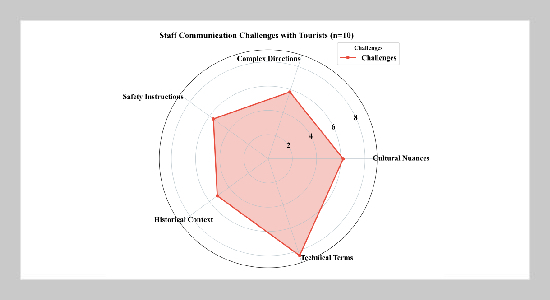
Staff Communication Challenges with Tourists.
Copyright The Author(s). This is an open access article distributed under the terms of the Creative Commons Attribution License (CC BY 4.0), which permits unrestricted use, distribution, and reproduction in any medium, provided the original author and source are cited.
Download Citation: BibTeX | http://dx.doi.org/10.6180/jase.202611_34.049
This study examines how digital language support services improve communication, visitor interaction, and service quality at multilingual tourist attractions. A mixed-method approach was used, involving quantitative data from 200 respondents through structured questionnaires and qualitative insights from 30 participants using interviews and focus group discussions. Quantitative analysis included descriptive statistics, Cronbach’s Alpha, Pearson correlation, and multiple regression, while qualitative data were analyzed through thematic coding and frequency mapping. The findings indicate moderate to high satisfaction with digital language services. Technology-related satisfaction recorded the highest mean score (3.14), whereas translation accuracy showed the lowest (3.01), suggesting a need for improvement. Correlation analysis revealed that language barriers negatively affect tourist satisfaction (r =-0.369), while effective digital language services positively influence satisfaction (r = 0.417). Regression analysis (R² = 0.712) showed that usability is the strongest predictor of tourist satisfaction. The study emphasizes the importance of accurate, user-friendly, and context-aware digital language systems in multilingual tourism environments.
Keywords: Digital Language Services; Tourist Satisfaction; Artificial Intelligence (AI); Language Barriers; Usability
- [1] S. Kahanurak, J. Dibyamandala, and C. Mangkhang, (2023) “Digital Storytelling and Intercultural Communicative Competence through English as a Foreign Language for Multilingual Learners” Journal of Curriculum and Teaching 12(1): 14–16. DOI: 10.5430/jct.v12n1p14.
- [2] S. P. Smith, (2025) “Discursive Extraction: Language, Value, and Capital in Myanmar’s Tourism Frontier” Antipode 57(2): 649–669. DOI: 10.1111/anti.13124.
- [3] N. Natsir and S. M. Asnur, (2025) “Enhancing Digital and Language Literacy for Community Empowerment: A Case Study of Ujung Baji Village, Takalar Regency, South Sulawesi Province” Global Sustainability and Community Engagement 1(4): 300–313. DOI: 10.62568/gsce.v1i4.522.
- [4] H. Ma and L. Ismail, (2025) “Empowering Language Teacher Educators: The Impact of Training, Emotions, Leadership, and Infrastructure on Digital Pedagogy and the Facilitation of Future Teachers’ Competence” Education and Information Technologies 30(16): 23817–23843. DOI: 10.1007/s10639-025-13700-8.
- [5] N. Taula’bi, Y. Tangdibiri, M. D. G. Allo, and D. Rio, (2025) “Trilingual-Based Instruction in English for Tourism: Empowering Students with Cultural Knowledge and Communication Competence” Eduvelop: Journal of English Education and Development 9(1): 97–117. DOI: 10.31605/eduvelop.v9i1.5227.
- [6] I. W. A. Anggayana, (2024) “Digital Literacy Through Teaching English Tourism Supporting Independent Campus Learning Curriculum in Applied Linguistic Studies” JMPH Jurnal Manajemen Pelayanan Hotel 8(1): 497–520. DOI: 10.37484/080130.
- [7] S. Choi, C. Moon, K. Lee, X. Su, J. Hwang, and I. Kim, (2024) “Exploring Smart Airports’ Information Service Technology for Sustainability: Integration of the Delphi and Kano Approaches” Sustainability 16(20): 8958. DOI: 10.3390/su16208958.
- [8] S. Jiang, Z. Zhang, H. Xu, and Y. Pan, (2024) “What Influences Users’ Continuous Behavioral Intention in Cultural Heritage Virtual Tourism: Integrating Experience Economy Theory and Stimulus–Organism–Response (SOR) Model” Sustainability 16(23): 10231. DOI: 10.3390/su162310231.
- [9] M. Al-Shafei, (2025) “Navigating Human-Chatbot Interactions: An Investigation into Factors Influencing User Satisfaction and Engagement” International Journal of Human–Computer Interaction 41(1): 411–428. DOI: 10.1080/10447318.2023.2301252.
- [10] C.-M. Chuang, (2023) “The Conceptualization of Smart Tourism Service Platforms on Tourist Value Co-Creation Behaviours: An Integrative Perspective of Smart Tourism Services” Humanities and Social Sciences Communications 10(1): 367. DOI: 10.1057/s41599-023-01867-9.