



Received: May 04, 2026
Accepted: July 20, 2026
Publication Date: August 17, 2026
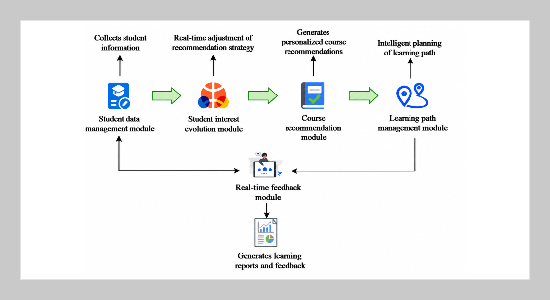
Overall architecture of the integrated teaching platform
Copyright The Author(s). This is an open access article distributed under the terms of the Creative Commons Attribution License (CC BY 4.0), which permits unrestricted use, distribution, and reproduction in any medium, provided the original author and source are cited.
Download Citation: BibTeX | http://dx.doi.org/10.6180/jase.202611_34.048
In the context of the knowledge economy and the transformation of higher education, cultivating innovation, entrepreneurship, and moral responsibility has become a strategic priority. Existing innovation and entrepreneurship education platforms often fail to address diverse student profiles and rarely integrate moral education into personalized learning pathways. This study proposes an integrated teaching platform that unifies innovation, entrepreneurship, and moral education through multimedia networks and neural network-driven cross-modal semantic retrieval. The platform consists of a student learning space, teacher management modules, a multimedia resource repository, and real-time feedback mechanisms. A hybrid neural network model is introduced to map multimodal educational resources and student submissions into a shared semantic space using weak semantic label generation, bidirectional feature crossing, attention-enhanced GRU modules, and position encoding. In this framework, weak semantic labels are automatically generated pseudo-labels derived from semantic category probability distributions of unlabeled multimodal samples and are iteratively incorporated into model training to enhance semantic representation learning. This framework enables personalized content recommendation, dynamic interest tracking, and moral dilemma feedback. Experiments conducted on the Wikipedia, Wikipedia-CNN, NUS-WIDE, and domain-specific I&E-EDU datasets demonstrate that the proposed method consistently outperforms baseline approaches, including MRCR-SNN. On the I&E-EDU dataset, the proposed model improves mean Average Precision (mAP) from 28.3% to 32.7% (+4.4 percentage points), Precision@10 from 43.1% to 49.4% (+6.3 percentage points), and increases student engagement by 26.5%.
Keywords: Cross-modal retrieval; Personalized recommendation; Entrepreneurship education; Moral education; Multimodal neural networks.
- [1] S. Ruan and K. Lu, (2025) “Adaptive deep reinforcement learning for personalized learning pathways: A multi-modal data-driven approach with real-time feedback optimization” Computers and Education: Artificial Intelligence 9: 100463. DOI: 10.1016/j.caeai.2025.100463.
- [2] Y. Zhou and H. Zhou, (2022) “Research on the quality evaluation of innovation and entrepreneurship education of college students based on extenics” Procedia Computer Science 199: 605–612. DOI: 10.1016/j.procs.2022.01.074.
- [3] F. Makhmudov, A. Kultimuratov, and Y. I. Cho, (2024) “Enhancing multimodal emotion recognition through attention mechanisms in BERT and CNN architectures” Applied Sciences 14(10): 4199. DOI: 10.3390/app14104199.
- [4] X. Ji, L. Sun, and K. Huang, (2025) “The construction and implementation direction of personalized learning model based on multimodal data fusion in the context of intelligent education” Cognitive Systems Research 92: 101379. DOI: 10.1016/j.cogsys.2025.101379.
- [5] T. Shengju, F. Li, Z. Wang, and X. Zhaoyuan, (2025) “Cross-modal adaptive reconstruction of open education resources” Scientific Reports 15(1): 30838. DOI: 10.1038/s41598-025-15200-8.
- [6] P. Cantillon, W. De Grave, and T. Dornan, (2022) “The social construction of teacher and learner identities in medicine and surgery” Medical Education 56(6): 614–624. DOI: 10.1111/medu.14727.
- [7] K. Liu, F. Xue, D. Guo, L. Wu, S. Li, and R. Hong, (2023) “MEGCF: Multimodal entity graph collaborative filtering for personalized recommendation” ACM Transactions on Information Systems 41(2): 1–27. DOI: 10.1145/3544106.
- [8] I. Chetoui, E. El Bachari, and M. El Adnani, (2026) “Multi-modal graph neural networks for cross-domain educational recommendation: integrating behavioral analytics and institutional context for personalized learning” Smart Learning Environments 13(1): 26. DOI: 10.1186/s40561-026-00452-2.
- [9] X. Xiao, (2025) “MMAgentRec, a personalized multimodal recommendation agent with large language model” Scientific Reports 15(1): 12062. DOI: 10.1038/s41598-025-96458-w.
- [10] D. Maier, (2022) “The use of wood waste from construction and demolition to produce sustainable bioenergy: a bibliometric review of the literature” International Journal of Energy Research 46(9): 11640–11658. DOI: 10.1002/er.8021.
- [11] V. Y. Dobrova, O. S. Popov, O. V. Shtrimaitis, O. O. Andreeva, and O. M. Proskurnia, (2022) “Joint task force core competency framework adoption process at a national level: a survey of Ukrainian-based clinical research professionals” Therapeutic Innovation and Regulatory Science 56(5): 814–821. DOI: 10.1007/s43441-022-00428-7.
- [12] Y. Xu, W. Li, J. Tai, and C. Zhang, (2022) “A bibliometric-based analytical framework for the study of smart city lifeforms in China” International Journal of Environmental Research and Public Health 19(22): 14762. DOI: 10.3390/ijerph192214762.
- [13] R. Mavilia and R. Pisani, (2022) “Blockchain for agricultural sector: the case of South Africa” African Journal of Science, Technology, Innovation and Development 14(3): 845–851. DOI: 10.1080/20421338.2021.1908660.
- [14] B. C. Lines, R. Kakarapalli, and P. H. D. Nguyen, (2022) “Does best value procurement cost more than low-bid? A total project cost perspective” International Journal of Construction Education and Research 18(1): 85–100. DOI: 10.1080/15578771.2020.1777489.
- [15] J. Liu, E. Gong, and X. Wang, (2022) “Economic benefits of construction waste recycling enterprises under tax incentive policies” Environmental Science and Pollution Research 29(9): 12574–12588. DOI: 10.1007/s11356-021-13831-8.