



1Department of Education, Faculty of Humanities and Arts, Xi’an FanYi University, Xi’an, 710000, China
1,2Faculty of Science and Engineering, Xi’an FanYi University, Xi’an, 710000, China
Received: May 18, 2026
Accepted: July 05, 2026
Publication Date: August 17, 2026
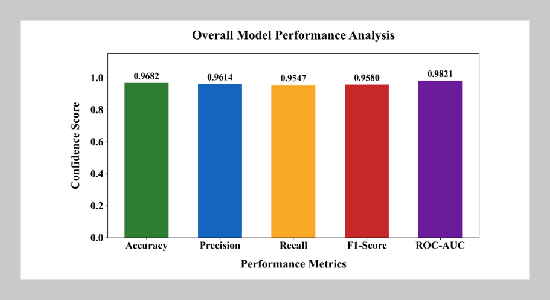
Overall Performance Evaluation of the Proposed Elmo-CNN Model
Copyright The Author(s). This is an open access article distributed under the terms of the Creative Commons Attribution License (CC BY 4.0), which permits unrestricted use, distribution, and reproduction in any medium, provided the original author and source are cited.
Download Citation: BibTeX | http://dx.doi.org/10.6180/jase.202611_34.046
Mental health issues among university students are increasing and negatively affect academic performance and quality of life. Traditional clinical interviews and surveys are time-consuming, costly, and often delayed, limiting timely intervention. This study proposes a rapid mental health screening system using machine learning to classify students into low, moderate, and high-risk groups by processing both structured and unstructured data. The framework integrates ELMo contextual embeddings to capture semantic meaning from text and CNN to extract high-level features. Demographic, lifestyle, and behavioral data are also incorporated. The proposed ELMo-CNN model achieved strong performance with 96.82% accuracy, 96.14% precision, 95.47% recall, 95.80% F1-score, and 0.9821 ROC-AUC, outperforming baseline models such as SVM and CNN. The results indicate that the model is effective for fast and accurate mental health screening in real-world educational settings.
Keywords: Mental Health Screening, ELMo Embeddings, College Students, Risk Classification, Deep Learning
- [1] N. King et al., (2021) “Mental health need of students at entry to university: Baseline findings from the U-Flourish Student Well-Being and Academic Success Study” Early Intervention in Psychiatry 15(2): 286–295. DOI: 10.1111/eip.12939.
- [2] M. Colizzi, A. Lasalvia, and M. Ruggeri, (2020) “Prevention and early intervention in youth mental health: Is it time for a multidisciplinary and trans-diagnostic model for care?” International Journal of Mental Health Systems 14(1): 23. DOI: 10.1186/s13033-020-00356-9.
- [3] T. Krawczyk and W. Nowakowski, (2026) “Industry 4.0 Applications Based on the Business Model Canvas” Scientific Papers of Silesian University of Technology. Organization and Management Series 245: 149–181. DOI: 10.29119/1641-3466.2026.245.9.
- [4] T. C. M. Caldeira, L. E. S. da Silva, R. M. Claro, J. d. J. Damião, D. S. Canella, and T. M. de Sousa, (2026) “Racial Inequality in the Prevalence of Symptom-Based Depression Versus Self-Reported Medical Diagnosis in Brazil” Journal of Racial and Ethnic Health Disparities 13(3): 2049–2058. DOI: 10.1007/s40615-025-02397-7.
- [5] V. M. Rao, R. K. Ramasamy, and M. S. Sayeed, (2026) “A Deployment-Oriented Hybrid Semantic–QoS Framework for Web Service Selection: A Comparative Study of Transformer Encoders” Information 17(3): 242. DOI: 10.3390/info17030242.
- [6] M. C. Dodge, A. D. Hicks, and D. M. McCord, (2024) “Rapid screening for suicide risk: An algorithmic approach” Suicide and Life-Threatening Behavior 54(1): 83–94. DOI: 10.1111/sltb.13020.
- [7] J. Qi and Z. Cai. “Research on Intelligent Evaluation of College Students’ Mental Health Based on Decision Tree Algorithm”. In: Application of Big Data, Blockchain, and Internet of Things for Education Informatization. Ed. by M. A. Jan and F. Khan. 467. Lecture Notes of the Institute for Computer Sciences, Social Informatics and Telecommunications Engineering. Cham: Springer Nature Switzerland, 2023, 92–103. DOI: 10.1007/978-3-031-23944-1_11.
- [8] T. Hu, X. Zhang, and N. Li, (2022) “Design of Intelligent Evaluation System for College Students’ Mental Health Based on Big Data” Computational Intelligence and Neuroscience 2022: 1–10. DOI: 10.1155/2022/7119994.
- [9] Y. Zhai et al., (2025) “Machine learning predictive models to guide prevention and intervention allocation for anxiety and depressive disorders among college students” Journal of Counseling and Development 103(1): 110–125. DOI: 10.1002/jcad.12543.
- [10] Z. Zhang, (2024) “Energy system optimization based on fuzzy decision support system and unstructured data” Energy Informatics 7(1): 82. DOI: 10.1186/s42162-024-00396-2.
- [11] M. Li, (2022) “Data Mining Algorithm for College Students’ Mental Health Questionnaire Based on Semisupervised Deep Learning Method” Scientific Programming 2022: 1–10. DOI: 10.1155/2022/7113312.
- [12] J. Lee, M. Solomon, T. Stead, B. Kwon, and L. Ganti, (2021) “Impact of COVID-19 on the mental health of US college students” BMC Psychology 9(1): 95. DOI: 10.1186/s40359-021-00598-3.
- [13] C. Gao, X. Li, J. Peng, and M. Liu, (2022) “Application of Virtual Reality with Positive Psychology in Adjusting Methods of College Students’ Mental Health” Mathematical Problems in Engineering 2022: 1–10. DOI: 10.1155/2022/4900890.
- [14] M. Polyvianaia, Y. Yachnik, J. M. Fegert, E. Sitarski, N. Stepanova, and I. Pinchuk, (2025) “Mental health of university students twenty months after the beginning of the full-scale Russian-Ukrainian war” BMC Psychiatry 25(1): 236. DOI: 10.1186/s12888-025-06654-1.
- [15] B. Jikadara. Mental Health Dataset. Kaggle. Accessed: 2026-06-12. 2026.