




Huan YAN1, Yuanyuan YUE1, Honggang JIA1, Zijia HUI1, and Hao ZENG2
1State Grid Shaanxi Electric Power Company Limited Research Institute, Xi’an, China
2Chongqing Electric Energy Star Co., Ltd, Chongqing, China
Received: April 26, 2025
Accepted: July 30, 2026
Publication Date: August 17, 2026
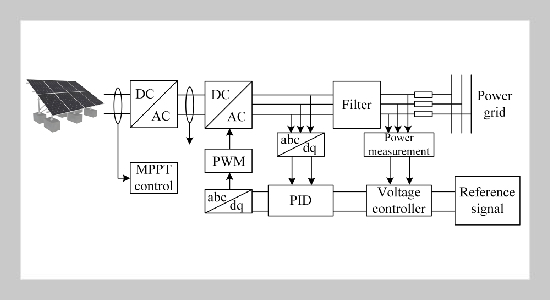
Overall control scheme of the grid-connected DPV system.
Copyright The Author(s). This is an open access article distributed under the terms of the Creative Commons Attribution License (CC BY 4.0), which permits unrestricted use, distribution, and reproduction in any medium, provided the original author and source are cited.
Download Citation: BibTeX | http://dx.doi.org/10.6180/jase.202611_34.045
The large-scale integration of distributed photovoltaic (DPV) systems introduces significant spatio-temporal variability into distribution networks, posing challenges to voltage stability, line loading, and protection coordination. This paper proposes a spatio-temporal analysis and modeling framework to quantify the safety impacts of DPV contributions. By integrating spatial topology characteristics with temporal generation-load fluctuations, the proposed model evaluates dynamic safety margins under varying penetration scenarios. A composite load model incorporating ZIP components, induction motor dynamics, and a simplified PV subsystem is established, and a reinforcement learning-enhanced Grey Wolf Optimizer (RL-GWO) is developed for high-precision parameter identification. Case studies demonstrate its effectiveness in identifying high-risk nodes and revealing critical spatio-temporal coupling effects, providing analytical support for distribution network planning and secure operation, while showing that appropriate DPV penetration can significantly improve voltage profiles and reduce network losses.
Keywords: Distributed photovoltaic; Spatio-temporal Analysis; Parameter Identification; Reinforcement learning; Distribution Network Security; Grey Wolf Optimizer
- [1] Y. Liu, W. Liu, Y. Wu, and H. Yu, (2025) “Distributed Voltage Optimal Control Method for Energy Storage Systems in Active Distribution Network” Energies 18(14): 3670. DOI: 10.3390/en18143670.
- [2] Z. Zhang, X. Guo, P. Yang, T. Wang, Y. Ji, and L. Yao, (2024) “Line Loss Calculation and Optimization in Low Voltage Lines with Photovoltaic Systems Using an Analytical Model and Quantum Genetic Algorithm” Tehnički vjesnik 31(2): 486–494. DOI: 10.17559/TV-20230516000638.
- [3] F. Yuan, Y. Lu, Z. Xie, and S. Dai, (2024) “Distributed Photovoltaic Distribution Voltage Prediction Based on eXtreme Gradient Boosting and Time Convolutional Networks” IEEE Access 12: 177576–177588. DOI: 10.1109/ACCESS.2024.3502759.
- [4] J. Yang, S. Zhu, and T. Zhou, (2024) “Distributed Model Predictive Control for Voltage Coordination of Distributed Photovoltaic Distribution Networks with High Permeability” Journal of Applied Science and Engineering 28(6): 1341–1350. DOI: 10.6180/jase.202506_28(6).0016.
- [5] H. Pei, G. Yan, Y. Zhao, W. Zhang, and C. Xiao, (2025) “Research on Harmonic Optimization and Suppression of Distributed Photovoltaic Storage and Distribution Networks by Improving PSO” Frontiers in Mechanical Engineering 11: 1667908. DOI: 10.3389/fmech.2025.1667908.
- [6] H. Shi et al., (2025) “A Novel Hosting Capacity Evaluation Method for Distributed PV Connected in Power System Based on Maximum Likelihood Estimation of Harmonic” IEEE Journal of Photovoltaics 15(3): 500–508. DOI: 10.1109/JPHOTOV.2025.3541402.
- [7] S. Sun, S. Yang, P. Yu, Y. Cheng, J. Xing, Y. Wang, Y. Yi, Z. Hu, L. Yao, and X. Pang, (2025) “A Reinforcement Learning-Based Approach for Distributed Photovoltaic Carrying Capacity Analysis in Distribution Grids” Energies 18(18): 5029. DOI: 10.3390/en18185029.
- [8] S. Rong et al., (2024) “Adaptive Modeling and Analysis of Distributed Photovoltaic Absorptive Capacity Based on Improved Simulated Annealing Algorithm” International Journal of Low-Carbon Technologies 19: 2032–2039. DOI: 10.1093/ijlct/ctae071/7745528.
- [9] W. Hao, W. Xiao, Q. Yan, Q. Jia, B. Hu, and P. Li, (2024) “Evaluation of Distributed Photovoltaic Economic Access Capacity in Distribution Networks Considering Proper Photovoltaic Power Curtailment” Energies 17(17): 4441. DOI: 10.3390/en17174441.
- [10] Y. Zheng, K. Zhou, Y. Yang, H. Diao, L. Hua, R. Wang, K. Liu, and Q. Guo, (2025) “Robust Assessment Method for Hosting Capacity of Distribution Network in Mountainous Areas for Distributed Photovoltaics” Energies 18(9): 2394. DOI: 10.3390/en18092394.
- [11] S. Liu, Y. Xie, Z. Jiang, et al., (2025) “Expansion Planning of Photovoltaic-Storage for Distribution Networks Based on Distributionally Robust Optimization” Chinese Journal of Electrical Engineering 11(4): 163–175. DOI: 10.23919/CJEE.2025.000113.
- [12] C. Gong, W. Wang, W. Zhang, N. Dong, X. Liu, Y. Dong, and D. Zhang, (2024) “Active Power Optimization Scheduling Method for Large-Scale Urban Distribution Networks with Distributed Photovoltaics Considering the Regulating Capacity of the Main Network” Frontiers in Energy Research 12: 1450986. DOI: 10.3389/fenrg.2024.1450986.
- [13] M. Kou et al., (2026) “Optimized Dispatch of Distribution Networks Considering Distributed Photovoltaic Uncertainty and Distributed Pumped Storage” Recent Advances in Electrical and Electronic Engineering 19(1): 1–16. DOI: 10.2174/0123520965377072250421074450.
- [14] B.-X. Ji, H.-H. Liu, P. Cheng, X.-Y. Ren, H.-D. Pi, and L.-L. Li, (2024) “Phased Optimization of Active Distribution Networks Incorporating Distributed Photovoltaic Storage System: A Multi-Objective Coati Optimization Algorithm” Journal of Energy Storage 91: 112093. DOI: 10.1016/j.est.2024.112093.
- [15] J. Li, X. Zhou, Y. Zhou, et al., (2024) “Optimal Configuration of Distributed Generation Based on an Improved Beluga Whale Optimization” IEEE Access 12: 31000–31013. DOI: 10.1109/ACCESS.2024.3368440.
- [16] K. Zhang, Y. Cui, Y. Wei, W. Wang, Y. Yue, and Y. Zhang, (2025) “Research on Distributed Photovoltaic Efficient Digestion Method Based on Optical Storage Direct Flexible Mode” Energy Reports 13: 4926–4935. DOI: 10.1016/j.egyr.2025.04.018.
- [17] G. Lei, B. He, J. Zhang, C. Liu, Z. Li, W. Dai, Y. Liu, and M. Wang, (2025) “Location and Sizing of Distributed Energy Storage in Distribution Substations under Multiple Scenarios Based on Improved Affinity Propagation Clustering” Electric Power Systems Research 248: 111898. DOI: 10.1016/j.epsr.2025.111898.
- [18] X. Zhang, J. Wang, J. Wang, H. Wang, and L. Lu, (2024) “Enhanced LSTM-Based Robotic Agent for Load Forecasting in Low-Voltage Distributed Photovoltaic Power Distribution Network” Frontiers in Neurorobotics 18: 1431643. DOI: 10.3389/fnbot.2024.1431643.
- [19] J. Zhang, B. Li, F. Chen, B. Li, X. Ji, and F. Xiao, (2024) “Multi-Terminal Negative Sequence Directional Pilot Protection Method for Distributed Photovoltaic and Energy Storage Distribution Network” International Journal of Electrical Power & Energy Systems 157: 109855. DOI: 10.1016/j.ijepes.2024.109855.
- [20] M. Zhang, J. Liu, Y. Liu, L. Xia, C. Chai, and P. Li, (2024) “Lightning Risk Assessment of Active Distribution Network with Distributed Photovoltaic System” Energy Reports 12: 3711–3717. DOI: 10.1016/j.egyr.2024.09.045.
- [21] M. Wang, R. Li, Y. Shi, X. Zhang, Y. Liu, and Q. Fang, (2026) “Intelligent Prediction of Grid Connection Point Voltage Overrun for Distributed Photovoltaic Generation Systems” Electric Power Systems Research 252: 112361. DOI: 10.1016/j.epsr.2025.112361.