




Kieu Do Trung Kien1,3, Hoang Trung Ngon2,3, Tran Tan Dat1,3, and Le Thi Quynh Anh1,3
1Faculty of Materials Technology, Ho Chi Minh City University of Technology (HCMUT), 268 Ly Thuong Kiet Street, Dien Hong
Ward, Ho Chi Minh City, Vietnam
2Faculty of Chemical Engineering, 268 Ly Thuong Kiet Street, Dien Hong Ward, Ho Chi Minh City, Vietnam
3Vietnam National University Ho Chi Minh City, Linh Xuan Ward, Ho Chi Minh City, Vietnam
Received: April 23, 2026
Accepted: July 22, 2026
Publication Date: August 17, 2026
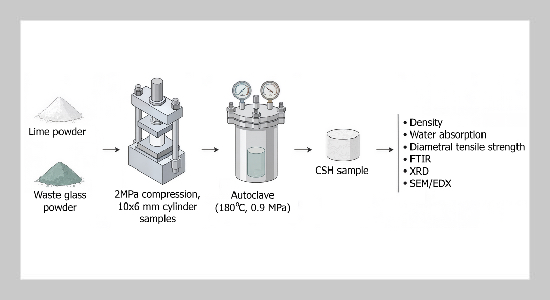
A diagram of the prototyping process.
Copyright The Author(s). This is an open access article distributed under the terms of the Creative Commons Attribution License (CC BY 4.0), which permits unrestricted use, distribution, and reproduction in any medium, provided the original author and source are cited.
Download Citation: BibTeX | http://dx.doi.org/10.6180/jase.202611_34.044
Environmental pollution has become increasingly severe due to multiple contributing factors, among which the rapid growth of industrial waste is particularly significant. In practice, the glass industry generates substantial waste daily, primarily in the form of grinding glass powder. While cullet can be recycled through remelting, the ground glass powder is often directly discharged into the environment or disposed of in landfills. Therefore, the treatment and valorization of industrial waste, particularly glass powder, have become research topics for mitigating environmental pollution. In this study, waste glass was used as a silica source to synthesize calcium silicate hydrate and investigate the effect of the CaO/SiO2 ratio on phase formation. Waste glass powder was mixed with lime, pelletized, and subjected to hydrothermal treatment at 180 oC for 10 hours. The formation of Xonotlite and Tobermorite was confirmed by XRD, FTIR, SEM, and EDX analyses, demonstrating the feasibility of synthesizing calcium silicate hydrate from waste glass powder. Mechanical and physical properties, including diametral tensile strength, water absorption, and bulk density, indicated that the optimal CaO/SiO2 ratio for synthesizing calcium silicate hydrate from waste glass is 0.9.
Keywords: Calcium silicate hydrate; CaO/SiO2 ratio; Waste glass; Hydrothermal synthesis; Recycled materials
- [1] V. Krivtsov, P. A. Wäger, P. Dacombe, P. W. Gilgen, S. Heaven, L. M. Hilty, and C. J. Banks, (2004) “Analysis of energy footprints associated with recycling of glass and plastic—case studies for industrial ecology” Ecological Modelling 174(1-2): 175–189. DOI: 10.1016/j.ecolmodel.2004.01.007.
- [2] S. Pennetier and B. Yu. “Re-Glass: Product Development Pathways for Post-Consumer Glass”. In: Challenging Glass Conference Proceedings. 9. 2024. DOI: 10.47982/cgc.9.649.
- [3] R. F. Cook, (1978) “The collection and recycling of waste glass (cullet) in glass container manufacture” Conservation & Recycling 2(1): 59–69. DOI: 10.1016/0361-3658(78)90029-2.
- [4] R. Beerkens, G. Kers, and E. van Santen. “Recycling of post-consumer glass: energy savings, CO2 emission reduction, effects on glass quality and glass melting”. In: 71st Conference on Glass Problems: Ceramic Engineering and Science Proceedings. 32. 2011, 167–194. DOI: 10.1002/9781118095348.ch16.
- [5] R. Conradt, (2019) “Prospects and physical limits of processes and technologies in glass melting” Journal of Asian Ceramic Societies 7(4): 377–396. DOI: 10.1080/21870764.2019.1656360.
- [6] N. H. Thang and N. V. U. e. a. Nhi, (2024) “Synthesis of calcium silicate materials from the residual waste sludge of a water-purification plant” Materials and Technology 58(1): 53–60. DOI: 10.17222/mit.2023.876.
- [7] P. T. Kien and N. H. M. e. a. Ngoc, (2021) “Study of removal Chrome (III) using Calcium Silicate Hydrate (CSH) synthesized from rice hush and CaO by hydrothermal method” Vietnam Journal of Catalysis and Adsorption 10(4): 18–22. DOI: 10.51316/jca.2021.063.
- [8] R. Siauciunas, G. Smalakys, A. Eisinas, and E. Prichockiene, (2022) “Synthesis of high crystallinity 1.13 nm tobermorite and xonotlite from natural rocks, their properties and application for heat-resistant products” Materials 15(10): 3474. DOI: 10.3390/ma15103474.
- [9] S. Wang, X. Peng, L. Tang, L. Zeng, and C. Lan, (2018) “Influence of hydrothermal synthesis conditions on the formation of calcium silicate hydrates: from amorphous to crystalline phases” Journal of Wuhan University of Technology-Mater. Sci. Ed. 33(5): 1150–1158. DOI: 10.1007/s11595-018-1947-0.
- [10] Z. Yang, C. Fang, Y. Jiao, D. Zhang, D. Kang, and K. Wang, (2023) “Study on crystal growth of tobermorite synthesized by calcium silicate slag and silica fume” Materials 16(3): 1288. DOI: 10.3390/ma16031288.
- [11] F. Pelisser, P. J. P. Gleize, and A. Mikowski, (2012) “Effect of the Ca/Si molar ratio on the micro/nanomechanical properties of synthetic CSH measured by nanoindentation” The Journal of Physical Chemistry C 116(32): 17219–17227. DOI: 10.1021/jp302240c.
- [12] J. Wu, H. Liao, Z. Ma, H. Song, and F. Cheng, (2023) “Effect of different initial CaO/SiO2 molar ratios and curing times on the preparation and formation mechanism of calcium silicate hydrate” Materials 16(2): 717. DOI: 10.3390/ma16020717.
- [13] A. Madadi and J. Wei, (2026) “New Insights into the Role of Ca/Si Ratio in Regulating the Formation, Phase Evolution, Atomic Structure, and Macro-Performance of Calcium Silicate Hydrates” Journal of Building Engineering 119: 115170. DOI: 10.1016/j.jobe.2025.115170.
- [14] T. N. Quan and P. T. Kien, (2026) “Synthesis Of Calcium Silicate Hydrate From PV Waste Glass And Carbide Waste Sludge In Water And NaOH Medium Toward The Cr (III) Removal In Wastewater” Journal of Applied Science and Engineering 29(5): 1075–1082. DOI: 10.6180/jase.202605_29(5).0005.
- [15] K. Luke, (2004) “Phase studies of pozzolanic stabilized calcium silicate hydrates at 180 °C” Cement and Concrete Research 34(9): 1725–1732. DOI: 10.1016/j.cemconres.2004.05.021.
- [16] R. Gendvilas and R. Siauciunas, (2016) “The Influence of Temperature and Nature of CaO Component on the Formation of α-C2SH” Solid State Phenomena 244: 12–18. DOI: 10.4028/www.scientific.net/ssp.244.12.
- [17] H. T. Nguyen, Q. B. Nguyen, V. P. Nguyen, and T. K. Pham, (2024) “Syntheses and Characteristics of Calcium-Based Geopolymer from Solar-Cell Panel-Glass Waste by Hydrothermal Method” Materials and Technology 58(4): 467–475. DOI: 10.17222/mit.2024.1153.
- [18] C. Shi and S. Hu, (2003) “Cementitious properties of ladle slag fines under autoclave curing conditions” Cement and Concrete Research 33(11): 1851–1856. DOI: 10.1016/s0008-8846(03)00211-4.
- [19] A. Monshi, M. R. Foroughi, M. R. Monshi, et al., (2012) “Modified Scherrer equation to estimate more accurately nano-crystallite size using XRD” World J. nano sci. eng 2(3): 154–160. DOI: 10.4236/wjnse.2012.23020.
- [20] N. H. Thien Khoi and N. H. Thang, (2026) “Low-field strain-driven phase diagram of (Bi1/2Na1/2) TiO3 – SrTiO3 – LiNbO3 lead-free relaxor ceramics for actuator applications” RSC advances 16(28): 26173–26189. DOI: 10.1039/D6RA00669H.
- [21] T. B. Chien, N. C. Bao, N. N. Thien, T. T. P. Nghi, T. N. P. Khuong, N. H. Thang, et al., (2026) “Sustainable glass-phase engineering via photovoltaic waste glass for enhanced energy storage in BNT ceramics” Particuology 115: 174–191. DOI: 10.1016/j.partic.2026.05.014.
- [22] I. G. Richardson, (2008) “The calcium silicate hydrates” Cement and Concrete Research 38(2): 137–158. DOI: 10.1016/j.cemconres.2007.11.005.
- [23] I. G. Richardson, (2014) “Model structures for c-(a)-sh (i)” Structural Science 70(6): 903–923. DOI: 10.1107/s2052520614021982.
- [24] D. R. Moorehead and E. R. McCARTNEY, (1965) “Hydrothermal formation of calcium silicate hydrates” Journal of the American Ceramic Society 48(11): 565–569. DOI: 10.1111/j.1151-2916.1965.tb14673.x.
- [25] A. Nonat, (2004) “The structure and stoichiometry of CSH” Cement and Concrete Research 34(9): 1521–1528. DOI: 10.1016/j.cemconres.2004.04.035.
- [26] G. Constantinides and F.-J. Ulm, (2007) “The nanogranular nature of C–S–H” Journal of the Mechanics and Physics of Solids 55(1): 64–90. DOI: 10.1016/j.jmps.2006.06.003.
- [27] K. L. Scrivener and A. Nonat, (2011) “Hydration of cementitious materials, present and future” Cement and Concrete Research 41(7): 651–665. DOI: 10.1016/j.cemconres.2011.03.026.
- [28] M. J. Zafar, H. Elsayed, and E. Bernardo, (2024) “Waste glass upcycling supported by alkali activation: an overview” Materials 17(9): 2169. DOI: 10.3390/ma17092169.
- [29] Y. Liu, C. Shi, Z. Zhang, and N. Li, (2019) “An overview on the reuse of waste glasses in alkali-activated materials” Resources, Conservation and Recycling 144: 297–309. DOI: 10.1016/j.resconrec.2019.02.007.
- [30] J. Kikuma, M. Tsunashima, T. Ishikawa, S. y. Matsuno, A. Ogawa, K. Matsui, and M. Sato, (2009) “Hydrothermal formation of tobermorite studied by in situ X-ray diffraction under autoclave condition” Synchrotron Radiation 16(5): 683–686. DOI: 10.1107/s0909049509022080.
- [31] A. B. Ikuyinminu, C. Pritzel, and R. Trettin, (2023) “Improved flexural strength and morphology of gypsum by wollastonite” International Journal of Ceramic Engineering & Science 5(4): e10177. DOI: 10.1002/ces2.10177.
- [32] S. S. Al-Jaroudi, A. Ul-Hamid, A.-R. I. Mohammed, and S. Saner, (2007) “Use of X-ray powder diffraction for quantitative analysis of carbonate rock reservoir samples” Powder Technology 175(3): 115–121. DOI: 10.1016/j.powtec.2007.01.013.
- [33] Z. Zhu, Z. Wang, Y. Zhou, Y. Chen, and K. Wu, (2022) “Nanoscale determination of calcium silicate hydrate (CSH) precursors crystallized at extreme early stage” Measurement 199: 111489. DOI: 10.1016/j.measurement.2022.111489.
- [34] L. Galvánková, J. Másilko, T. Solný, and E. Štěpánková, (2016) “Tobermorite synthesis under hydrothermal conditions” Procedia Engineering 151: 100–107. DOI: 10.1016/j.proeng.2016.07.394.
- [35] N. D. Van, K. Imasawa, and Y. Hama, (2022) “Influence of hydrothermal synthesis conditions and carbonation on physical properties of xonotlite-based lightweight material” Construction and Building Materials 321: 126328. DOI: 10.1016/j.conbuildmat.2022.126328.
- [36] E. Herth, R. Zeggari, J.-Y. Rauch, F. Remy-Martin, and W. Boireau, (2016) “Investigation of amorphous SiOx layer on gold surface for Surface Plasmon Resonance measurements” Microelectronic Engineering 163: 43–48. DOI: 10.1016/j.mee.2016.04.014.
- [37] N. Y. Mostafa, A. A. Shaltout, H. Omar, and S. A. Abo-El-Enein, (2009) “Hydrothermal synthesis and characterization of aluminium and sulfate substituted 1.1 nm tobermorites” Journal of Alloys and Compounds 467(1-2): 332–337. DOI: 10.1016/j.jallcom.2007.11.130.
- [38] L. F. Isernia, (2013) “FTIR study of the relation, between extra-framework aluminum species and the adsorbed molecular water, and its effect on the acidity in ZSM-5 steamed zeolite” Materials Research 16(4): 792–802. DOI: 10.1590/s1516-14392013005000044.
- [39] S. Shaw, C. M. B. Henderson, and S. M. Clark, (2002) “In-situ synchrotron study of the kinetics, thermodynamics, and reaction mechanisms of the hydrothermal crystallization of gyrolite, Ca16Si24O60(OH)8.14H2O” American Mineralogist 87(4): 533–541. DOI: 10.2138/am-2002-0416.
- [40] H. F. W. Taylor, (1959) “The transformation of tobermorite into xonotlite” Mineralogical magazine and journal of the Mineralogical Society 32(245): 110–116. DOI: 10.1180/minmag.1959.32.245.03.
- [41] A. Hartmann, D. Schulenberg, and J.-C. Buhl, (2015) “Investigation of the transition reaction of tobermorite to xonotlite under influence of additives” Advances in Chemical Engineering and Science 5 (2015), Nr. 2 5: 197–214. DOI: 10.4236/aces.2015.52022.
- [42] S. Shaw, S. M. Clark, and C. M. B. Henderson, (2000) “Hydrothermal formation of the calcium silicate hydrates, tobermorite (Ca5Si6O16(OH)2.4H2O) and xonotlite (Ca6Si6O17(OH)2): an in situ synchrotron study” Chemical Geology 167(1-2): 129–140. DOI: 10.1016/s0009-2541(99)00205-3.
- [43] L. M. Federico and S. E. Chidiac, (2009) “Waste glass as a supplementary cementitious material in concrete–critical review of treatment methods” Cement and concrete composites 31(8): 606–610. DOI: 10.1016/j.cemconcomp.2009.02.001.