





Anjiang Liu1, Shuqing Hao1, Yue Li1, Yu Miao1, and Hongyu Zuo2
1Electric Power Research Institute, Guizhou Power Grid Co., Ltd, Guiyang, Guizhou, China
2Zunyi Power Supply Bureau of Guizhou Power Grid Company, Zunyi, Guizhou, China
Received: May 21, 2026
Accepted: July 26, 2026
Publication Date: August 12, 2026
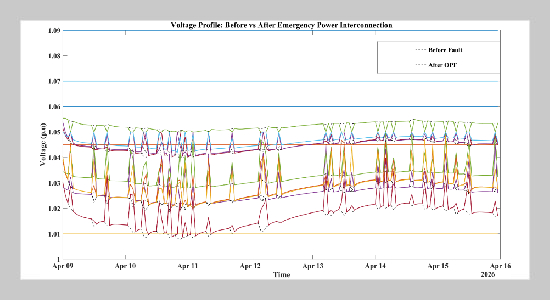
Voltage Recovery Performance Before and After OPF Control
Copyright The Author(s). This is an open access article distributed under the terms of the Creative Commons Attribution License (CC BY 4.0), which permits unrestricted use, distribution, and reproduction in any medium, provided the original author and source are cited.
Download Citation: BibTeX | http://dx.doi.org/10.6180/jase.202611_34.040
Extreme climatic conditions pose significant operational challenges to power systems by increasing fault occurrences, communication failures, voltage instability, and large-scale outages. This study proposes a high resilience integrated emergency interconnection and communication framework for reliable power system operation during extreme weather events. The proposed system combines Optimal Power Flow (OPF) control with hybrid communication technologies, including satellite, unmanned aerial vehicle (UAV), and Mobile Ad Hoc Network(MANET)-based communication systems. In addition, a hybrid artificial intelligence fault detection model integrating Random Forest (RF) and Support Vector Machine (SVM) with ensemble learning is developed for accurate fault identification. The methodology is implemented on the IEEE 14-Bus System using the Newton–Raphson load flow method. Extreme climatic conditions are modeled through scenario based simulations, while Monte Carlo simulations are employed to generate synthetic disturbances and faults. Communication performance is evaluated through delay and packet loss analysis within hybrid fiber–IoT communication networks. The framework also incorporates rule-based communication selection, optimization driven coordination strategies, load shedding optimization, and power balancing mechanisms to maintain system stability during emergencies. Experimental results demonstrate strong resilience and communication performance, achieving a Voltage Deviation Index (VDI) of 0.04281 p.u., Resilience Index (RI) of 0.7241, Recovery
Time (RT) of 5.64 hours, and Energy Not Supplied (ENS) of 2.85 MWh. The communication system records latency between 0.005 s and 0.018 s, throughput of 99.34 Mbps, and a Communication Reliability Index (CRI) of 0.9782. The hybrid fault detection model achieves 98.83% accuracy, confirming the effectiveness of the proposed framework for resilient smart grid operations.
Keywords: Power System Resilience, Extreme Climatic Conditions, Optimal Power Flow, Hybrid Communication Networks, AI-Based Fault Detection
- [1] Y. Wang et al., (2024) “IoT-based green-smart photovoltaic system under extreme climatic conditions for sustainable energy development” Global Energy Interconnection 7(6): 836–856. DOI: 10.1016/j.gloei.2024.11.006.
- [2] Y. Wang, D. Qiu, X. Sun, Z. Bie, and G. Strbac, (2024) “Coordinating multi-energy microgrids for integrated energy system resilience: A multi-task learning approach” IEEE Transactions on Sustainable Energy 15(2): 920–937. DOI: 10.1109/TSTE.2023.3317133.
- [3] T. A. Rajaperumal and C. C. Columbus, (2025) “Transforming the electrical grid: The role of AI in advancing smart, sustainable, and secure energy systems” Energy Informatics 8(1): 51. DOI: 10.1186/s42162-024-00461-w.
- [4] M. Thirumalai, R. Hariharan, T. Yuvaraj, and N. Prabaharan, (2024) “Optimizing distribution system resilience in extreme weather using prosumer-centric microgrids with integrated distributed energy resources and battery electric vehicles” Sustainability 16(6): 2379. DOI: 10.3390/su16062379.
- [5] M. Sharifpour, M. T. Ameli, H. Ameli, and G. Strbac, (2023) “A resilience-oriented approach for microgrid energy management with hydrogen integration during extreme events” Energies 16(24): 8099. DOI: 10.3390/en16248099.
- [6] S. Bahramirad, S. Pandey, A. Paaso, and S. Bahramirad, (2025) “Generation, transmission, and distribution system resilience: A holistic approach for enhancing the power system sustainability” IEEE Energy and Sustainability Magazine 1(1): 106–114. DOI: 10.1109/ESM.2025.3559291.
- [7] F. M. Almasoudi, (2023) “Enhancing power grid resilience through real-time fault detection and remediation using advanced hybrid machine learning models” Sustainability 15(10): 8348. DOI: 10.3390/su15108348.
- [8] U. AlHaddad, A. Basuhail, M. Khemakhem, F. E. Eassa, and K. Jambi, (2023) “Towards sustainable energy grids: A machine learning-based ensemble methods approach for outages estimation in extreme weather events” Sustainability 15(16): 12622. DOI: 10.3390/su151612622.
- [9] D. C. Lazar et al., (2026) “Real-time energy system optimization and resilience analysis in low-voltage networks using intelligent edge computing” Processes 14(4): 660. DOI: 10.3390/pr14040660.
- [10] M. Tian, Z. Zhu, Z. Dong, L. Zhao, and H. Yao, (2025) “Resilience enhancement of cyber-physical distribution systems via mobile power sources and unmanned aerial vehicles” Reliability Engineering & System Safety 254: 110603. DOI: 10.1016/j.ress.2024.110603.
- [11] N. M. Hijazi, M. Aloqaily, M. Guizani, B. Ouni, and F. Karray, (2024) “Secure federated learning with fully homomorphic encryption for IoT communications” IEEE Internet of Things Journal 11(3): 4289–4300. DOI: 10.1109/JIOT.2023.3302065.
- [12] M. P. Suresh, S. J. Isac, M. Joly, and J. A. Kumar, (2025) “Automatic fault detection and stability management using intelligent hybrid controller” Electric Power Systems Research 238: 111075. DOI: 10.1016/j.epsr.2024.111075.
- [13] N. Kumar, J. Raji, S. Sridevi, M. M. Irfan, R. Rajeshwari, and A. Inbamani. “A PSO Tuned CNN Approach for Accurate Fault Detection in PV Grid Systems”. In: 2025 IEEE 14th International Conference on Communication Systems and Network Technologies (CSNT). IEEE, 2025, 1257–1262. DOI: 10.1109/CSNT64827.2025.10968346.
- [14] A. M. Saber, A. Selim, M. M. Hammad, A. Youssef, D. Kundur, and E. El-Saadany. “A Novel Approach to Classify Power Quality Signals Using Vision Transformers”. In: IECON 2024 – 50th Annual Conference of the IEEE Industrial Electronics Society. IEEE, 2024, 1–6. DOI: 10.1109/IECON55916.2024.10905293.
- [15] R. Sahu, P. K. Panigrahi, D. K. Lal, R. Pradhan, and C. Mahanty, (2026) “A Deep Recurrent Learning Frame work for Multi-Class Microgrid Fault Classification Using LSTM and Bi-LSTM Models” Eng 7(3): 143. DOI: 10.3390/eng7030143.