




Jinyu Ren, Weijie Ma, and Qi Yang
School of Mechanical Engineering, Shenyang Ligong University, Shenyang, Liaoning, China
Received: June 02, 2026
Accepted: June 28, 2026
Publication Date: August 12, 2026
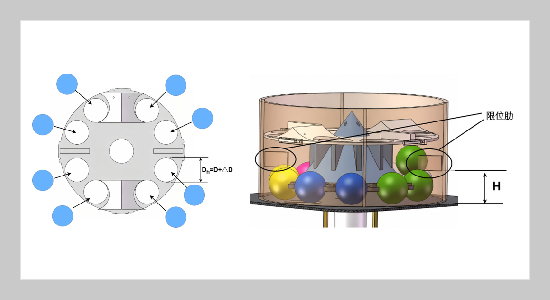
Schematic diagram of the anti-jamming structure
Copyright The Author(s). This is an open access article distributed under the terms of the Creative Commons Attribution License (CC BY 4.0), which permits unrestricted use, distribution, and reproduction in any medium, provided the original author and source are cited.
Download Citation: BibTeX | http://dx.doi.org/10.6180/jase.202611_34.039
To address illumination-induced color recognition instability, ball stacking and jamming during continuous delivery, and reduced reliability of intelligent delivery robots in complex environments, this paper proposes a robot intelligent delivery method integrating an anti-jamming storage structure and an adaptive CLAHE-LAB spatial feature fusion algorithm. First, a passive anti-jamming ball storage structure based on ball-diameter
constraints is designed for continuous ball storage and delivery. A top light shield reduces external illumination interference, a ball-diameter-matched multi-hole inlet array disperses the ball entry path, and inner-wall antibridging limiting ribs disrupt stable support states caused by multi-ball stacking, thereby reducing the risk of jamming and discharge interruption. Second, an adaptive CLAHE-LAB spatial feature fusion algorithm is proposed to overcome false and missed detection caused by traditional RGB/HSV threshold segmentation under weak, strong, and non-uniform illumination. By decoupling luminance and chromaticity in LAB space, enhancing local contrast, and fusing color saliency features, the separability between blue targets and the background is improved. Finally, an experimental platform is built to evaluate color recognition, segmentation accuracy, jamming frequency, and continuous delivery success rate. Experimental results show that the proposed method improves blue target recognition stability, alleviates ball stacking and jamming, and enhances continuous delivery reliability.
Keywords: Intelligent delivery robot; Adaptive CLAHE; LAB color space; Feature fusion; Color recognition
- [1] V. D. Cong, L. D. Hanh, L. H. Phuong, and D. A. Duy, (2022) “Design and development of robot arm system for classification and sorting using machine vision” FME Transactions 50(1): 181–189. DOI: 10.5937/fme2201181C.
- [2] S. Sanwar and M. I. Ahmed, (2023) “Automated object sorting system with real-time image processing and robotic gripper mechanism control” Journal of Engineering Advancements 4(03): 70–79. DOI: 10.38032/jea.2023.03.003.
- [3] Y. Luo. “Research on Sorting System of Industrial Robot Based on Machine Vision”. In: 2024 International Conference on Power, Electrical Engineering, Electronics and Control (PEEEC). 2024, 270–274. DOI: 10.1109/PEEEC63877.2024.00055.
- [4] S. E. Schrøder, U. L. Christensen, M. H. Lauritsen, A. L. Enevoldsen, A. F. Mikkelstrup, and M. Kristiansen. “Object detection and colour evaluation of multicoloured waste textiles using machine vision”. In: Proceedings of the 16th International Conference on Pervasive Technologies Related to Assistive Environments (PETRA 2023). 2023, 543–549. DOI: 10.1145/3594806.3596583.
- [5] I. Alrushidy, Y. Bahumid, R. Bin Shujaa, A. Abdullah, A. Kurd, and M. Abdullah, (2025) “Design And Fabrication of Color Sorting Machine Based on Computer Vision” Journal of Science and Technology 30(6): 107–115. DOI: 10.20428/jst.v30i6.2954.
- [6] X. Tian, J. Ke, W. Wu, and J. Teng, (2025) “Design of a Pill-Sorting and Pill-Grasping Robot System Based on Machine Vision” Future Internet 17(11): 501. DOI: 10.3390/fi17110501.
- [7] D. Giuliani, (2022) “Metaheuristic Algorithms Applied to Color Image Segmentation on HSV Space” Journal of Imaging 8(1): 6. DOI: 10.3390/jimaging8010006.
- [8] Y. S. Alsahafi, D. S. Elshora, E. R. Mohamed, and K. M. Hosny, (2023) “Multilevel threshold segmentation of skin lesions in color images using Coronavirus Optimization Algorithm” Diagnostics 13(18): 2958. DOI: 10.3390/diagnostics13182958.
- [9] A. R. Robertson, (1977) “The CIE 1976 color-difference formulae” Color Research & Application 2(1): 7–11. DOI: 10.1002/j.1520-6378.1977.tb00104.x.
- [10] I. A. P. F. Imawati, M. Sudarma, I. K. G. Darma Putra, and I. P. A. Bayupati. “A Study of Lab Color Space and Its Visualization”. In: Proceedings of the First International Conference on Applied Mathematics, Statistics, and Computing (ICAMSAC 2023). 2024, 17–28. DOI: 10.2991/978-94-6463-413-6_3.
- [11] C. Castiello, N. Del Buono, and F. Esposito, (2024) “Novel color space representation extracted by NMF to segment a color image” Journal of Computational Mathematics and Data Science 13: 100104. DOI: 10.1016/j.jcmds.2024.100104.
- [12] S. M. Pizer, E. P. Amburn, J. D. Austin, R. Cromartie, A. Geselowitz, T. Greer, B. M. ter Haar Romeny, J. B. Zimmerman, and K. J. Zuiderveld, (1987) “Adaptive histogram equalization and its variations” Computer Vision, Graphics, and Image Processing 39(3): 355–368. DOI: 10.1016/S0734-189X(87)80186-X.
- [13] J. Guo, J. Ma, Á. F. García-Fernández, Y. Zhang, and H. Liang, (2023) “A survey on image enhancement for low-light images” Heliyon 9(4): e14558. DOI: 10.1016/j.heliyon.2023.e14558.
- [14] J. Zhan, E. S. Goh, and M. S. Sunar, (2024) “Low-light image enhancement: A comprehensive review on methods, datasets and evaluation metrics” Journal of King Saud University – Computer and Information Sciences 36(10): 102234. DOI: 10.1016/j.jksuci.2024.102234.
- [15] Y. Demir and N. H. Kaplan, (2023) “Low-light image enhancement based on sharpening-smoothing image filter” Digital Signal Processing 138: 104054. DOI: 10.1016/j.dsp.2023.104054.
- [16] Y. Cai, H. Bian, J. Lin, H. Wang, R. Timofte, and Y. Zhang. “Retinexformer: One-stage Retinex-based Transformer for low-light image enhancement”. In: Proceedings of the IEEE/CVF International Conference on Computer Vision (ICCV). 2023, 12470–12479. DOI: 10.1109/ICCV51070.2023.01149.
- [17] T. Wang, K. Zhang, T. Shen, W. Luo, B. Stenger, and T. Lu. “Ultra-high-definition low-light image enhancement: A benchmark and transformer-based method”. In: Proceedings of the AAAI Conference on Artificial Intelligence. 37. 3. 2023, 2654–2662. DOI: 10.1609/aaai.v37i3.25364.
- [18] X. Xu, R. Wang, C. W. Fu, and J. Jia. “SNR-Aware Low-Light Image Enhancement”. In: Proceedings of the IEEE/CVF Conference on Computer Vision and Pattern Recognition (CVPR). 2022, 17693–17703. DOI: 10.1109/CVPR52688.2022.01719.
- [19] L. Ma, T. Ma, R. Liu, X. Fan, and Z. Luo. “Toward Fast, Flexible, and Robust Low-Light Image Enhancement”. In: Proceedings of the IEEE/CVF Conference on Computer Vision and Pattern Recognition (CVPR). 2022, 5627–5636. DOI: 10.1109/CVPR52688.2022.00555.
- [20] S. Qiao and R. Chen, (2024) “Progressive feature fusion for SNR-aware low-light image enhancement” Journal of Visual Communication and Image Representation 100: 104148. DOI: 10.1016/j.jvcir.2024.104148.
- [21] H. Zhang, L. Wang, Q. Zou, and J. Zeng, (2025) “DFF-Net: Deep Feature Fusion Network for low-light image enhancement” Image and Vision Computing 161: 105645. DOI: 10.1016/j.imavis.2025.105645.
- [22] D. Gella, D. Maza, and I. Zuriguel, (2022) “On the dual effect of obstacles in preventing silo clogging in 2D” Communications Physics 5: 4. DOI: 10.1038/s42005-021-00756-4.
- [23] S. Zhang, Z. Zeng, H. Yuan, Z. Li, and Y. Wang, (2024) “Precursory arch-like structures explain the clogging probability in a granular hopper flow” Communications Physics 7: 202. DOI: 10.1038/s42005-024-01694-7.